
 E-Paper



India, France adopt action plan to speed up Jaitapur nuclear project
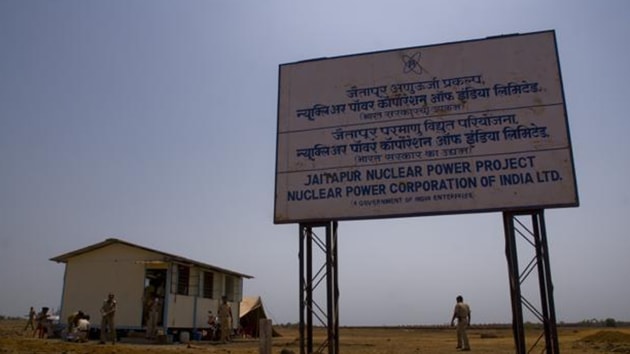
India and France on Saturday adopted an action plan to speed up decision-making on the Jaitapur nuclear power project, work on which is yet to begin despite the initial agreement signed eight years ago.


India and France on Saturday adopted an action plan to speed up decision-making on the Jaitapur nuclear power project, work on which is yet to begin despite the initial agreement signed eight years ago.
Civil nuclear cooperation, defence ties and the fight against terror figured in discussions between external affairs minister Sushma Swaraj and her visiting French counterpart Jean-Yves Le Drian.
After the talks, Swaraj and Le Drian said both sides had reviewed progress on the Jaitapur project. Swaraj said the Nuclear Power Corporation of India Limited (NPCIL) and Electricite de France (EDF) had made a lot of progress on the “industrial way forward” agreement of 2018.
Le Drian said the two sides “adopted an action plan to guide our work for the coming months so as to advance as efficiently as possible towards the final decision for building” the project. The plant’s six European Pressurised Reactors (EPRs) will have a capacity of almost 10 GW and make a “significant contribution to India’s aim of producing 40% of its electricity from non-fossil fuels by 2030”, he said.
“The Jaitapur project will also contribute to ‘Make in India’ as it involves transfers of production, technology, joint research and training,” Le Drian added.
Foreign suppliers of civil nuclear equipment have been reluctant to move ahead with projects in India because the country’s nuclear liability law exposes them to claims for damages in the event of an accident. This has complicated India’s plans to expand its nuclear power capacity more than nine-fold by 2032.
The Jaitapur project, which will be the world’s largest nuclear power plant, has been hit by problems over land acquisition and lack of agreement on credit limits. The two sides are unlikely to meet a target of beginning construction by the yearend, people familiar with the latest developments said.
French state-run reactor maker Areva SA signed the initial agreement for the Jaitapur project with NPCIL. After Areva’s restructuring, EDF signed an agreement to supply six reactors for the project.
Describing her talks with Le Drian as fruitful, Swaraj said the two countries were taking forward cooperation in the Indian Ocean region, which will also benefit other nations in the region.
Defence cooperation in fields such as co-production, joint exercises and training will also be taken forward, she said. The two sides reiterated their resolve to fight terrorism and to cooperate at international platforms such as the Financial Action Task Force (FATF), she added.
“Last year, our bilateral trade was worth 9.62 billion euro. If we both have to reach the target of 15 million euro by 2022, we will have to do more work to strengthen our trade relations,” Swaraj said.
Earlier, India’s Centre for Development of Advanced Computing and France’s IT services company Atos signed a three-year contract for designing, building and installing the BullSequana supercomputers in the country.
The signing ceremony took place in the presence of Le Drian, who said: “We often say data for the 21st century is what oil was to the 20th century…India and France share not only interests but also values that require us to use technology for the good of humanity.”
The contract was awarded to Atos under the National Supercomputing Mission (NSM), a scheme worth ₹4,500 crores that is aimed at creating a network of more than 70 high-performance supercomputing facilities for academic and research institutions. The delivery of BullSequana supercomputers is expected to start early next year.
Le Drian also called on Prime Minister Narendra Modi, who conveyed his condolences for victims of a recent terror attack in Strasbourg. Modi welcomed the strengthening of ties in defence, space, counter-terrorism, maritime security and civil nuclear cooperation.


