
 E-Paper



India will stick to its NDCs under Paris Agreement despite Covid-19: Prakash Javadekar
Prakash Javadekar said in 2009 the world had agreed that developed countries will mobilise 100 billion dollars every year for climate adaptation and mitigation.


Union environment minister, Prakash Javadekar on Wednesday said India stands committed to its nationally determined contributions (NDCs) under the Paris Agreement. He was speaking on a webinar organised by the Tata Institute of Social Sciences (TISS) organised on the occasion of Earth Day.
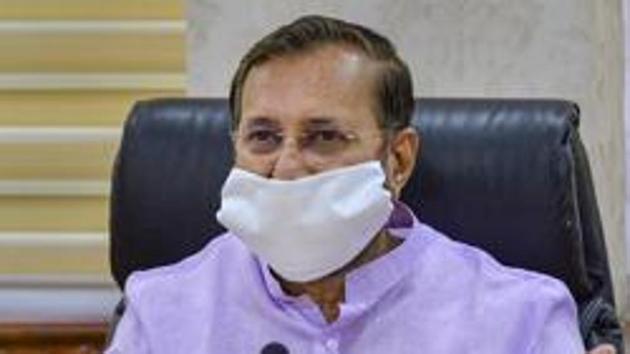
But Javadekar said action on climate would depend on whether big polluters deliver on their promises. “The biggest hurdle in climate action is broken promises. Next week I am participating in the Petersburg Climate dialogue XI where I will raise this issue. Yes, we have a pandemic (Covid-19) and the economy is impacted, there can be a little delay on action but we have to accept the new lifestyle,” Javadekar said.
He said in 2009 the world had agreed that developed countries will mobilise 100 billion dollars every year for climate adaptation and mitigation. “Its been 11 years and the amount is 1 trillion now. Where is the money? There is no money on the table,” Javadekar said adding that a second big promise on technology transfer has also not been delivered on.
Coronavirus outbreak: Full coverage
Sustainable lifestyle is at the core of India’s ethos, Javadekar said adding that our electricity consumption is only 1,000 units per person per year compared to 12,000 units per person per year in the US.
Javadekar added that there was no point romanticising about the clean rivers and air during the lockdown. “Last one month we saw clean rivers, green earth, blue sky, stars, one could see Himalayas from Jalandhar. That is how we used to live in villages... If we want these to continue then we have to stop only a few things -- you cant have vehicles, you cant have industries, cant have cities, you can sustain only 30 crore people and not 130 crore people.”
India has three main NDCs -- to achieve 40% of electric power installed capacity from non-fossil fuel sources by 2030; to reduce the emissions intensity of India’s gross domestic product (GDP) by 33 to 35% compared to 2005 levels by 2030; to create carbon sinks of about 2.5 to 3 billion tonnes.


