E-Paper



INSACOG to make genome sequencing portal open to public
The entire genome sequencing portal of the Indian SARS-CoV-2 Genomics Consortium (INSACOG) will soon be opened to the general public, people familiar with the matter said — a move that will help analysts, journalists, and scientists track the variants causing Covid-19 cases

 Prefer HTon Google


New Delhi: The entire genome sequencing portal of the Indian SARS-CoV-2 Genomics Consortium (INSACOG) will soon be opened to the general public, people familiar with the matter said -- a move that will help analysts, journalists, and scientists track the variants causing Covid-19 cases.
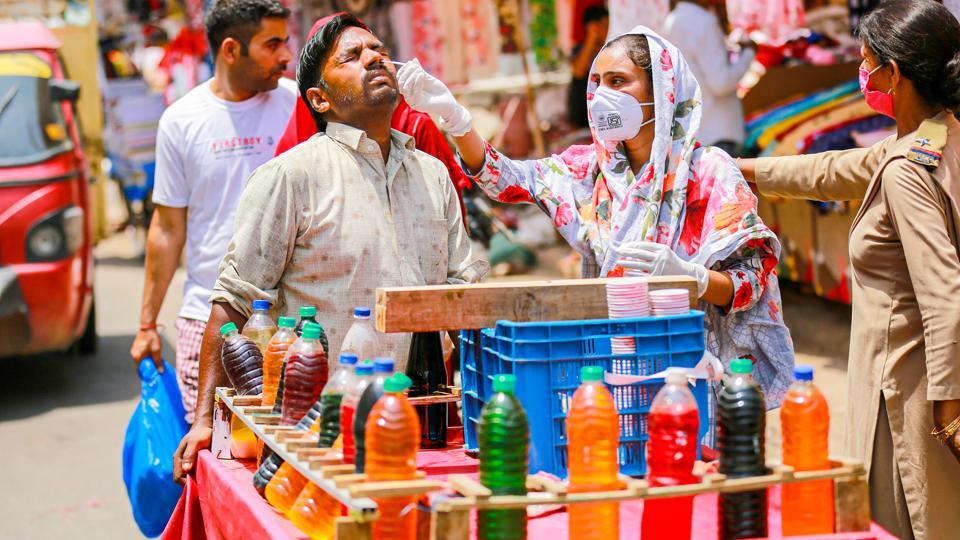
The current surge of Covid-19 infections is not driven by Omicron sub-variants BA.4 or BA.5, as BA.2 is still the dominant sub-variant in the country, they added on condition of anonymity.
“The portal will have results of genome sequencing updated on a real-time basis for everyone to see and use as they deem fit,” a person from one of the INSACOG members said. “The aim behind opening the portal for the general public is not just to maintain transparency about variants in circulation, but also to prevent any kind of misinformation being spread about disease transmission.”
The data can be also used for research purposes, this person added
Currently, the consortium periodically releases bulletins on Covid-19 variants in circulation across India based on the latest results from its network of laboratories.
INSACOG, a joint initiative of the health ministry, department of biotechnology, Council for Scientific and Industrial Research and Indian Council of Medical Research, is a group of 58 laboratories monitoring the genomic variations of Sars-CoV-2, the virus that causes Covid-19.
Just about 44 and 23 positive samples of BA.5 and BA.4, respectively, have been detected in the past 4-6 weeks, which does not adequately establish that these are causing the current surge, according to the latest data reviewed by HT. The two sub-variants have so far been restricted to the five states of Tamil Nadu, Telangana, Maharashtra, Karnataka and Gujarat.
“BA.2 and its sub-lineages continue to dominate with about 80% samples belonging to the said sub-variant of Omicron,” a second person, who works for another INSACOG member said. “Had BA.4 and BA.5 been driving the surge, the numbers in the past month or so— since the sub-variants were first detected in the country— should have been way higher; grown exponentially, in fact. Clearly, that is not the case as established by the sequencing data.”
The data from the genome sequencing laboratories is being analysed to study possible linkages between genomic variants and epidemiological trends. This helps to understand super spreader events and outbreaks, and strengthen public health interventions to help in breaking the chains of transmission.
“We are currently able to sequence most RT-PCR positive samples,” a third person, from another INSACOG member said. “Our genome sequencing capacity is pretty good.”
India has the capacity to sequence 10,000 samples a week, and is currently is doing about 2-3,000 samples as the case numbers are not very high.
The current surge can be called a ripple and not really a wave, the third person added.
“These ripples will come and go as it is an infectious disease, but hospitalisation rate and death numbers tell us that it is not of a major concern at the moment,” the member added.
With fewer hospitalisations and deaths, the current sub-variants do not seem to pose a major threat at the moment, experts said.
“It is an RNA virus that is bound to mutate at a greater rate, but it should be of concern if the mutations are causing higher hospitalisations or more deaths,” said Dr R Gangakhedkar, former head of the epidemiology and communicable diseases division at the Indian Council of Medical Research. “Fortunately, that is not the case at the moment, which can be attributed to natural infection and large vaccination coverage. The vaccines that we have are working sufficiently, which is good news.”
“Having said that, we cannot afford to drop our guard, as nobody can foresee what shape the pandemic may take in the future,” he added.