
 E-Paper



BRICS joint statement mentions West Asia war, stresses dialogue to end conflicts
The BRICS declaration, adopted unanimously in New Delhi, called for parties involved in the West Asia conflict to exercise “maximum restraint.”

 Prefer HTon Google


The ongoing conflict in West Asia emerged as one of the key focus areas at the BRICS summit in New Delhi, with the hostilities finding mention in the bloc's declaration.
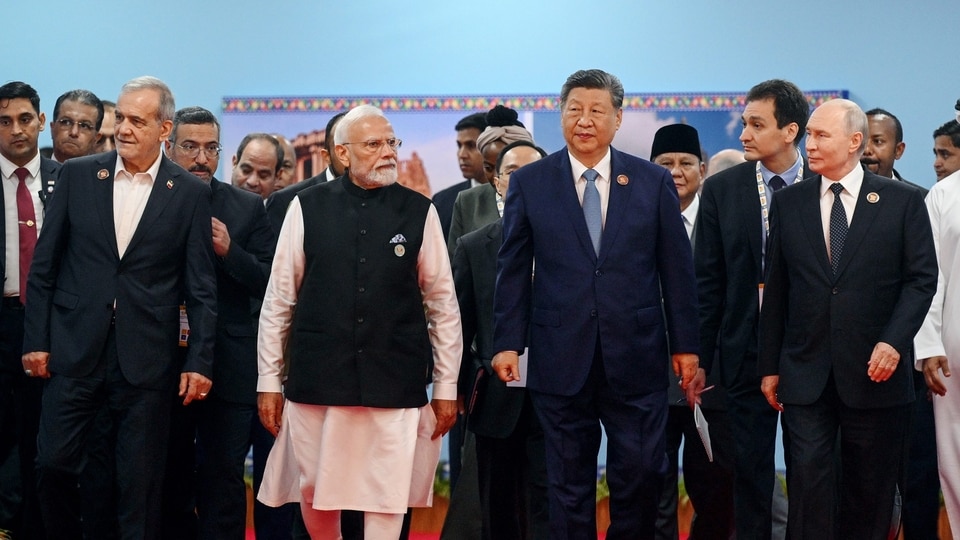
In the BRICS joint declaration, which was adopted unanimously on Saturday, the members states voiced their concern regarding the tensions in the West Asian region, while calling for parties involved in the conflict to exercise “maximum restraint.”
Follow live updates on BRICS summit here
The nations “recalled” their respective national positions on the war and called for “exercising maximum restraint, as well as avoiding actions that could further aggravate the situation.”
Deep Dive

Iran, UAE leaders meet on BRICS sidelines
Leaders of Iran and United Arab Emirates, BRICS member states which have engaged in hostilities against each other since the start of the conflict, met in New Delhi on the sidelines of the summit.
Iran's President Masoud Pezeshkian “held a meeting and talks” with United Arab Emirates Crown Prince Sheikh Khaled bin Mohamed bin Zayed Al Nahyan on the sidelines of the summit on Saturday, the Iranian embassy in India said.
The embassy also posted a photograph of the meeting on social media.
Also Read | BRICS Delhi declaration condemns Pahalgam attack, says no act of terror justified
What does the New Delhi declaration say on conflict and nuclear risk?
The joint statement further called for the protection of civilians and civilian infrastructure in the war “in accordance with the purposes and principles of the Charter of the United Nations in their entirety and interconnectedness, including respect for the sovereignty and territorial integrity of the States.”
The statement encouraged increasing efforts, through dialogue and diplomacy, “towards a longterm understanding that will contribute to lasting peace, security and stability in the region.”
Also Read | Nuclear ‘danger’ flagged, unilateral action opposed: Inside the BRICS Delhi declaration
The declaration also expressed “serious concern” on the “deliberate attacks on civilian infrastructure and peaceful nuclear facilities under full safeguards of the International Atomic Energy Agency (IAEA)”. The statement said that the above was in violation of international law and relevant resolutions of the IAEA. “Nuclear safeguards, safety, and security must always be upheld, including in armed conflicts, to protect people and the environment from harm,” it said.
The declaration acknowledged the wider trend of a critical increase in global military spending, expressing alarm at the development. It said that the trend was detrimental to the “provision of adequate financing for development to developing countries.”
“We express concern about ongoing conflicts in many parts of the world and the current state of polarization and fragmentation in the international order,” it said, while advocating for a multilateral approach that respects diverse national viewpoints and positions on crucial global issues.


