India on May 13 increased the waiting period between two doses of the Covishield vaccine from four-eight weeks to 12-16 weeks. The idea back then was to administer the first dose of Covid-19 vaccines to as many people as possible. As of 6 PM on October 12, Covishield accounted for 88% of Covid-19 vaccine doses administered in the country. But with a decline in registrations as well as the number of first doses of the vaccine administered, is it time to reduce the gap between two doses of the Covishield vaccine? An HT analysis shows it is an idea that merits serious consideration.
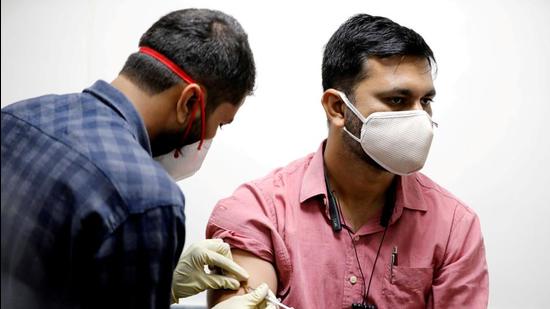
A medic administers Covaxin to a health worker. (REUTERS File)
The Co-Win dashboard provides data on daily vaccinations by first and second doses. The number of first doses has been falling consistently since September 17. The proportion of the first doses in total doses has been declining since late August. This is the third time since May that this proportion has decreased, but is perhaps the most significant because the number of those vaccinated may be nearing an important milestone.
Have vaccinations in India hit a ceiling?
India’s projected adult population in March, as per a National Commission on Population report, was 940.2 million. By October 11, 684.1 million have received their first dose of Covid-19 vaccines. The share of the adult population that has received at least one dose is 73%. Comparing the time taken to provide the first dose for each 10% of India’s adult population, the increase in coverage from 50% to 60%, between August 18 and September 13, was the fastest. This pace has slowed since then. The weekly average of first doses administered in the week ending October 9 is the lowest since the week ended July 29. It will likely slow even more.
That the slowdown is on account of low demand is evident from data on number of registrations on the Co-WIN dashboard. The dashboard gives a combined number for online and offline registrations. After the week ended September 17, there has been a consistent decline in new registrations. In that week, there were 39.36 million registrations. In the week ended October 8, new registrations were 58% of that number at 22.66 million. To be sure, there has been one more such period of consistent decline since May 1, when vaccinations were opened up for all adults. In the week ended July 16, new registrations were only 45% of the new registrations in the week ended June 25. Still, when seen along with the fact that 73% of the eligible population has received at least one dose -- many experts say coverage will max out at 75-80% -- the reason for the current decline is evident.
States with higher first dose coverage are showing a bigger fall in new vaccinations
The number of registrations across states is not available from the Co-WIN dashboard. However, growth rates of new first doses across states have some correlation with coverage. Himachal Pradesh has given first doses to its entire population, according to the 2021 population projections. Here, the overall rate of first doses delivered since September 1 is 4,591 per day, which is 15% of the rate in the May to August period. In West Bengal, where only 65% of adults have been given at least one dose, the overall per day rate of first doses since September is 2.5 times the rate in May to August.
Is it time to expedite second doses?
The decision to prolong the gap between the first and second doses of Covishield was motivated by supply constraints. Data on falling demand for the first dose of Covid-19 vaccines shows that India might be reaching a point of moderation in demand for the first dose. Can this window be utilised to accelerate the process of administering second doses, and boost immunity levels against the pandemic?
Follow India news real-time updates and the latest news covered on Hindustan Times, featuring today's critical updates on Sonam Wangchuk LIVE and more across India.
Home/India News/Is It Time To Reduce The Waiting Time For Second Dose Of Covid-19 Vaccines?

 E-Paper