E-Paper



Ladakh administration calls Sonam Wangchuk’s allegations on liquor policy ‘false, baseless'
The Ladakh administration rejected Sonam Wangchuk’s claims that alcohol was being promoted and bars were opening near schools.

 Prefer HTon Google


The Union Territory Administration of Ladakh has rejected climate activist Sonam Wangchuk’s statement about the region’s excise policy. The administration called his statements “false”, “baseless” and “totally imaginary”. It has also advised him to verify facts with official sources before making statements to the media.
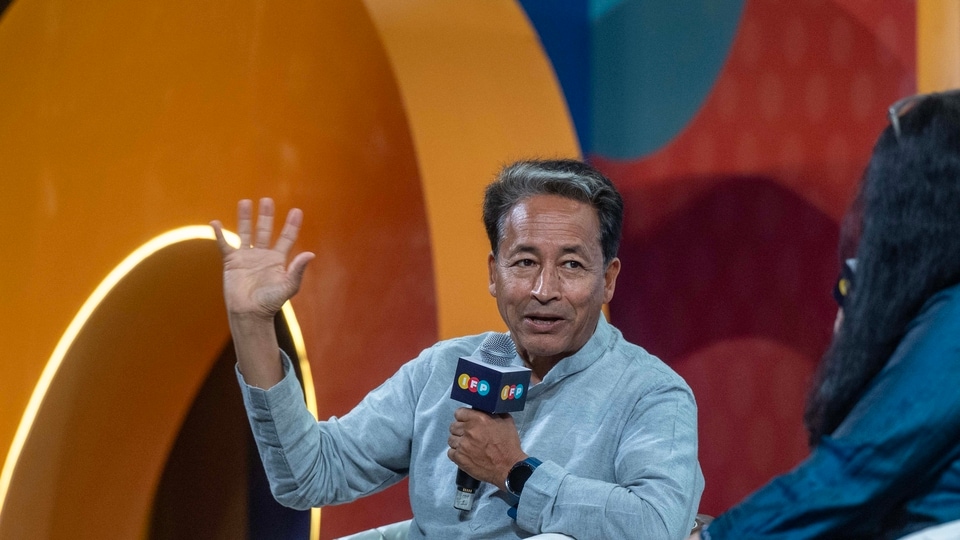
In an official press release, the administration said it had taken “serious note” of Wangchuk’s remarks during a press conference at Ladakh Bhavan in New Delhi on October 22.
Wangchuk had alleged that Lieutenant Governor VK Saxena was acting arbitrarily and that alcohol was being promoted across Ladakh despite public opposition. He also claimed that bars were being opened in neighbourhoods and near schools.
The administration rejected these allegations, stating that only one liquor shop is currently operational across the Union Territory.
Also read: Sonam Wangchuk slams Ladakh administration's stand over institute's land lease cancellation
Only one liquor shop operational in Ladakh
Only two liquor shops were permitted in Leh, in Ward No. 4 and Ward No. 6.
The administration said a wine shop in Ward No. 6 became operational after an auction held on October 14, 2026. However, no bids were received for the shop proposed in Ward No. 4, and it did not open.
As a result, only one liquor shop is currently operational across Ladakh.
Rejecting Wangchuk’s claim that alcohol was being forcibly promoted, the administration said, “The statement of Mr Wangchuk that ‘Ladakh mein sharab ko zabardasti badhaya ja raha hai’ (Alcohol is being forcibly promoted in Ladakh) is totally false and misleading,” it said.
Also read: ‘Deprived of democracy’: Wangchuk says cancelled home ministry meeting has broken Ladakh’s trust
Administration says excise policy was rolled back
Wangchuk had claimed that a decision was taken around two months ago to open liquor shops across Ladakh, despite repeated written representations and protests by residents.
Responding to this, the administration said the new Excise Policy for 2026-27 was notified through S.O. 198 on June 1, 2026. However, after receiving feedback and suggestions from residents and social organisations, the Lieutenant Governor withdrew the policy on August 26, 2026.
According to the administration, the proposal to open wine shops under the new policy was withdrawn, and the auction notice issued under it was cancelled.
The previous Excise Policy for 2025-26, notified through S.O. 35 on April 4, 2025, was restored through S.O. 256 on August 26, 2026. The administration said this policy remains in force.
Also read: Ladakh administration defends in HC cancellation of land allotment to Wangchuk’s institute
Administration cites rules for bars and hotel licences
The administration also provided details of liquor-serving establishments operating across Ladakh.
It said 50 retail vends of liquor in a bar with a restaurant are currently operational across the Union Territory. Of these, 38 are in Leh, seven in Nubra, three in Zanskar and two in Changthang. Two beer bars are also operational in Leh.
In addition, nine hotels in Leh hold liquor licences. Four of these hotels applied for and received licences this year. One hotel in Nubra also applied for and received a licence during the year.
According to the administration, licences are issued only to applicants who meet the prescribed requirements. These include compliance with distance criteria related to highways, religious institutions and educational institutions. The same criteria have also been adopted for hotel licences.
Rejecting the claim that bars were being opened in every neighbourhood and near schools, the administration said, “Hence, Mr Wangchuk’s claim of opening ‘Bars in every street, locality and around schools’ also holds no ground.”
Also read: Scarcity to surplus: Ladakh’s new excise policy counts on alcohol to fight drug abuse
Administration accuses Wangchuk of spreading misinformation
The administration said its official records contradicted Wangchuk’s claims that liquor shops were being opened across Ladakh.
“These official records contradict Mr Wangchuk’s deliberate campaign of falsehood and misinformation that ‘liquor shops are being opened in every nook and corner of Ladakh’. Clearly, the averments made by Mr Wangchuk are false, baseless and to ‘create unnecessary public alarm’,” the release said.
The administration also urged Wangchuk to check information with official sources before making statements to the national media and the public.
"Verify the facts, from official sources, before feeding completely false and imaginary claims to the national media and the people at large,” the administration stated.