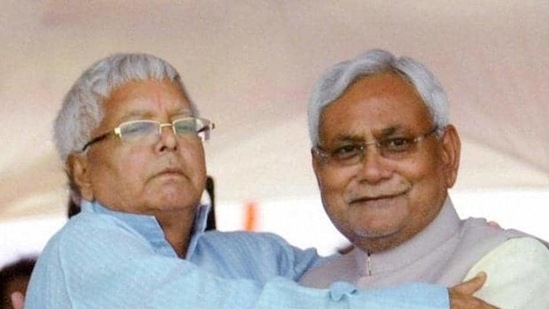
The results of the two assembly bypolls in Bihar would have had no impact on the stability of the Nitish Kumar government. However, there was a lot riding on these results for Kumar and bitter adversary Lalu Prasad. These two politicians have dominated the state’s politics for the past three decades, sharing the chief minister’s post between them (Prasad nominated his wife Rabri Devi in 1997 and Kumar gave the reins of office to Jitan Ram Manjhi for a short while in 2014) during this period. This dominance notwithstanding, both Kumar and Prasad (or their parties) have been unable to chart a solo path in the state’s politics. Any attempts to do this have backfired politically and forced a reconciliation with their respective alliance partners. The latest results underline this trend once again. Here are four charts which explain this argument.
The results of the two assembly bypolls in Bihar would have had no impact on the stability of the Nitish Kumar government. However, there was a lot riding on these results for Kumar and bitter adversary Lalu Prasad.
2020 assembly elections produced a bitter winner and an emboldened loser
The Rashtriya Janata Dal (RJD) fought the 2020 assembly elections with its back against the wall. It failed to open its account in the 2019 Lok Sabha elections, a first in the party’s history. 2020 was the first assembly election the party was contesting with its biggest leader, Lalu Prasad, behind bars. It decided to drop some caste-based parties (Vikassheel Insan Party and Hindustan Awami Morcha) which were its alliance partners in the 2019 Lok Sabha polls and struck a pre-poll alliance with the Congress and three Left parties, namely Communist Party of India (CPI), Communist Party of India (Marxist) or CPI (M) and the Communist Party of India Marxist-Leninist (Liberation) or CPI ML. While the RJD contested relatively fewer assembly constituencies (ACs), its alliance partners agreed to project Tejashwi Yadav as the chief minister candidate.
Nitish Kumar’s Janata Dal (United) ran into headwinds from an unexpected source: the Lok Janshakti Party (LJP), its alliance partner in the National Democratic Alliance (NDA) at the Centre. While an ailing Ramvilas Paswan (he passed away weeks before the polls started) was out of action, his son Chirag Paswan launched a scathing attack on Kumar, even as he continued to praise the Bharatiya Janata Party (BJP) and Prime Minister Narendra Modi. Chirag’s rhetoric ultimately translated into the LJP fielding candidates against the JD(U) but not the BJP. The JD(U) would pay the biggest price for the LJP playing spoiler. In 64 assembly constituencies (AC) where the LJP polled more votes than the victory margin, the JD(U) lost 27. To be sure, the RJD also lost some of these ACs, but the number was much lower, just 17. This played an important role in the RJD ending up as the single largest party in the new assembly, and the JD(U) a distant third, much behind the BJP’s tally of 74. That the RJD got more seats than the JD(U), even though Kumar continued to be the chief minister for a record fourth term in the state, allowed the former to keep attacking the latter.
Chart 1: Party at second position where the LJP played spoiler
By-poll results a reality check for the RJD
The RJD tried to make the two bypolls, happening a year after the assembly elections, into a contest between Kumar and Prasad. The latter was brought into the campaign despite ill health, and he launched a bitter attack on the former. However, the RJD also signalled that it did not require an all-in-unity strategy to take on the JD(U), which, unlike in 2020, had a united NDA behind it. The RJD refused to give one of the ACs, Kusheshwar Asthan, to the Congress in keeping with the 2020 seat-sharing arrangement. To make matters worse, Prasad made a personal attack on Bhakt Charan Das, the Bihar incharge of the Congress, and said that giving the AC to the Congress would be a complete waste. That the RJD failed to win either of the ACs, and its post-result posturing towards the Congress has become much softer than what it was pre-results suggests that there is a realisation within the RJD ranks that alienating the Congress was not a good move. To be sure, the RJD’s performance in both these ACs was better than how the RJD alliance performed in 2020. However, in a first-past-the-post system, it is winning, not vote share, which matters. On the other hand, the wafer-thin margin in Tarapur AC will keep reminding the JD(U) of the importance of the BJP’s core voters in winning elections.
Chart 2: RJD/MGB and JD(U)/NDA performance in two ACs in 2020 and 2021
JD(U)’s social engineering has triumphed over RJD’s aggressive MY politics in Bihar
From being the biggest within-NDA adversary of Narendra Modi — the JD(U) walked out of the NDA in 2013 against Modi’s prime ministerial candidature — to reconciling himself with the BJP’s invincibility — this was one of the justifications given for breaking ranks with the 2015 Mahagathbandhan in 2017 — Kumar has come more than full circle in Bihar’s politics. The reason why the BJP has not given up on the JD(U); Kumar is often critical of the core Hindutva agenda, is the latter’s success in forging a solid caste coalition of the lower Other Backward Classes (OBCs) in the state, who often see the RJD as a party of the Yadavs, the dominant OBCs. According to the 2015-16 National Family and Health Survey, OBCs have a share of 58% in Bihar’s population. Herein lies the RJD’s central challenge, which even Prasad, its tallest leader, could not successfully handle. While Yadavs account for just 10-11% of the state’s population, they have had a disproportionate share; often at the cost of other OBCs, when it comes to the RJD’s candidature and therefore MLAs. The desertion of lower OBCs from the RJD to the JD(U) has weakened the RJD considerably in Bihar.
Chart 3: Share of Yadavs in RJD candidates and MLAs
Can Mandal 2.0 revive the RJD’s pan-OBC appeal and political fortunes?
Unless the RJD is able to shed its image as a party of Yadavs, it will find it difficult to regain its electoral mojo in the state. To be sure, it is trying to reassert its pan-OBC politics by pushing for a caste census and using the numbers to demand a dilution of the existing 50% on reservations, so that OBC reservations can be increased beyond the 27% limit. There are two problems in this tactic for RJD’s revival. One, by joining ranks with the RJD on this issue, Kumar – he led an all-party delegation to the Prime Minister demanding a caste census – has ensured that the RJD does not get the sole credit for this issue.
Second, any efforts to raise the rhetoric on Mandal will alienate upper caste voters away from the RJD. While they may not matter directly in the RJD’s scheme of things, the party has used the Congress to woo this constituency, most effectively in the 2015 elections, when the RJD and JD(U) were jointly pitted against the BJP, a party which has historically commanded upper caste loyalty in Bihar since the 1990s. The number of upper caste MLAs the Congress managed in 2015 is testimony to this fact. This will make sure that the friction between the RJD and the Congress will not end with these bypolls.

 E-Paper