
 E-Paper



Locust swarms reach NCR, race over to UP
Swarms appeared over the skies of Delhi and its satellite cities, Gurugram and Faridabad, on Saturday at mid-morning.

 Prefer HTon Google


Columns of desert locusts, menacing crop-eating pests, which survived a control operation in Rajasthan on June 26, flew over parts of the national capital region on Saturday, including rural west Delhi (Dwarka), Gurugram and Faridabad, as residents kept their windows shut, banged utensils or played loud music to chase the insects away.
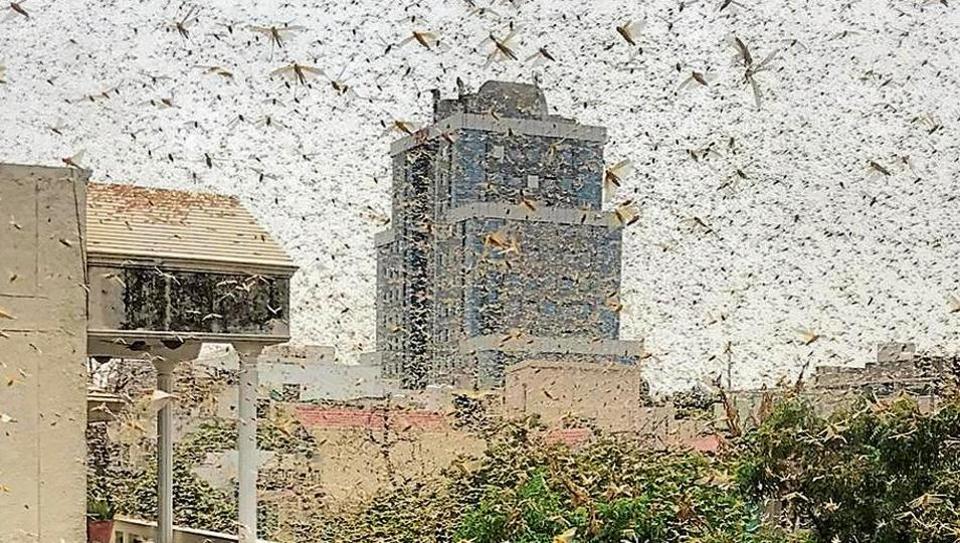
Swarms appeared over the skies of Delhi and its satellite cities, Gurugram and Faridabad, on Saturday at mid-morning. The national capital region has likely escaped a major attack because the swarms don’t settle during the day and were racing towards Uttar Pradesh, an official of the agricultural ministry said, requesting anonymity because he is not authorised to speak to the media.
Locusts fly constantly during daytime and settle down at nightfall.
Officials at Delhi’s airport, which falls close to areas over which the locusts flew, were being updated by locust control authorities of the agriculture ministry so that pilots can be briefed, the official cited above said.
India is battling an invasions of locusts, which can flatten whole farms overnight, after they appeared earlier than anticipated this year in April in the border areas of Rajasthan.
Also read | ‘Shut your windows’: Delhi advises people as locusts enter Delhi from Gurugram
The Horn of Africa has been witnessing large breading by locusts since 2019 due to frequent cyclones possibly linked to climate change and swarms have invaded several regions from there, according to the UN’s Food and Agriculture Organisation (FAO).
The FAO has warned that locust invasions pose a “severe risk” to India’s farm economy this year. In a June 23 update, the FAO said India was among five nations that cannot lower their guard against the locusts for the next four weeks.
Desert locusts can fly hundreds of kilometres a daily and a one square-km swarm can eat as much crop food as 35,000 people in terms of weight in a single day, according to the FAO Desert Locust Information Service manual.
“As of now, no locust swarms are active in any city. Authorities are tracking their route. The locusts have reached Uttar Pradesh flying over parts of the national capital,” the official cited above said. The swarms may descend somewhere near Agra by nightfall, according to inputs received from tacking teams.
On Saturday, expert teams scoured areas which lay under the locust flight path.
The country has deployed drones, locally developed sprayers and modified fire tenders to spray malathion, the main pesticide that is effective against the desert locust.
India this month shipped 20,000 litres of malathion to Iran to curb breeding there. Controlling the pests in Iran helps India because Iran lies on a west-east corridor the locusts take to enter India through Rajasthan.
People living in Gurugram and Faridabad posted pictures and videos showing clouds of pests in their areas.
“It was around noon. We heard a humming noise and saw the entire sky covered. The insects must have been several feet up in the air,” said Kuldeep Gurjar, a farmer and the head of Manesar Farmers’ Producer Organisation near Gurugram’s Manesar.
“Ground control teams are constantly tracking them and will undertake major control operations once they settle down,” an official statement said.
Well-equipped teams in UP are on alert and ready for overnight operations, the official cited above said. Officials are also on alert in Delhi, Rajasthan and Haryana.
The locust invasion of the national capital region Saturday was from a large offshoot of pests that survived an elimination operation by agriculture officials in Rajasthan’s Jhunjhunu on the morning of June 26, according to a locust status report.
About a third of the pests from that operation is estimated to have survived. These swarms reached Rewari in Haryana on June 26 evening, destroying some crops. Local teams from the locust control organisation, under the farm ministry, undertook control operations there.
A group that survived the control operations in Haryana then flew out in three separate formations, each containing millions of locusts.
“One of columns headed into Gurugram. It flew in a route that took them over Faridabad and onwards to Uttar Pradesh,” the official said.
Another formation flew past rural Dwarka in Delhi towards Daulatabad, Faridabad and Gurugram. “That is why there was a very large presence in Gurugram,” the official cited above said. This swarm too entered UP by afternoon Saturday.
A third group headed towards Palwal in Haryana and is also reported to be moving towards UP. If not checked, locust attacks are known to cause considerable drops in food output.
The official cited above said all the formations are being tracked by teams of state agriculture departments of Rajasthan, Haryana and UP.
More control teams from Rajasthan were being moved to Haryana and UP to launch operations.
Locust authorities have ramped up containment since May. The area under control currently stands at about 114,026 hectares, up from about 49,000 hectares in May. One hectare is roughly 2.4 acres.
The most threatened states where locust control operations are under way are Rajasthan, Punjab, Madhya Pradesh, Gujarat, Maharashtra and UP.
“India has experience of fighting the pest from two previous outbreaks in 1950 and 1993. We have better technology now. If need be help can be taken of the air force for aerial spraying,” said JN Thakur, a former chief of locust monitoring at the agriculture ministry.


