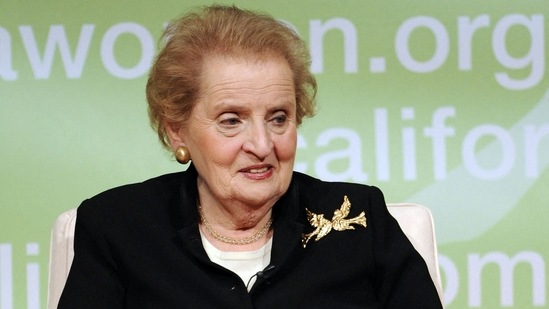
‘Madam Secretary’ who shaped foreign policy and public life
Madeleine Albright, the first woman to rise up to become the Secretary of State in the US in President Bill Clinton’s second administration, died at the age of 84 on Wednesday, sparking a set of tributes from across the American political spectrum
Madeleine Albright, the first woman to rise up to become the Secretary of State in the US in President Bill Clinton’s second administration, died at the age of 84 on Wednesday, sparking a set of tributes from across the American political spectrum. What made Albright stand out was her remarkable personal story, which shaped her life’s trajectory, her career, and her political judgements, not all of which will stand the judgement of history.
Madeleine Albright, the first female US secretary of state and one of the most influential stateswomen of her generation. (AFP)
Albright was born in Prague in 1937. But her story is inextricably linked to that of her father, Josef Korbel – “To understand me, you must understand my father,” she wrote in her memoir, Madam Secretary.
Korbel was a Czech diplomat, who first fled his country to escape the Nazi onslaught in the second world war, and then fled a second time to escape the Soviet-backed communist takeover of his country in 1948. Decades later, when she became Secretary of State, she discovered, thanks to an investigative story in the Washington Post, that she was Jewish—a fact her parents kept from her—and that three of her grandparents died in Nazi concentration camps. She also had an India connection through her father, who was a part of the UN Commission for India and Pakistan—set up in the wake of Pakistan’s aggression in Kashmir in 1948 and India’s controversial decision to take the issue to the United Nations.
Albright went on to specialise in foreign policy, worked in the National Security Council in the Jimmy Carter administration, became a fundraiser for Democrats, and then, under the Clinton administration, first served as the US ambassador to the UN and then the first woman Secretary of State. But in this role, she was at the heart of decisions that continue to shape US foreign policy today.
For one, Albright was a great champion of expanding NATO eastward after the fall of the Soviet Union, arguing, “One didn’t have to be a native of the region to see the logic of what was planned. After four decades of Communist subjugation, the nations of Central and East Europe were eager to join an enlarged NATO. I felt we should welcome them.” She acknowledged that there was opposition to the move, including from the architect of the US’s containment policy towards the Soviet Union, George Kennan, who called it the “the greatest mistake in Western policy in the entire post-Cold War era”. But, in the final analysis, Albright said, “We had to walk a tightrope to keep faith with Europe’s new democracies while not recreating our old enemy. Our critics didn’t think we would be able to keep our balance. I thought we could.” The Russian invasion of Ukraine is seen as evidence that the US failed in walking that tightrope, critics were right, and Albright overreached.
Two, while acknowledging that China was “too big to ignore, too repressive to embrace, difficult to influence and very, very proud”, Albright appeared to have a sanguine view on how economic reforms would create a democratic China. In her memoir, she claimed that China’s entry in the World Trade Organisation would lead to “more technological innovation, more use of the Internet, more frequent contact with foreigners, and more institutions and associations free from Communist Party control” and argued that the US must not be in any hurry to “cast China in the role of the enemy”. A little over 20 years later, in a Senate testimony in 2021, she called China America’s biggest problem, “hustling in every single way”, and a clear military adversary and economic competitor.
And finally, on India-Pakistan, Albright led the charge against India’s nuclear tests and sought to internationalise the Kashmir dispute. Indian diplomats who interacted with the US during the period believe that, in the initial years, she was somewhat partial to the Pakistani narrative on Kashmir, and her father’s work in the region had an influence on her. But, to be fair, it was also when she was Secretary of State that her deputy, Strobe Talbott, engaged in his extensive dialogue with Jaswant Singh—this laid the foundations of much stronger India-US ties and Clinton’s historic visit to India in 2000 and Atal Bihari Vajpayee’s visit to the US. A diplomat familiar with that period said that she was supportive of closer partnership with India in her later years. And in 2008, after the Mumbai attacks, she said Pakistan had all ingredients to give the world an “international migraine”.
The young girl from Prague, who saw the rise of the Nazis and the communists, who saw the US fight the Cold War and led it during the unipolar moment, and who eventually tied her country of birth and the country she made home in a security architecture, wrote her last piece in the New York Times in February, calling the Russian invasion of Ukraine a “historic error”. In life, and till her death, Madeleine Albright continued to be a formidable voice in American public life and diplomacy.
Prashant Jha is the Washington DC-based US correspondent of Hindustan Times. He is also the editor of HT Premium. Jha has earlier served as editor-views and national political editor/bureau chief of the paper. He is the author of How the BJP Wins: Inside India's Greatest Election Machine and Battles of the New Republic: A Contemporary History of Nepal.Read More

 E-Paper