
 E-Paper



Madras high court refuses to stay expulsion of O Panneerselvam, 3 others from AIADMK
AIADMK general secretary and former chief minister Edappadi K Palaniswami (popularly known as EPS) termed the decision a “victory for justice”

 Prefer HTon Google


The Madras high court on Friday refused to stay the expulsion of former Tamil Nadu deputy chief minister O Panneerselvam (popularly known as OPS) and three others from the All India Anna Dravida Munnetra Kazhagham (AIADMK) during a general council meeting of the party in July last year.
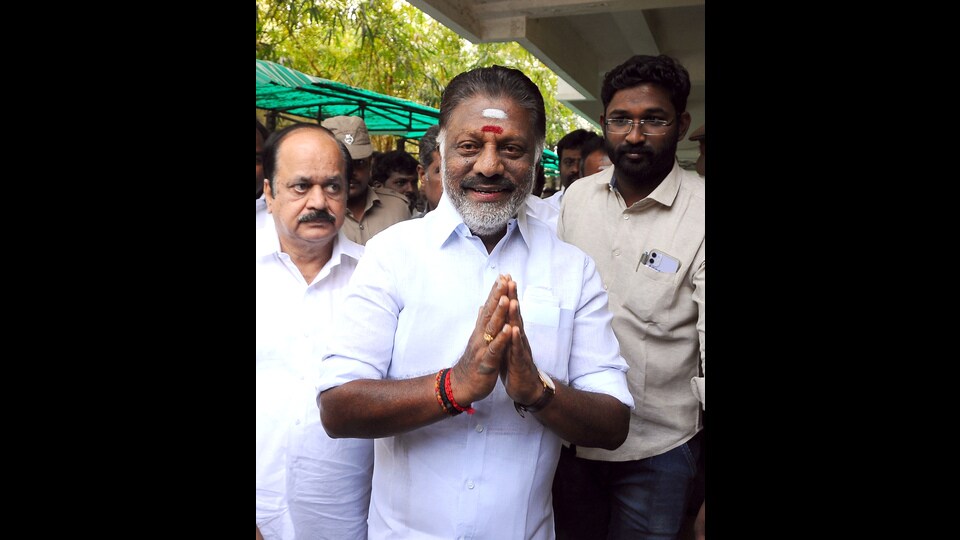
A division bench of justices R Mahadevan and Mohammed Shaffi dismissed the appeals filed by OPS and his three supporters – JCD Prabhakar, R Vaithilingam, and PH Manoj Pandian – against a single bench’s refusal to stay the expulsion, saying “the appellants are not entitled for interim injunction/relief”.
While AIADMK general secretary and former chief minister Edappadi K Palaniswami (popularly known as EPS) termed the decision a “victory for justice”, the OPS camp say they may consider approaching the Supreme Court.
In its order, seen by HT, the division bench said: “...we conclude that the appellants are not entitled for interim injunction/relief as prayed for. Therefore, we do not intend to interfere with the order of the learned Judge in rejecting the original applications filed by the appellants herein.”
The bench also said that the bylaws of the party made it clear that the general council is the ultimate authority to take disciplinary action against any party members and the merits of their decision in expelling the leaders is necessarily a matter for trial.
“The contention of the learned senior counsel for the appellants in this regard is contradictory and self-defeating,” it said.
“Any finding given on the merits of this decision may have a bearing on the suit and we consciously refrain from making any observations on the alleged facts on the basis of which the purported action of expulsion was made and whether such facts merited emergent disciplinary action or action after a detailed procedure, is a matter for trial,” it added.
On July 11 last year, the party’s general council meeting elected EPS as the interim general secretary and expelled OPS. In the days that followed, all of OPS’s supporters, including his two sons, were removed from the AIADMK. On September 2, the high court upheld EPS’s appointment; this was also done by the Supreme Court on February 23 this year. On March 28 this year, EPS was elevated as AIADMK general secretary.
The division bench, in its order, said that since the Supreme Court has already held EPS’s elevation as valid, any injunction would mean going back to the dual leadership scenario. “...the party would face a situation of being without leadership as there would be no general secretary which also cannot be permitted,” the bench said.
“Further, this would mean that the party would have to be run under the Joint leadership of the Coordinator and Joint Co-ordinator which was not practically working out, and which led to the change in scenario,” it added.
The AIADMK had a dual leadership model following former party president and chief minister J Jayalalithaa’s death in December 2016. Both EPS and OPS had merged their warring factions and functioned as joint coordinator and coordinator, respectively, in the party. In the government, they were chief minister and deputy chief minister, respectively.
After the party lost the 2021 assembly elections, EPS became leader of the opposition and OPS, the deputy leader. But EPS and his supporters started pitching for a unified single leadership on the grounds that the dual leadership arrangement was not working.
Matters came to a head at a June 23 meeting last year when OPS wanted a resolution backing the dual leadership structure, and the EPS camp wanted to discuss a return to a unified leadership. After a court ruling restricted the meeting’s scope, preventing it from discussing the latter, the council vetoed all items on the agenda (including the one backing the dual leadership model). A subsequent meeting on July 11 saw OPS’s expulsion, along with several others, and EPS’s appointment as interim general secretary.
Following the division bench’s decision, celebrations erupted outside the AIADMK headquarters in Chennai, as party cadres burst crackers and distributed sweets among workers and supporters.
“The AIADMK will never accept people who are against the party. The high court has recognised the AIADMK’s general council resolutions. This judgment is a victory for justice, dharma and truth. We got this verdict because justice is on our side… Our win will be big in the 2024 Lok Sabha elections,” EPS said.
While there was no immediate reaction from OPS, his lawyer Subburathinam said: “We have options in the Supreme Court. We still room legally. An original suit is pending before a single bench of the high court. He was referring to a plea against the resolutions passed by the general council.
Panruti Ramachandran, who was also expelled from the AIADMK, said those ousted from the party will move the top court.
However, the EPS camp said there are no legal options left for OPS. “Our only argument was that AIADMK’s general council is the superior authority,” said Inbadurai, an advocate representing EPS.
Another advocate, Babu Murugavel said: “We have crossed so many barriers in various courts. All courts have declared a verdict favouring EPS and that the general council is valid. To my knowledge, this is the last battle for OPS and no other options are left.”
Earlier in April, the Election Commission of India recognised EPS as the general secretary of the AIADMK, and allotted the party the two-leaves symbol.


