
 E-Paper



Militants trying to drive agenda in Valley: Officials
Jammu and Kashmir governor Satya Pal Malik said in an interview that operations against militants have indeed taken a hit.


The ongoing restrictions on movement and communication in Jammu & Kashmir have also taken a toll on security operations, which are now largely focused on maintaining peace in the region, with the result that militants, some openly armed, are now moving around several villages in South Kashmir, at least four security and intelligence officials said on condition of anonymity.
To be sure, this hasn’t resulted in any significant increase in attacks by militants to date. Meanwhile, Pakistan has also opened its training camps for militants “after a gap of two years” said one of the officials. Intelligence inputs point to mosques in Rawalpindi and Muzaffarabad in Pakistan-occupied Kashmir being used to indoctrinate people and mobilise fresh recruits to “go to Kashmir”, this person added.
The standard practice is for Pakistani forces to violate the ceasefire along the Line of Control so that militants can infiltrate India under the cover of the shelling. Since August 5, when Indian parliament passed laws and regulations to bifurcate the state of Jammu & Kashmir into two union territories and also remove the special status of the region and the special privileges enjoyed by its permanent residents, there have been 200 instances of ceasefire violations by Pakistan, according to army officials.
Jammu and Kashmir governor Satya Pal Malik said in an interview that operations against militants have indeed taken a hit.
“The focus of the security forces has been on keeping law and order and avoiding casualties. It is true that operations have reduced. That is because intelligence gathering has suffered due to mobiles and the net being down. But we will continue to keep the militants under pressure,” he said.
Most political leaders in the state and hundreds of local youth have also been arrested, with the numbers varying widely from around 400 to 4,000.
“With the arrest of separatists and mainstream political leaders, there is now a leadership vaccum. That vaccum is now being filled by militants,” said a second senior security official.
A third security official added that the militants have been trying to drive the agenda. “Several posters have been posted outside mosques and some are also being distruibuted in different colonies all across the Valley,” he said.
In the posters reviewed by HT the Hizbul Mujahideen is calling upon people to help their ‘mujahid brothers’ in several ways. In one notice that has been posted outside mosques, the call is to “give a befitting reply to every conspiracy of Indian imperialists and enforce strict restrictions on the movement of traffic.”
The notice goes on to say: “Only the patients going to hospitals may be allowed to move on the road…After magrib (evening) namaz, people are requested to turn off the street lights so that our Mujahid brothers can move around freely.”
In another release, militants say they are now starting a struggle under the name of Tehreek-e-Azadi (Movement for Freedom) and that all programmes will be organized and posters issued by this front, until “our leaders SAS Geelani, Mirwaiz Umar Farooq and Yasin Malik are released.
The three leaders, part of the joint leadership of separatist group Hurriyat, are among those arrested.
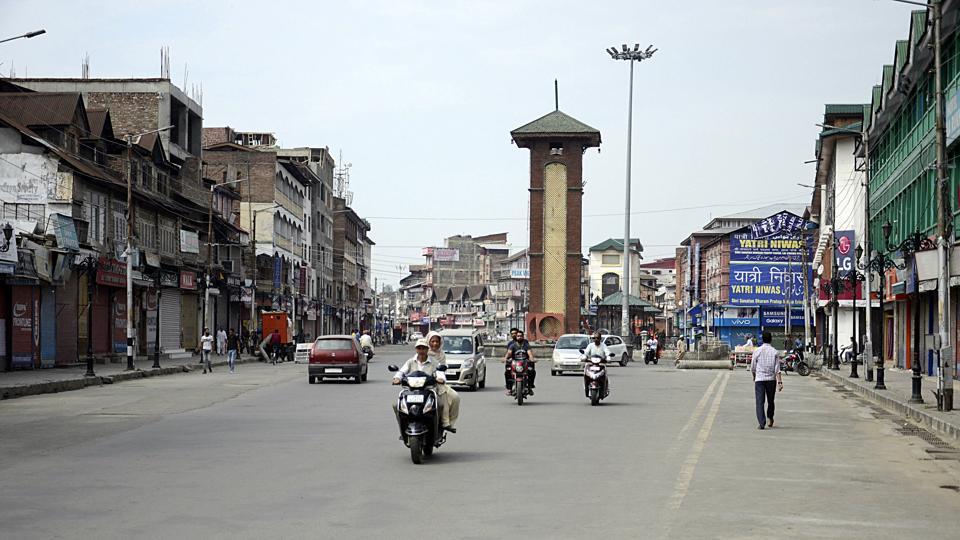
In Srinagar city, where some restrictions have been eased, a civil curfew continues to remain in place. All major shops – except neighbourhood grocery stores – continue to stay shut and even though the government has asked schools to reopen, attendance is very thin.
“We managed to avoid casualties by locking down the Valley. We are now watching to see how long this will continue,” a fourth security d official said, adding, “ but there is deep anger and we don’t know what final shape it will take.”


