E-Paper



Manipur unrest lingers; mob sets 2 houses afire
Manipur violence: A mob burnt down two houses as clashes broke out between protesters and security personnel in Imphal on Thursday.

 Prefer HTon Google


A mob burnt down two houses as clashes broke out between protesters and security personnel in Imphal on Thursday, two days after the sharpest escalation of violence in the state saw nine people gunned down and another 10 injured.
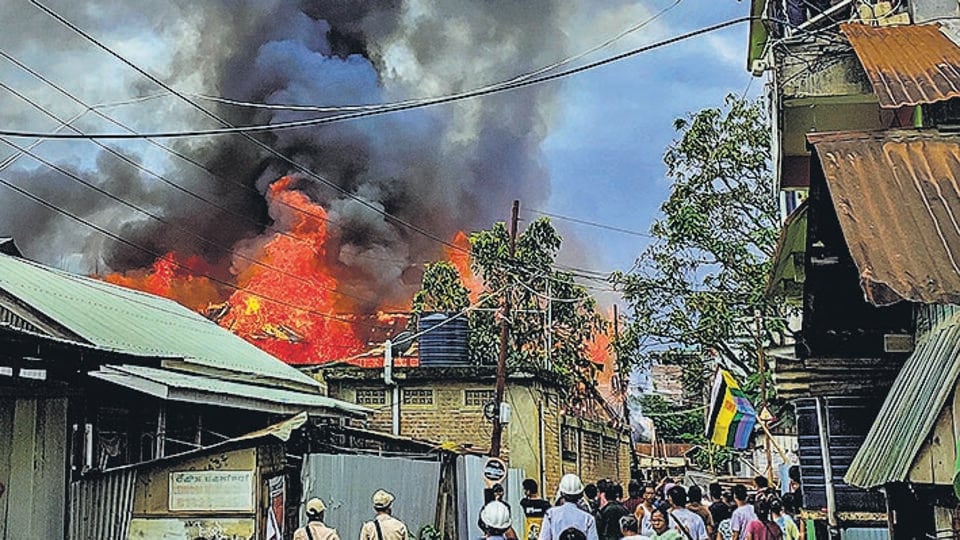
Army officials who spoke on the condition of anonymity said at least two houses were burned down by the mob in New Checkon area of Imphal East district. When security forces reached the area to prevent more violence, clashes broke out between protesters comprising mostly women, and security personnel, the officials added.
At least three people, including a woman and a security personnel, sustained injuries. Rapid Action Force and other security personnel resorted to force and fired tear gas shells to disperse the mob.
Manipur chief minister N Biren Singh assured strict action against those involved in the violence. “Action will be taken up against those who commit heinous crimes,” he told a media briefing.
On Tuesday night, nine people were shot dead and another 10 injured after a group of unidentified men stormed a village and opened fire. Manipur Police officers said that between 10pm and 10.30pm on Tuesday, a group of armed men walked into Agjiang village on the border between Imphal East and Kangpokpi district and started shooting.
Hours later, on Wednesday evening, a mob torched the official residence of BJP lawmaker Nemcha Kipgen, the only woman minister in the state cabinet. Kigpen is the legislator from Kangpokpi and among the 10 Kuki lawmakers seeking a separate administration in the state. She was in Delhi when the incident happened.
Singh said the state government has started combing operation to book those involved in the arson and killing of nine people. “The state government started combing operation yesterday to find out the culprits. So far no arrest has been made but six improvised pipe bombs have been recovered.”
Clashes between the majority Meitei community and the tribal Kuki community first erupted on May 3 and has since claimed 115 lives. Tuesday night’s incident marked the highest number of casualties in a single day since violence first broke out six weeks ago, underlining the challenge of restoring peace in a state where ethnic divisions run deep. At least 300 people have been injured and nearly 40,000 displaced.
As violence mounted, Army and Assam Rifles personnel increased “area domination operations” on Thursday.
“Day two of domination of fringe areas and higher reaches underway by long duration self-contained columns,” said the Spear Corps division of Indian Army in a social media post.
Some civil society groups said the clashes in Meitei-dominated Imphal on Thursday were in retaliation to the deaths on Tuesday night.
“This is retaliatory action due to what happened on Tuesday night,” said Khuraijam Athouba, spokesperson of Coordinating Committee for Manipur Integrity (COCOMI), a Imphal-based conglomerate of Meitei civil society organisations.
The Indigenous Tribal Leaders Forum (ITLF), a conglomerate of Kuki groups in Churachandpur district, accused Meitei groups of continued attacks and reiterated its demand for President’s Rule and complete separation of tribal areas.
“This is the only solution that safeguards and protects the lives of the tribals and ensures lasting peace in the region,” the statement said.
Clashes between the Kukis and Meiteis first erupted on May 3 during a protest against a court-ordered tweak to the state’s reservation matrix, granting Scheduled Tribe (ST) status to the latter. Violence quickly engulfed the state, displacing tens of thousands of people who fled burning homes and neighbourhoods into jungles, often across state borders. The authorities clamped a curfew and suspended internet, pumping in additional security forces to force a break in the spiraling clashes. Internet is still not fully back in the state.
Union home minister Amit Shah visited the state for four days between May 31 and June 3. The Central Bureau of Investigation is looking into five specific cases of violence and a sixth case of conspiracy behind the cases. The government has also announced a peace committee headed by governor Anasuiya Uikey but prominent groups from both sides of the divide have distanced themselves from the process.
The first wave of violence was seen between May 3 and 6, when a wave of attacks and arson forced people to flee their homes and prompted the government to fly in thousands of security personnel. But despite some easing of tensions, sporadic violence has continued.