
 E-Paper



PM Modi, Australian PM bolster military ties
The two sides also upgraded their “2+2” foreign affairs and defence dialogue to the ministerial level and unveiled a “shared vision for maritime cooperation in the Indo- Pacific”.


India and Australia elevated their ties to a comprehensive strategic partnership and signed a crucial agreement for reciprocal access to military logistics during a virtual summit between Prime Minister Narendra Modi and his counterpart Scott Morrison on Thursday.
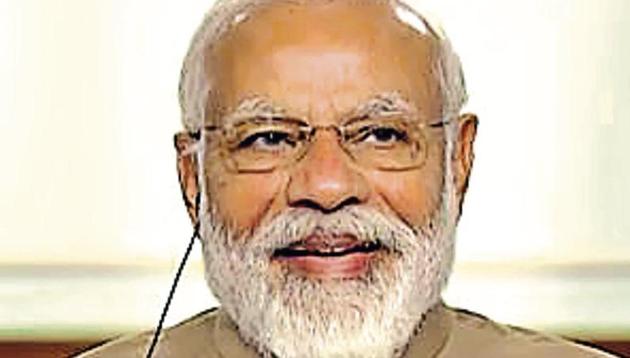
The two sides also upgraded their “2+2” foreign affairs and defence dialogue to the ministerial level and unveiled a “shared vision for maritime cooperation in the Indo- Pacific”.
The Mutual Logistics Support Agreement (MLSA), one of seven agreements signed during the summit, will facilitate reciprocal access to military logistics facilities, allow for more complex joint military exercises and improve interoperability between the armed forces of the two countries.
“India is committed to expanding its relations with Australia in a comprehensive and quick manner. This is important not only for our two countries, but also for the Indo-Pacific region and the world,” Modi said in his opening televised remarks in Hindi.
Morrision said the comprehensive strategic partnership formed by the two sides will take them “to a whole new level of relationship” and “continue to build the trust because we want commercial and trading relationships that are built on trust”.
Referring to the joint declaration on cooperation in the Indo-Pacific, he added, “We share an ocean and we share responsibilities for that ocean as well – its health, well-being [and] security and the relationship we’re forming around those issues and our maritime domain is the platform for so many other things between our countries.”
The summit was held against the backdrop of growing tensions with China for both India and Australia, though secretary (east) Vijay Thakur Singh of the external affairs ministry told an online briefing there was no specific discussion on China.
However, many of the items on the agenda – shared democratic values, rules-based multilateral systems, an open and inclusive Indo-Pacific, respect for transparency, strengthening and diversifying supply chains for critical health, technology and other goods and services, and cooperation in rare earth minerals – appeared to be aimed at countering China’s influence in the region, experts said.
Modi said the two sides should focus on how their relationship can be a “factor of stability for our region and for the world”, while Morrison said Australia is working with friends such as India and Japan to provide a “steadying and stabilising and wise influence during…an incredibly difficult time”.
Morrison said Australia is “committed to an open, inclusive, prosperous Indo-Pacific and India’s role in that region…will be critical”. He added, “We share a vision for open, free, rules-based multilateral systems in our region, whether that’s in the health area or it’s in trade or in other places.”
He also tacitly referred to Australia’s demand for a probe into the origins of the Covid-19 pandemic while commending India’s taking over as chair of the World Health Organization (WHO)’s executive board.
“This is a very important time to be chairing that executive board. I have no doubt the way that that will be led under India’s leadership will be critical to how we deal with many difficult problems that we are encountering globally, particularly in the health area,” Morrison said.
Among the other important agreements signed by the two sides during the virtual bilateral summit – the first such meeting for Modi – were a framework arrangement on cyber and cyber-enabled critical technology cooperation, a memorandum of understanding (MoU) on cooperation in mining and processing of critical and strategic minerals, and an implementing arrangement on cooperation in defence science and technology under the existing MoU on defence cooperation.
Even before the Covid-19 crisis, the two sides had been exploring the possibility of cooperation in mining and processing of rare earth metals such as lithium, neodymium and dysprosium, of which Australia has the world’s sixth largest reserves.
Indian officials said Australia is seen as a “reliable and secure supplier” of rare earth metals and institutions from both sides will jointly take forward collaboration in this field.
India, which imports more than 90% of the rare earth metals it needs from China, has been looking to diversify sources. In 2016, the imports from China were worth $3.4 million.
The two sides also signed three MoUs on cooperation in public administration and governance reforms, cooperation in vocational education and training and water resources management.
The virtual summit was arranged after Morrison was forced to put off a planned visit to India twice – first in January because of the devastating bushfires in Australia and then in May because of the Covid-19 crisis. Though the discussions were slated to last 40 minutes, they stretched to 70 minutes and secretary (east) characterised the talks as “extremely productive”.
As part of the joint response to the Covid-19 crisis, an allocation will be made from the Australia-India Strategic Research Fund for work in seven areas to counter the pandemic.
An Australian statement said the joint declaration on maritime cooperation in the Indo-Pacific committed both sides to supporting rules-based maritime order in the region and working together to strengthen maritime domain awareness and combating trans-national challenges such as people smuggling, arms and narcotics trafficking, terrorism, and illegal and unregulated fishing.
The Australian side also said the cooperative arrangement on cyber affairs and critical technology will be complemented by a new, four-year $12.7 million partnership that will create a research and development fund for Indian and Australian businesses and support other countries to improve their cyber resilience.
Modi reiterated his invitation to Morrison to visit India when the situation normalises. Morrison, who has met Modi four times in the recent past, joked about how he had missed out on the “famous Modi hug”.


