
 E-Paper



Modi in Wayanad: PM recalls 1979 Morbi disaster as he vows to leave ‘no stone unturned’
Prime Minister Narendra Modi chaired a review meeting after undertaking an aerial and on-the-ground survey of affected sites in Wayanad.


Prime Minister Narendra Modi on Saturday evoked the harrowing memories of the 1979 Morbi dam disaster in Gujarat after he visited the landslide-devastated areas of Wayanad district, Kerala, offering empathy and assuring all possible support from the central government.
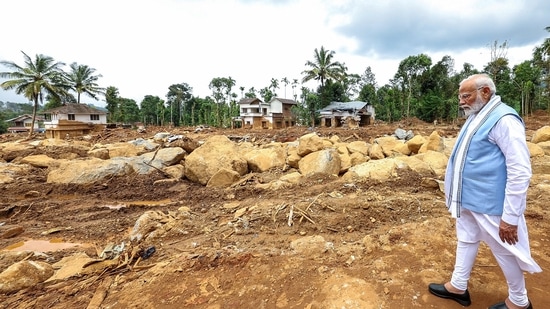
The prime minister was on a day-long visit to Wayanad, where he conducted an aerial and on-the-ground survey of the destruction caused by the July 30 landslides, which have claimed over 200 lives and left many more missing.
Read: PM Modi on meeting landslide victims in Kerala's Wayanad: ‘Disaster not normal’
Speaking at a review meeting after his tour, Modi reflected on his experience with the Morbi disaster, one of the deadliest dam failures in India's history.
"I have seen and experienced a disaster very closely. About 45-47 years ago, there was a dam in Morbi, Gujarat. Heavy rains occurred, and the dam was completely destroyed, leading to water flooding Morbi city. There was 10-12 feet of water in the entire city, and more than 2,500 people died," Modi recounted.
"I stayed there for about six months as a volunteer...I can well understand these circumstances and I assure you that the country and the Government of India will leave no stone unturned," he added, expressing his deep understanding of the suffering faced by those in disaster-stricken areas.
Read: Rahul Gandhi faces a UPA II hurdle in PM Modi declaring Wayanad as ‘national disaster’
Modi surveys damage
During his visit, Modi trekked through the severely impacted Chooralmala region, where he surveyed the extensive damage and interacted with rescue personnel, state officials, and local residents. He also visited a relief camp in Meppadi, spending time with survivors, including children who had lost family members in the landslides. Visuals from the visit showed Modi offering comfort to the victims, placing his hands on their shoulders as they recounted their traumatic experiences.
The prime minister was accompanied by Kerala governor Arif Mohammed Khan, chief minister Pinarayi Vijayan, and Union minister Suresh Gopi. Together, they walked on a 190-foot Bailey bridge constructed by the army in Chooralmala following the disaster.
Modi's visit also included an aerial survey, where he observed the origins of the landslide at Iruvazhinji Puzha (River) and some of the worst-hit areas, including Punchirimattam, Mundakkai, and Chooralmala.
As Modi departed Wayanad, he assured the state of Kerala that the central government would provide all necessary resources to aid in recovery and rebuilding efforts.


