
Sign in

Negligence at Pakistan’s border quarantine facilities spark concern as Covid-19 cases surge

The country has reported two deaths and a total of 301 confirmed cases of coronavirus disease Covid-19.

Updated on: Mar 19, 2020, 11:02:25 IST
Hindustan Times, New Delhi | By
Share
Share via
  • facebook
  • twitter
  • linkedin
  • whatsapp
Copy link
  • copy link

As coronavirus spreads rapidly across the world, doctors in Pakistan have warned that a large number of people in Lahore could be affected in the coming days because around 5,600 pilgrims who recently returned from Iran have spread all over the country.
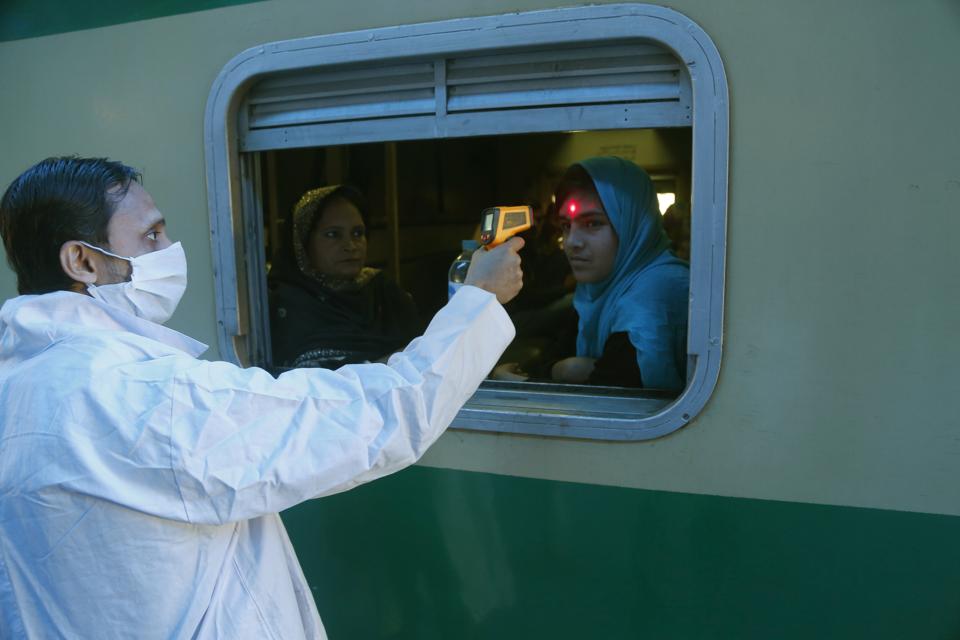
A Pakistani volunteer checks the body temperature of a passenger to help detect coronavirus, at a railway station in Lahore, on March 18. (AP Photo)

Tracking Coronavirus Outbreak: Live Updates

These pilgrims were held at Pakistan’s Taftan border crossing (in Balochistan) with Iran, one of the countries worst affected worldwide by the virus, but due to negligence of officials in enforcing quarantine, the number of cases spiked.

The country has reported two deaths and a total of 301 confirmed cases of Covid-19, including 208 in the southern province of Sindh alone. Thirty-three cases have been reported in the eastern province of Punjab, 23 in Balochistan, 19 in Khyber Pakhtunkhwa, and two in capital Islamabad. As of Wednesday, Pakistan had tested at least 1,621 people for the disease.

The provincial government in Punjab has earmarked three hospitals for coronavirus patients, and has also imposed prohibitory orders under Section 144 to check the spread of virus. However, there is little impact of the prohibitory orders on the ground.

Experts have suggested quarantining the entire country, and suspending flight operations in view of increase in number of those infected with coronavirus. Many doctors and nurses have threatened to stop work in view of shortage of equipment/facilities and inadequate measures to shield them from the infection.

For now, Islamabad has ordered both the Afghan and Iranian borders sealed, wedding halls shuttered, and schools closed across the country for the remainder of the month to prevent the virus’s transmission.

Pakistan’s porous borders, creaking hospitals, culture of hand shaking and hugging, and crowded urban centres mean containing the crisis could be a huge challenge.

A deteriorating situation in Pakistan could have ramifications for regional security and more pressure along the Line of Control (LoC).

  • Shishir Gupta
    ABOUT THE AUTHOR
    Shishir Gupta

    Shishir Gupta is Executive Editor at Hindustan Times and one of India's top journalists covering national security, strategic affairs, foreign policy and geopolitics. Over the past three decades, he has extensively reported on India's military, diplomatic and security landscape, covering every major conflict and national security challenge, from the 1999 Kargil War and the 2020 East Ladakh standoff to Operation Sindoor in 2025. He has also covered major terror attacks, including the IC-814 hijacking, the 26/11 Mumbai attacks and the 2025 Pahalgam terror strike, along with numerous Pakistan-backed terrorist incidents in the Kashmir Valley and across India. He has reported on national and state elections for more than three decades. A recognised authority on strategic affairs, Gupta has covered India's nuclear programme since the Pokhran-II (Shakti series) tests in May 1998 and has written extensively on global nuclear issues, Indian diplomacy and the country's expanding global outreach. He has also reported widely on international conflicts and terrorism, with a special focus on the Indian subcontinent. Gupta has interviewed Prime Minister Narendra Modi more than four times, including Modi's first interview with the print media after becoming Prime Minister in May 2014. His other interviews include three with the Dalai Lama, as well as conversations with Benjamin Netanyahu, Amit Shah, Yogi Adityanath, S. Jaishankar, Nirmala Sitharaman and Piyush Goyal. He is the author of Indian Mujahideen: The Enemy Within (Hachette, 2011) and Himalayan Face-off: Chinese Assertion and Indian Riposte (Hachette, 2014). He was awarded the Chevening-Wolfson Joint Scholarship at Wolfson College, University of Cambridge, UK, in 1998 and participated in the International Visitor Leadership Program (IVLP) of the US State Department in 2006. He received the Ben Gurion Prize from Israel in 2011 and the K. Subrahmanyam Prize for Strategic Studies in 2015 from the Manohar Parrikar Institute for Defence Studies and Analyses (MP-IDSA). Since 2024, he has hosted Point Blank, Hindustan Times' weekly YouTube show on global geopolitics.Read More

Get the latest India News, breaking headlines and real-time updates from across the country. Stay informed about politics, government policies, crime, weather and major national developments.