
 E-Paper



No shortage, but ₹1,000cr/day loss is keeping fuel prices in check, explains govt after PM Modi's ‘save petrol’ appeal
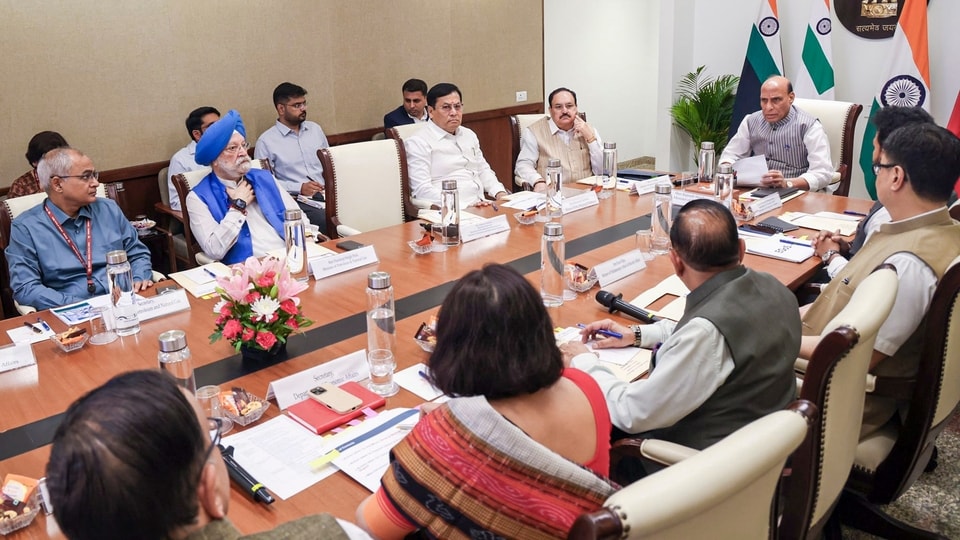
Defence minister Rajnath Singh chaired the fifth meeting of the Informal Group of Ministers (IGoM) on West Asia on Monday

 Prefer HTon Google


A day after Prime Minister Narendra Modi urged Indians to save fuel, avoid gold purchases and work from home, the government held a formal ministerial meeting on the West Asia crisis and stated that there is no shortage of any petroleum product in the country.
It noted, however, that the public-sector oil marketing companies are absorbing losses of nearly ₹1,000 crore a day to keep pump prices from rising even as crude prices spike.
What govt said, PM repeats appeal
Defence minister Rajnath Singh chaired the fifth meeting of the Informal Group of Ministers (IGoM) on West Asia on Monday, attended by the ministers of petroleum, railways, civil aviation, fertilisers, ports and science. The meeting's key message, as per a government press release, was that India has 60 days of crude oil and natural gas stocks, and 45 days of LPG rolling stock.
“There is no reason for anxiety, and no reason for any citizens to rush to retail outlets,” the Press Information Bureau (PIB) release stated.
Foreign exchange reserves stand at a $703 billion, which was also seen as comfortable.
“But there is a huge cost being borne by the nation as international crude prices are continuing at very high levels,” the ministers were informed by officials, said the release.
“Fuel conservation can ease this burden. Prime Minister Shri Narendra Modi’s appeal (Hyderabad) to the people… emphasised prudence in usage of petroleum products and reducing wasteful consumption, so that the fiscal burden on the nation is reduced in the present and into the future,” the release read.
PM Modi repeated his appeal in Gujarat later in the day: “Even in the earlier decades, whenever the country has gone through war or any other major crisis, every citizen has fulfilled their responsibility in the same way in response to the government's appeal."
He further stressed, "India spends lakhs of crores of rupees in foreign exchange to import many products from abroad. At the same time, the prices of imported goods are soaring, and global supply chains have also been severely disrupted. Just as every drop fills a pot, every small and big effort matters. We must reduce the use of products that come from abroad and avoid unnecessary dependence on imported goods in our daily lives, and also avoid such personal activities that involve spending foreign exchange."
Oil companies' losses amid war
The group noted that India is among the few countries where petroleum prices have held steady through a period of global volatility “even after more than 70 days since the conflict started”.
It noted, “In many nations, prices have increased by 30 to 70 per cent. However, India’s oil marketing companies have absorbed losses of close to ₹1,000 crore a day, with under-recoveries running to nearly ₹2 lakh crore in [the first quarter of the current fiscal year], so that the burden of global astronomical prices is not passed to the Indian citizens.”
The opposition has for long been saying the government is not reducing taxes and will, at some point, pass on the crude-price burden onto the consumers.
‘Atmosphere being created’ for price rise: Oppn
Congress leader Rahul Gandhi, writing on X on Sunday, called PM Modi's seven austerity appeals “proofs of failure”.
"In 12 years, he's brought the country to such a pass that the public has to be told what to buy, what not to buy, where to go, where not to go," he wrote, describing Modi as a "compromised PM" no longer capable of running the country.
Senior Congress leader Jairam Ramesh read the PM's Hyderabad speech as preparation for something harder. “A phase of stringent cost-cutting measures, including a hike in fuel prices, may be on the horizon, and an atmosphere is being created to make them more acceptable,” he said.
Samajwadi Party chief Akhilesh Yadav questioned why the crisis had surfaced only after the recent elections in four states and a UT.
"During the elections, BJP leaders took thousands of chartered flights. Were those planes flying on water?" he asked.
RJD's Tejashwi Yadav drew a contrast with Modi's 2024 Lok Sabha campaign, in which the PM had accused the Congress-led Opposition of planning to "snatch the mangalsutra" from married Hindu women — widely read as a defence of gold ownership — and was now asking those same citizens to stop buying the metal for a year.
The markets have been spooked by the austerity call already. The BSE Sensex tumbled 1,300+ points, its steepest fall since March, on Monday. Titan, India's largest jewellery company, was the single biggest Sensex loser, down nearly 7%. The rupee closed at an all-time low of 95.31 against the US dollar.
PM faces criticism
PM Modi has also come under criticism for his roadshows even after calling for saving fuel. His foreign visits — he is scheduled to depart on a seven-day overseas visit to the UAE, Sweden, the Netherlands, Norway and Italy on Friday — also became the subject of some comments on X and elsewhere.
BJP IT cell chief Amit Malviya has pushed back against the criticism, arguing that PM Modi had not demanded sacrifice but called for “conscious choices in the national interest”.
He drew a comparison to India's first PM Jawaharlal Nehru, the Congress leader whom BJP often derides, for his similar appeals during the Korean War.
The US-Iran war is currently stuck in a precarious ceasefire but the blockade of the Strait of Hormuz, a key waterway for oil, remains in place by both Iran and the US.


