
 E-Paper



Not enough being done for stranded marine life: Environmentalists on trapped olive ridley turtles
The incident has put the spotlight on how olive ridley turtles – a Schedule I species under the Wildlife (Protection) Act, 1972 – routinely get caught in abandoned fishing nets floating in the Arabian Sea.


Videos of local fishermen rescuing four adult olive ridley turtles trapped in a single fishing net at a beach in south Goa have gone viral and have been lauded by Chief Minister Pramod Sawant while raising ecological concerns about the fragile marine lives in the coastal state.
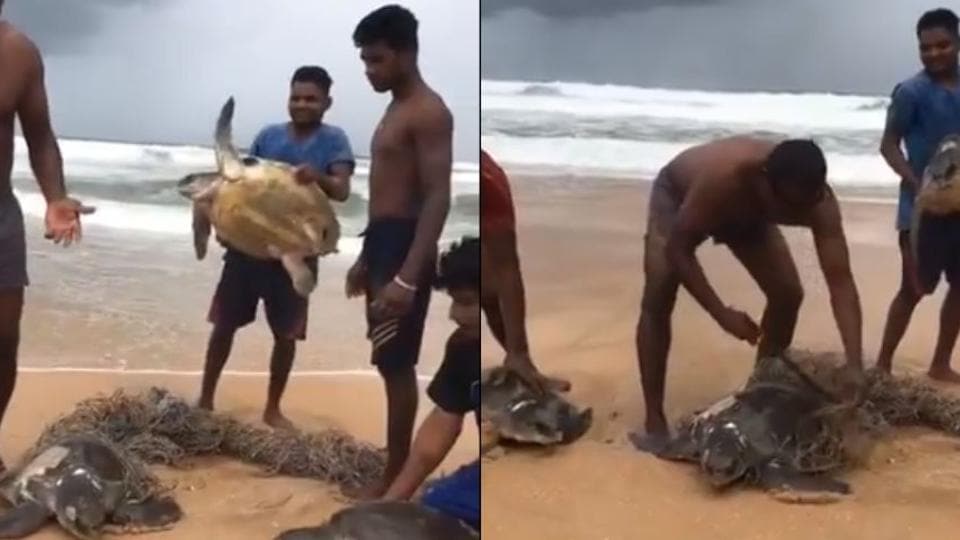
The incident has put the spotlight on how olive ridley turtles – a Schedule I species under the Wildlife (Protection) Act, 1972 – routinely get caught in abandoned fishing nets floating in the Arabian Sea.
Five other olive ridley turtles either got badly injured or died after they were stranded on beaches close to where the viral videos were shot.
“These are not one-off incidents,” said Puja Mitra, co-founder, Marine Wildlife Stranding Network, Ocean Watch, which was set up in 2017.
The organisation enjoys the support of the International Union for Conservation of Nature (IUCN), uses Goa’s extensive network of lifeguards and beach cleaners to rescue stranded and injured turtles and cetaceans such as whales, dolphins, and porpoises.
It also keeps an annual record of the number of such incidents are reported in the state, known for its 105-kilometre coastline.
For instance, on Monday, lifeguards, who man Goa’s beaches, found two sea turtles trapped in an abandoned fishing net – one dead and the other badly injured.
Data, shared by Ocean Watch, showed 340 stranding incidents have been reported from the state over the last three years.
A sea turtle has been washing up every three days on an average over the last three years and the frequency of such incidents increases when the sea is choppy.
Earlier on Sunday, CM Sawant had tweeted the pictures of the viral videos showing the rescue of the four adult olive ridley turtles and praised the “kind gesture”.
“Grateful for the kind gesture of my Goan brothers, making our state a better place to live by respecting the ecosystem,” the CM had tweeted.
However, conservationists have criticised the state government for paying lip-service to the ecological cause and posting videos on social media to attract popular attention.
“Many of the recommendations made to the state government, especially to the forest department, are still a paper tiger. Goa doesn’t have the capacity to handle the high volume of strandings,” Mitra said.
Ocean Watch has urged the state government to set up a sea turtle treatment clinic.
“A quick release with no follow-up action often leads to the death of a turtle,” Mitra said.
Ocean Watch had also proposed to the state government about the recycling of abandoned fishing nets.


