E-Paper



Number Theory: Are lazy workers really holding back growth?
This is the first of a two-part data journalism series which asks whether Indian workers do not work hard enough

 Prefer HTon Google


Is India’s economic progress being held back because workers, especially the younger ones, prefer leisure to work? This is what Narayana Murthy; the founder of Infosys, one of India’s most successful IT companies, suggested to Mohandas Pai in a conversation published on YouTube.

“Somehow our youth have the habit of taking, not-so-desirable habits from the West, and not helping the country. India’s work productivity is one of the lowest in the world…So, therefore my request is that youngsters must say, this is my country, I want to work 70 hours a week. You know, this is exactly what the Germans and Japanese did after the Second World War… they made sure that every German worked extra hours for a certain number of years,” he said. To be sure, Murthy suggested a 60-hour work week in April 2020 to pull the economy out of the contraction that the pandemic was causing.
How correct are such claims? Answering this question requires more nuance than what most social media reactions to the comment have displayed. This two-part data journalism series will try to answer this question from both the supply and demand side perspectives as far as labour is concerned. The first part will examine whether Indian workers prefer an easy life to working hard and the second part will ask whether there are enough employers willing to make a fortune from hard working workers.
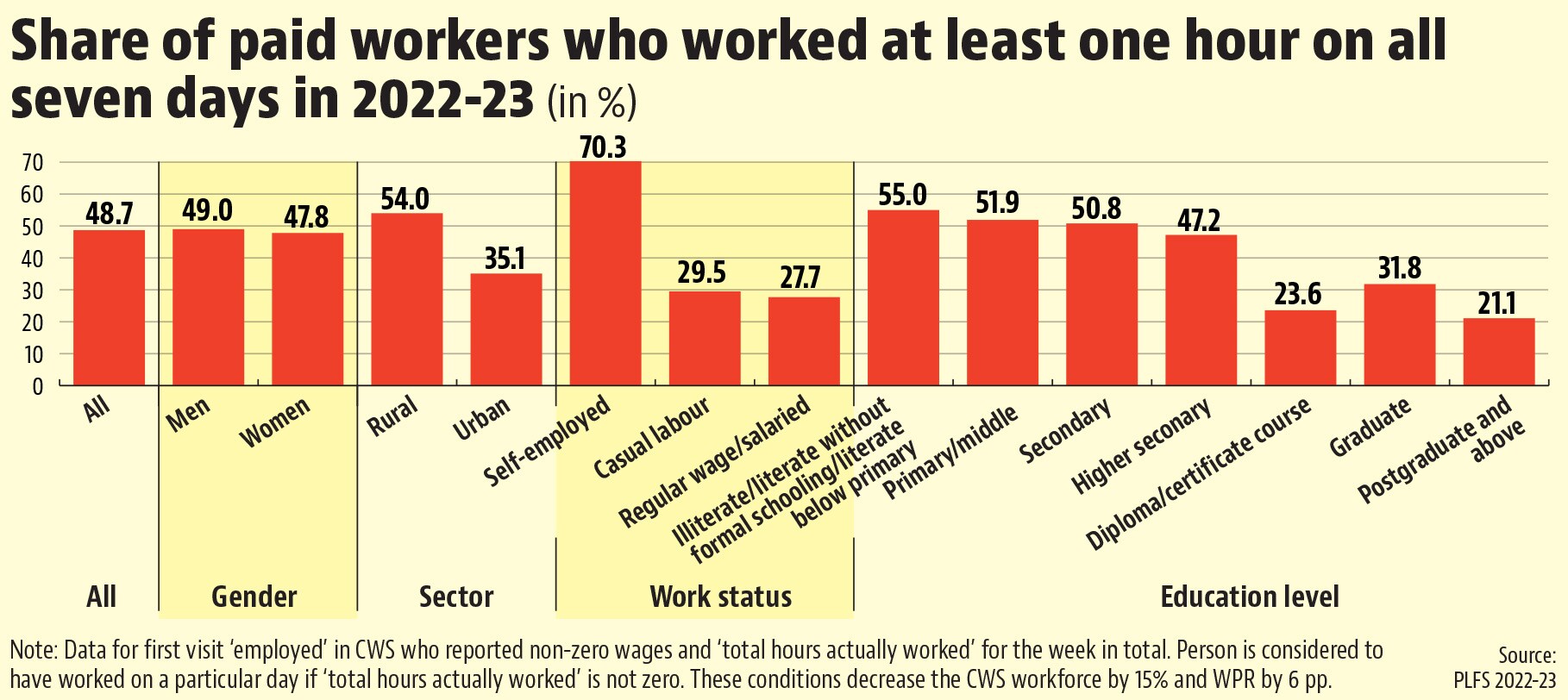
 Most Indian workers are overworked rather than underworkedIdeal work, in modern capitalism, should promise weekly offs. An HT analysis of unit-level data from the Period Labour Force Surveys (PLFS), suggests that this is not the case for a large number of Indian workers. Of the 459 million estimated paid workers reporting at least an hour’s work in the week preceding the 2022-23 PLFS (these caveats are necessary because some workers could be on leave throughout the week), 48.7% reported working all seven days a week, which suggests no weekends. Even among salaried workers, this number is 28%. These numbers need to be read with the fact that 47% of India’s usual salaried workers were not entitled to paid leaves. “Usual” here refers to their economic status in the whole year and not just the survey week. Data on eligibility for paid leaves is not collected in the current weekly status and data on the number of days a person worked in a week is not collected in the usual status.
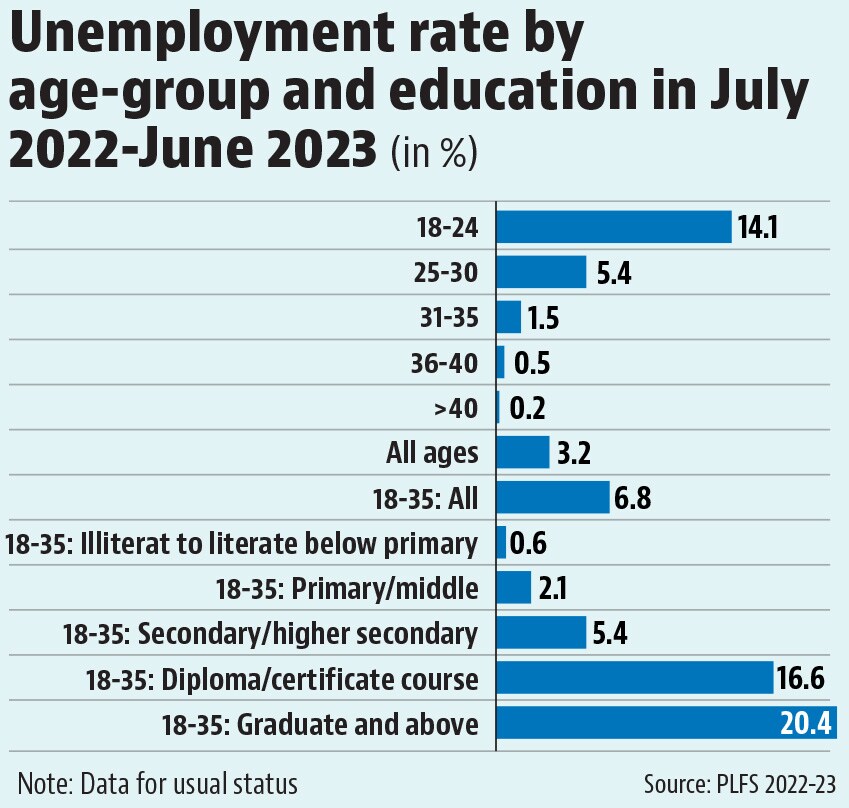
- For young workers, unemployment is a bigger problem…Numbers speak for themselves. Unemployment rate among India’s young workers (18-35 years) was 6.8% in the 2022-23 PLFS, double the overall unemployment rate of just 3.2%. This number increases significantly with an increase in educational qualification of the worker, becoming as high as 20.4% for workers in this age-group with a graduate degree or above.
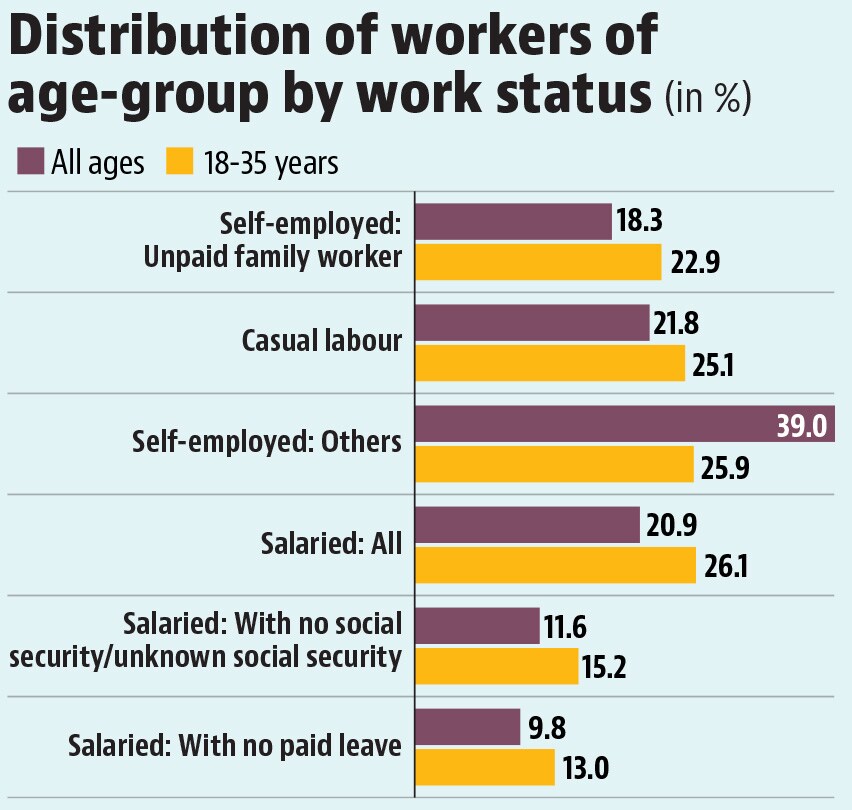
- …and they are willing to sacrifice work-life balance for itAdditional data from the PLFS shows that younger workers are more than willing to take up jobs with fewer perks or more hardship than their older peers to escape unemployment. This is evident if one sees the relative share of young workers in salaried jobs without social security and paid leaves or even self-employment of the unpaid variety.
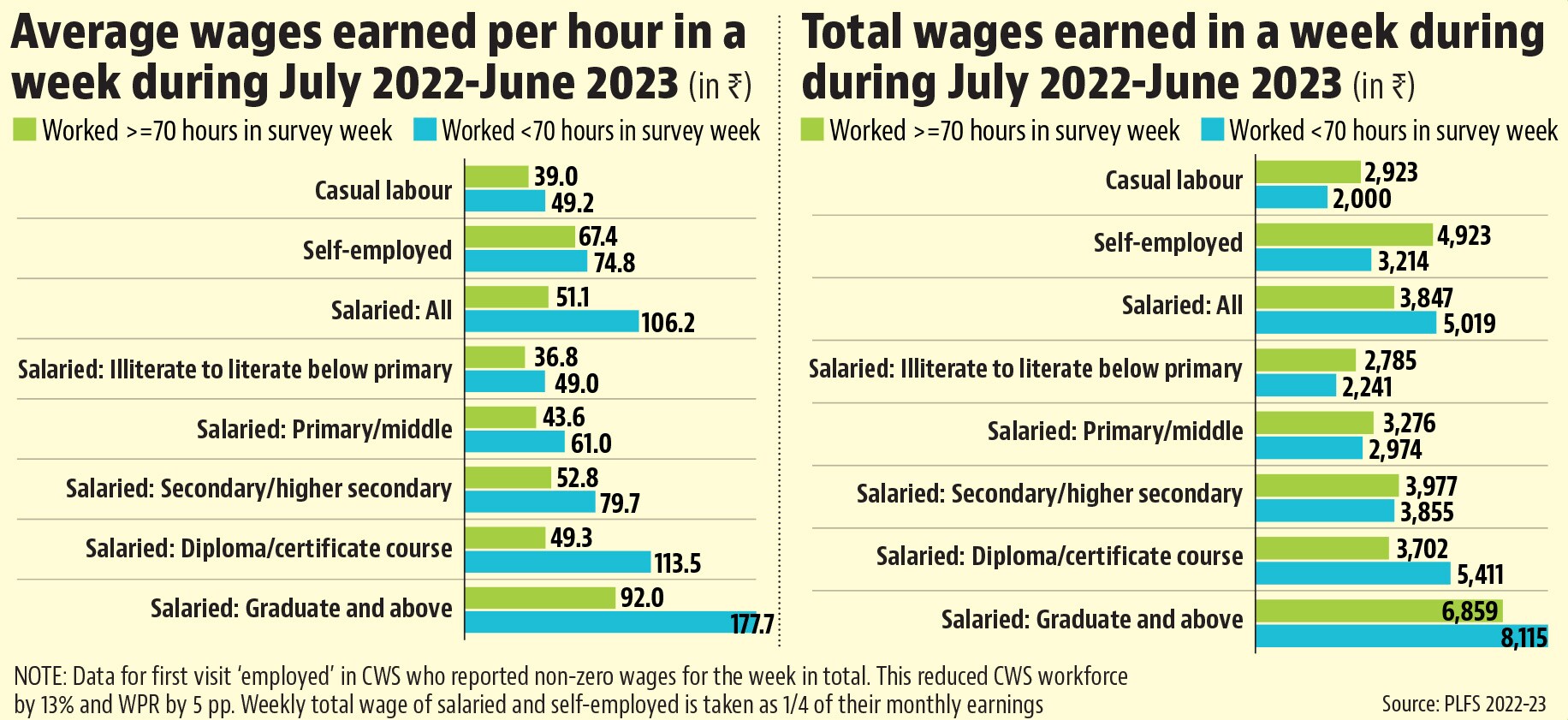
- PLFS also shows that longer hours don’t necessarily mean higher incomesWhether or not a worker works longer hours is more likely a result of the economic rewards than altruistic motives such as nation-building. It is here that PLFS data gives us a real insight. It is the poorly paid worker who seems to work longer to make up for poor hourly rates. Those who work 70 hours or more in a week have a lower average hourly wage rate across casual, self-employed, and salaried workers. While casual and self-employed workers who cross the 70-hour threshold at least end up with higher weekly earnings than their counterparts of the same work status, the salaried do not, the data shows. To be sure, it is eminently likely that PLFS does not capture a small world of workers who work for very long hours and receive very high rewards for it. This is likely to be the world of highly paid executives in the private sector which manifests itself in a sharp increase in the number of highly paid salaried workers in India’s income tax returns. Murthy and his executives at Infosys fall in exactly this category. Why are more young workers not willing to work hard to become a Narayana Murthy? The second part of this series will try and answer exactly this question.