
 E-Paper



Number theory: The state of investment at the end of FY2022-23
One of the most remarkable things in the central government's spending in the last few years has been the rising share of capital expenditure in total spending.

 Prefer HTon Google


The first of this three-part data series looked at the state of private consumption in the Indian economy after fiscal year 2022-23. While consumption accounts for more than half of India’s GDP, it is investment that boosts the long-term growth potential of any economy. This makes it important to track the state of investment demand for any holistic macroeconomic assessment. Here are four charts that look at the state of investment demand in the Indian economy.
1 The importance of investment demand for India
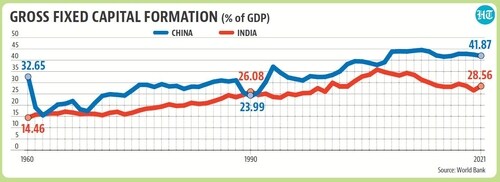
The best way to understand this is to look at the share of Gross Fixed Capital Formation (GFCF) in GDP for India and China. While China has had a higher share of GFCF in GDP than India from 1970 onwards, India's investment spending as a share of GDP was consistently rising before the 2008 crisis and it caught up with the Chinese economy in 2008. This was the time when there were talks of India managing to pull off a sustained double-digit GDP growth.
This trend came to an end in 2008 with the Chinese economy being able to sustain its GFCF share in GDP at 40% of higher while India's investment rate came down gradually, largely a result of the twin balance sheet crisis, which was a result of accumulation of bad loans in the books of both firms and banks. Still, GFCF as a share of GDP has increased in India in the last couple of years which is not shown in the World Bank data. At 34%, the share of GFCF in 2022-23 (as per second advance estimates) is the highest since 2012-13.
2 CMIE numbers suggest that private sector investment revival is far from complete
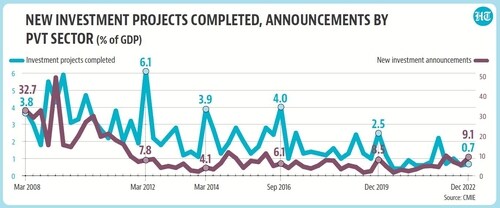
Centre for Monitoring Indian Economy (CMIE) data on new investment announcements and completion of investment projects shows this clearly. New investment announcements are a metric of business sentiment. New investment announcements by private sector, when taken as a share of GDP, fell from around half to one-third of GDP in 2008-09 to less than 5% by 2014. While there was a short period of revival, investment sentiment plummeted again as the Indian economy entered a prolonged slowdown before the pandemic hit. While things have improved slightly in the last few quarters, not only are they nowhere near the past highs, it is too early to see if investment is on a sustained rising trajectory. Data on investment projects completed shows the same trend.
3 This time, it is demand, not finance which is generating headwinds for investments
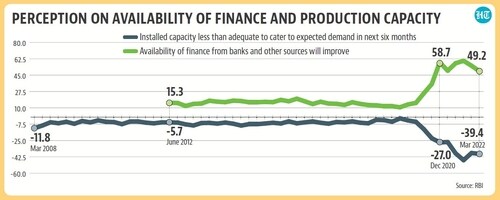
While it is based on a small sample of companies, RBI's Industrial Outlook Survey (IOS) shows this clearly. IOS seeks responses on expectations about production capacity in the next six months and expectations about availability of finance from banks and others sources (excluding overseas sources). A comparison of these two indicators shows that there has been a change in the constraint facing private investment in the Indian economy. While availability of finance has improved significantly in the post-pandemic period, expectations about future demand have seen a considerable weakness as evidenced in a growing sentiment that currently installed capacity is more than adequate. It is the latter which seems to be holding back private investment.
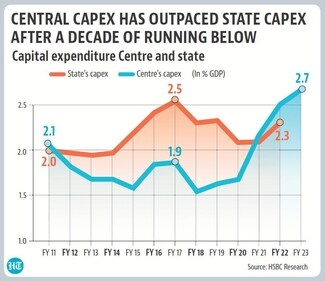
4 The government is hoping to create a virtuous cycle of public-private investment spending
One of the most remarkable things in the central government's spending in the last few years has been the rising share of capital expenditure in total spending. This number has increased by ten percentage points between 2019-20 and 2023-24 (Budget Estimates) to reach more than 22%. The government has repeatedly maintained that the capital spending focus in its budget will give a boost to private investment and create a virtuous cycle of growth. While the logic is perfectly sound and analysts are beginning to take note of the potential benefits of India's infrastructure spending push in the medium to long term, questions remain about its efficacy in giving a boost to private investment in the near term.
Another factor worth paying more attention to is the weakness in capital spending by state governments. A research note released on March 27 by HSBC economists Pranjul Bhandari and Aayushi Chaudhury has drawn attention towards this fact. "In fact, a question confounding the markets in recent times is why the overall investment cycle is not picking up despite the central government raising capex meaningfully. There are several reasons for this, in our view, and one amongst them is the weak state capex. In fact, after a decade of state capex running higher than central capex, the tables turned in FY21", the note says.


