E-Paper



Number Theory: Why the political future of TDP is at a crossroads
Chandrababu Naidu’s arrest by AP Criminal Investigation Department in corruption case raises questions about his and TDP's political prospects ahead of 2024
Updated on: Sep 12, 2023, 18:39:21 IST

 Prefer HTon Google
Share via


Copy link

Andhra Pradesh is one of the few states in India which has simultaneous national and state elections. Here are four charts which explain in detail why Naidu’s arrest could be a crucial moment in Telugu Desam’s and Andhra Pradesh’s political trajectory.
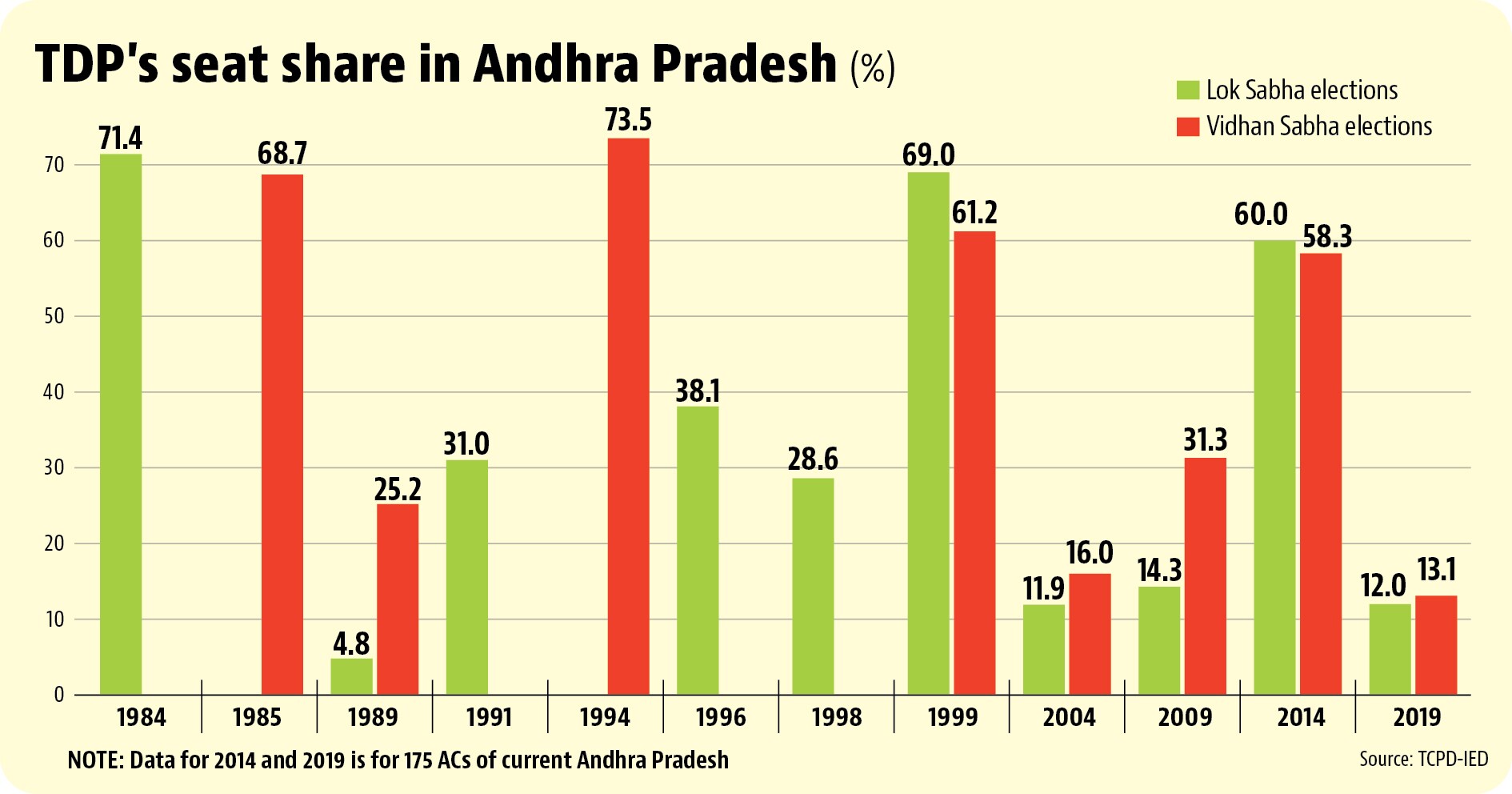
 2019 was TDP’s worst political performanceThe 2024 elections are pretty much a battle for survival for the TDP and therefore Naidu. It managed to win just three out of the 25 Lok Sabha constituencies in the state and 23 out of the 175 assembly constituencies (ACs) in the state in 2019. In terms of seat share and strike rate this was the TDP’s worst ever performance in a state assembly election and the third and second worst performance in Lok Sabha elections (the 1989 Lok Sabha election saw its worst performance) in the state. Our analysis here has looked at undivided Andhra Pradesh up to 2009 and bifurcated Andhra Pradesh from 2014 onwards. To be sure, the Election Commission’s official data does not show the TDP as a winner in the 1983 assembly elections which is the first time its founder N T Rama Rao became the chief minister of the state. This is likely because a lot of TDP MLAs contested as independents and became a part of the party later.
- TDP’s 2019 disaster was a result of Naidu’s bad call of walking out of the NDAThe 2019 Lok Sabha and assembly elections mark the only time the TDP contested an election on its own in Andhra Pradesh. This, despite the fact that the TDP won the 2014 state election as part of the National Democratic Alliance (NDA) after back-to-back losses against the Congress in 2004 and 2009. While contesting alone in 2019 significantly increased the TDP’s vote share in the state compared to 2009, its strike rate and the seat share to vote share ratio plummeted in a big way, making the party a distant second in the state and a politically irrelevant force in national politics. This was a sharp fall in the TDP’s and Naidu’s political fortunes, which reached a peak in 1999 when he did not need an ally for a majority – Naidu had orchestrated a palace coup against his father-in-law N T Rama Rao to capture the party in 1995 – and played a decisive role in taking the Atal Bihari Vajpayee led National Democratic Alliance (NDA) government past the majority mark in the Lok Sabha.
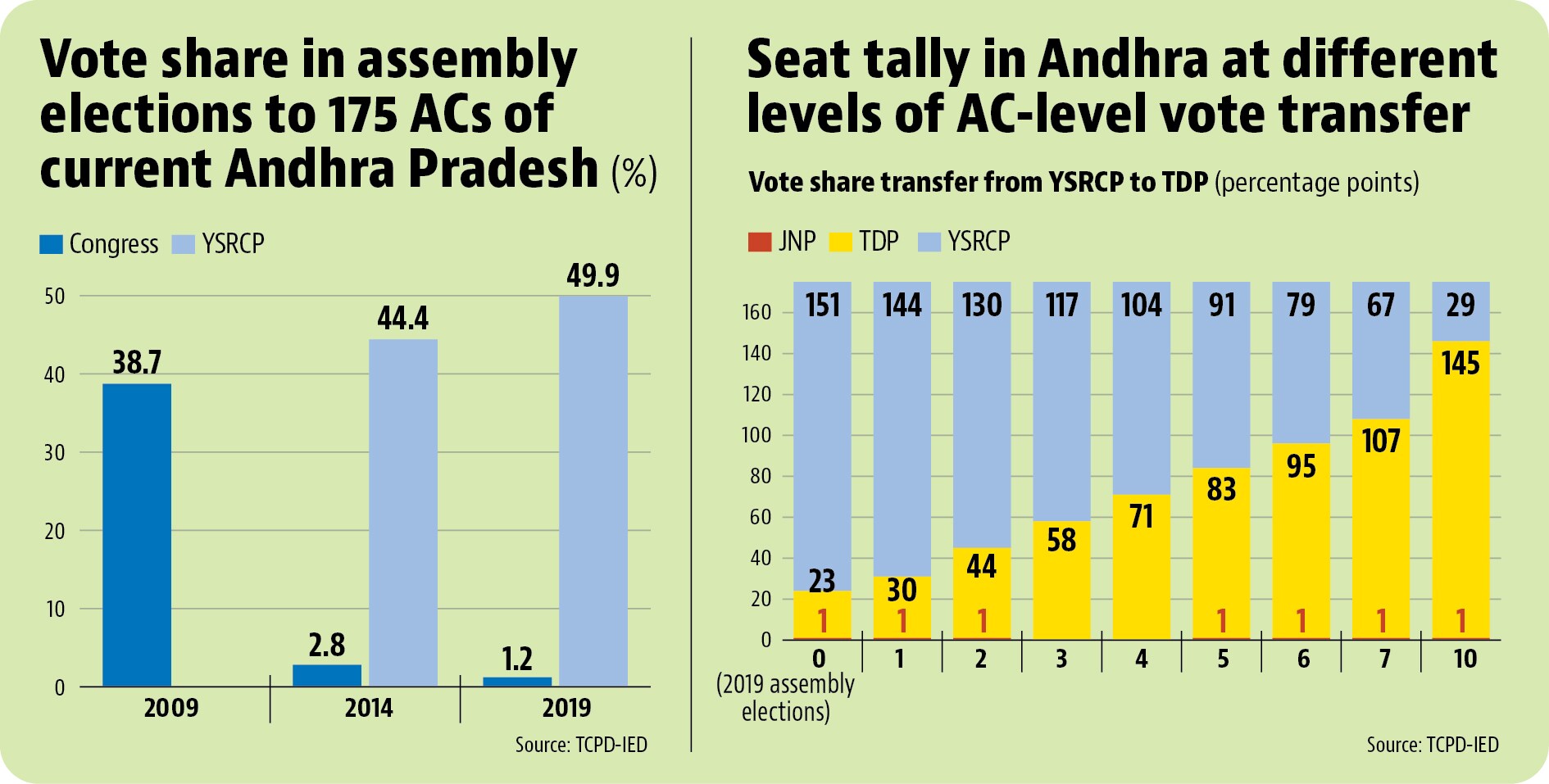
- To be sure, the TDP could still be the primary beneficiary of anti-incumbency in Andhra PradeshThe TDP, so far, has maintained its independent course in Andhra Pradesh politics. Given the fact that it was not even invited to join the INDIA (Indian National Developmental Inclusive Alliance) bloc,it is unlikely that it will be part of some larger coalition against the BJP. Since the TDP’s main adversary in the state, the YSR Congress Party has supported the BJP on crucial legislative issues in the Rajya Sabha – the NDA still does not have a majority in the upper house – it is unlikely that the BJP will be willing to court Naidu and potentially burn its bridges with YSRCP. To be sure, the TDP’s political isolation in the state need not necessarily be a bad thing for it. With a vote share of 39% in the last assembly elections, it is the only opposition party to reckon with in the state, making it the primary beneficiary of any anti-incumbency sentiment against the YSRCP. While the YSRCP had a 11 percentage point lead in terms of vote share over the TDP in the 2019 assembly elections, there is room to argue that its core voter base in the state is much smaller. The YSRCP has primarily usurped the Congress’s organisation and support base in Andhra Pradesh where Jagan Mohan Reddy’s father YSR Reddy led the Congress to back- to-back victories in 2004 and 2009. While a delimitation in 2008 prevents us from comparing ACs in the 2004 assembly elections with the post delimitation phase, vote share comparisons from 2009 onwards show that the Congress never had as big a vote share as the YSRCP had, especially in 2019. Moreover, a simulation of vote swing away from the YSRCP shows that a six percentage point vote share transfer from the YSRCP to TDP could take the latter past the majority mark in the assembly. Naidu being in judicial custody until the elections could lead to two potential outcomes for TDP. Either the party implodes given his centrality in the scheme of things, or it could benefit from a mix of anti-incumbency and sympathy for Naidu. Which of these factors dominates will only be known in May 2024.