E-Paper



Tyeb Mehta’s 2002 painting sold for a record ₹69.1 crore at auction
Jiwarajka’s auction house, Volte Una sold the piece in a new format that only puts up a single work of art for sale

 Prefer HTon Google


A 2002 acrylic on canvas by modernist Tyeb Mehta was sold at auction for ₹69.1 crore, setting a record for the artist. The sum surpassed the ₹61.80 crore achieved for Trussed Bull at a Saffronart auction in Mumbai in April 2025.
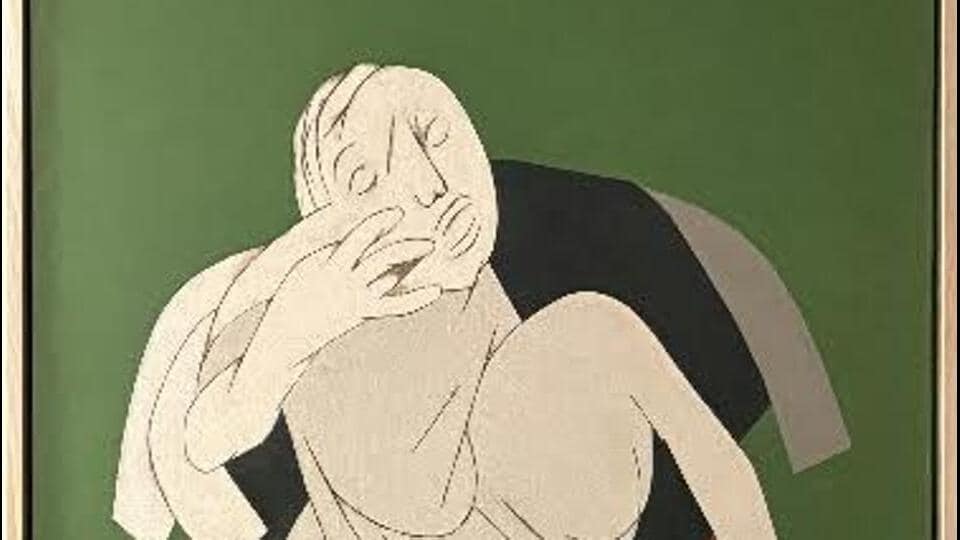
“A Tyeb Mehta at ₹69.1 crore is a world record for the artist, and among the highest Indian artworks sold at auction. It shows what Indian modernism is worth when a museum-grade work meets serious buyers.
“Wealthy Indians are finally realising that art is a serious asset class, and store of value,” said Tushar Jiwarajka, the auctioneer who made the sale.
Jiwarajka’s auction house, Volte Una sold the piece in a new format that only puts up a single work of art for sale. The single-lot format focuses on works that are not readily available in the market and collectibles that may surface only once or twice over several years.
Jiwarajka showed the works to collectors in Mumbai, New Delhi, New York, Dubai and London before opening the bidding on October 11 for a 12-hour window. The bidding started at ₹33 crore, Jiwarajka said. The sum includes a buyer’s premium of 15%.
“One of the earliest Rickshaw Pullers that he made,” said art critic Uma Nair, “was in 1961. It was a monochromatic work and sold at a Christie’s sale in 2004. The solitary figure was a symbol of labour as well as alienation. Tyeb never let us forget that what we are looking at is a sign of bondage. Tyeb believed that human struggle deserved to be at the core of his practise. This sensitivity of the artist resonates even today.”
Mehta, a modernist Indian painter, was a contemporary of Maqbool Fida Husain, Akbar Padamsee, Francis Newton Souza and Sayed Haidar Raza among others, and an early member of the Progressive Artists Group formed out of the JJ School of Art in 1947.
A witness to the gory realities of Partition on the streets of what was then Bombay, Mehta’s preoccupation with the human condition, and the violence that is part of our social fabric, permeated many of his early works. His style and subjects evolved over the decades, moving from expressionism in his early works to the minimalism of his later pieces.
At the turn of century, Mehta’s 1995 work, Celebration, sold at auction for ₹2.19 crore; a few years later, his 1997 work, Mahishasura, sold for ₹10.9 crore, making him the first modernist painter to achieve those sums in a public auction.
Since then, Indian painters have crossed the ₹100-crore mark: earlier this year in April, an 1890s Raja Ravi Varma oil painting, Yashoda and Krishna sold for ₹167.2 crore, while last March, an MF Husain work from 1954 fetched ₹118 crore at a Christie’s sale.
Mehta’s latest record-breaking work revisits the figure of a rickshaw puller whom Mehta has painted several times starting in the 1960s. However the figure itself, as well as Mehta’s use of colours, and utilisation of space on the canvas changed over the decades making each work unique and distinctive.
“The rickshaw is not a simple means of transport but a sign of bondage, and the slave sitting near it is naked Man, staring into meaningless space, enduring his existence,” Nissim Ezekiel wrote of Mehta’s 1961 Rickshaw Puller, when it was exhibited at the Kunika-Chemould Art Centre in Mumbai in 1970.