
 E-Paper



Odisha warns farmers to be ready for locust attacks beginning June
He said farmers residing close to Chhattisgarh, have been asked to remain alert and take immediate steps like spraying 5% Neem Seed Kernel Extract 200 litres per acre of crops and vegetation after sunset as a precautionary measure.

 Prefer HTon Google


With farmers in states like Rajasthan battling swarms of locusts invading their farmlands, the Odisha government on Sunday asked its farmers to get ready for a similar attack in June.
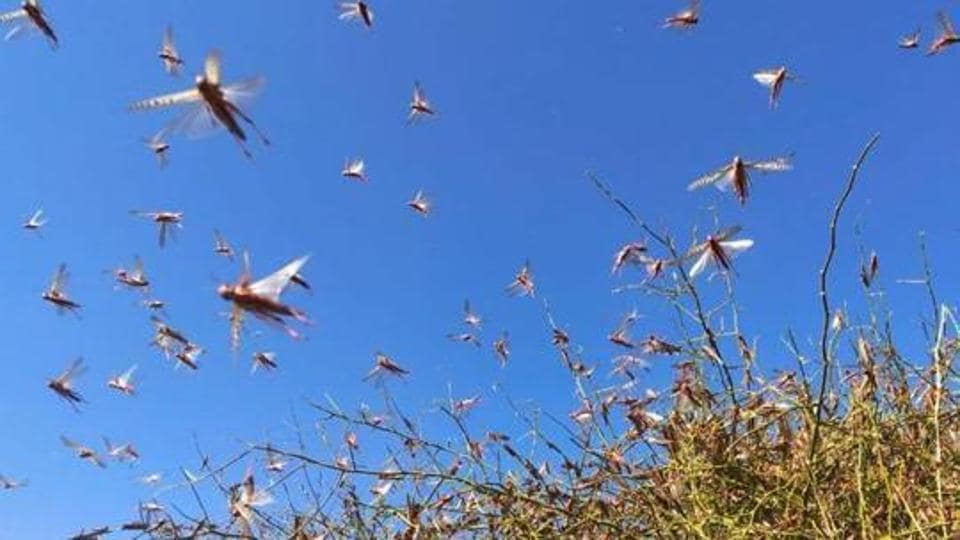
“As informed by the Centre, the locust swarm will invade western Odisha districts like Bargarh and Sambalpur in June and cause extensive damage to trees and other vegetable plantations. Adequate steps will be taken to create awareness among farmers and soon a SOP will be issued. The movement of locusts will be monitored at district and block levels,” Dean of the Odisha University of Agriculture Technology, Lalit Mohan Gadnayak said.
“It has been decided that a team of entomologists of the OUAT and the Central Rice Research Institute at Bidyadharpur in Cuttack will be formed. The team will issue the SOP for farmers to save their crops,” he said.
Gadnayak, however, said the locusts will leave the state with the onset of rain.
He said farmers residing close to Chhattisgarh, have been asked to remain alert and take immediate steps like spraying 5% Neem Seed Kernel Extract 200 litres per acre of crops and vegetation after sunset as a precautionary measure.
If farmers spot locusts swarming towards their farmland, steps like beating utensils can be taken in order to stop the swarms. Since locusts stop movement and settle on vegetation after dusk, farmers can hit branches of trees and crops to remove the locusts, collect and dispose of them by setting fire to the pests at a safe place.
India is currently, seeing the worst locust attack in over 7 decades as locust swarms from Pakistan now threaten to devastate crops and vegetables over thousands of hectares in states like Rajasthan, Punjab, Uttar Pradesh, Haryana and Madhya Pradesh. Rajasthan is now the most affected state.
The desert locust is a species of locust, a swarming short-horned grasshopper that devour everything in their path. As per entomologists, the current swarm of locusts contains immature locusts that could gorge on the crops before getting ready for mating.


