E-Paper



On Diwali eve, Centre slashes petrol price by ₹5, diesel by ₹10
From Thursday, the price of petrol will come down from the current rate of over ₹110 a litre in Delhi to about ₹105. The diesel rate will be reduced from over ₹98 per litre to about ₹88

 Prefer HTon Google


The Union government on Wednesday announced reduction in central levies on petrol by ₹5 a litre and diesel by ₹10 a litre from Thursday, providing major relief to consumers amid spiralling fuel prices, even as it urged states to further bring down the rates.
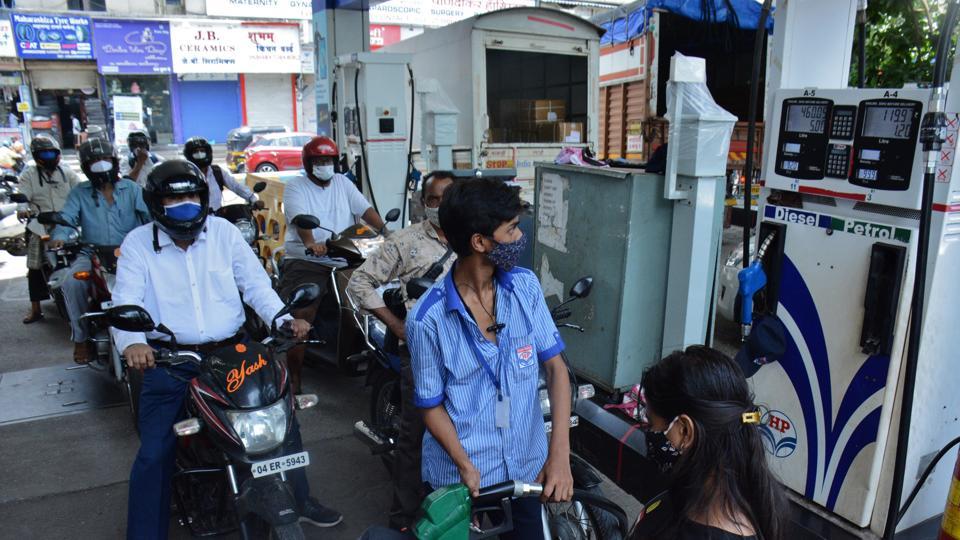
From Thursday – when Diwali will be celebrated – the price of petrol will come down from the current rate of over ₹110 a litre in Delhi to about ₹105. The diesel rate will be reduced from over ₹98 per litre to about ₹88. To be sure, there may be minor variations depending on global oil prices and if there are any additional cuts by state governments.
“The decision was announced immediately after the Prime Minister gave his nod to providing relief to consumers, tame inflation and boost growth,” an official with direct knowledge of the matter said, asking not to be named.
Announcing the decision on Wednesday evening, the Union finance ministry said: “Government of India has taken a significant decision of reducing Central Excise Duty on petrol and diesel by ₹5 and ₹10 (per litre) respectively from tomorrow.”
“States are also urged to commensurately reduce VAT [value-added tax] on petrol and diesel to give relief to consumers,” it added.
Central excise on petrol, which is currently ₹32.90 per litre, will be reduced to ₹27.90 on Thursday, and the levy on diesel will be reduced from ₹31.80 to ₹21.80, an executive in state-run oil marketing company said on condition of anonymity. “As these taxes are specific and not ad valorem, the entire excise duty reduction will be immediately passed on to the consumer,” he said.
Taking cue from the Centre, Assam, Goa, Karnataka and Tripura governments announced ₹7 per litre reduction in state levies (value-added tax) with immediate effect. Bihar also announced ₹1.30 per litre reduction in VAT on petrol and ₹1.90 on diesel.
The increase in fuel prices was criticised by opposition parties, which linked the decision to recent bypoll results in which the Opposition made inroads in some key areas, and demanded that the government reduce excise duty further.
Domestic prices of petrol and diesel have been surging to record levels almost every day since October 1 because of two key reasons – surging international oil prices due to prolonged supply squeeze by producers’ cartel, and high incidence of central and state taxes on the two fuels. On Wednesday, petrol was being sold in Delhi for ₹110.04 and diesel for ₹98.42.
The reduction is the highest ever in excise duty and rolls back a part of the ₹13 and ₹16 per litre increase in taxes on petrol and diesel effected between March 2020 and May 2020 to avoid passing on to consumers the sharp fall in international oil prices.
“I thank PM Narendra Modi for the significant reduction in Excise Duty on Petrol & Diesel. A big relief for fuel consumers, particularly our farmers just ahead of Rabi season. The states should add to this celebration by reducing VAT on fuel to give further relief to consumers,” Union petroleum minister Hardeep Singh Puri tweeted.
Through 2020, as global crude prices plunged (below $20 a barrel in April last year), the central government raised excise duty on fuel to shore up its finances. States, too, followed suit as their revenues were hit on account of the Covid-19 pandemic. As a result, the central excise and state VAT (which is ad valorem) on petrol and diesel went up to 53% and 46.9% of their respective retail prices.
State-run oil companies are expecting petrol and diesel rates to go down further if the producers’ cartel – Organisation of the Petroleum Exporting Countries and its allies (together known as OPEC+) – on Thursday decides to increase output to calm oil prices under international pressure. At Glasgow on Tuesday, US President Joe Biden blamed OPEC for the current surge in oil and gas prices because of supply squeeze.
Ahead of the OPEC+ meeting and a jump in the US crude stockpile, international oil prices slumped. Benchmark Brent crude fell 3.19% at $82.02 per barrel in the Wednesday session.
“If OPEC+ decides to raise output, international oil prices will fall further and retail prices of petrol and diesel could be reduced by more than ₹5 and ₹10 [per litre respectively]. Public sector oil marketing companies will be happy to pass on the benefit of falling oil prices to the consumers immediately as government is also keen to check inflation,” the official quoted in the first instance said.
The official said the fiscal impact of the excise duty reduction would be about ₹50,000 crore in the current financial year, which could be compensated to a great extent by robust Goods and Services Tax (GST) collections. GST revenue in October surged to ₹1.3 lakh crore, the second highest since the new tax was launched in July 2017. Even the highest GST collection was reported in April this year at ₹1.41 lakh crore and the trend is expected to continue in the festive months of November and December on rapid economic recovery after the second wave of the Covid-19 pandemic, and increased compliance.
“The reduction in excise duty on petrol and diesel will also boost consumption and keep inflation low, thus helping the poor and middle classes. Today’s decision is expected to further spur the overall economic cycle,” the finance ministry said in its statement.
In recent months, crude oil prices have witnessed a global upsurge. Consequently, domestic prices of petrol and diesel increased in recent weeks, exerting inflationary pressure, it said. “The world has also seen shortages and increased prices of all forms of energy. The Government of India has made efforts to ensure that there is no energy shortage in the country and that commodities such as petrol and diesel are available adequately to meet our requirements,” it added.
“The reduction in excise duty on diesel will be double that of petrol. The Indian farmers have, through their hard work, kept the economic growth momentum going even during the lockdown phase and the massive reduction in excise on diesel will come as a boost to the farmers during the upcoming Rabi season,” it said. The move is also to give a further fillip to the economy, it added.
While petrol is above ₹100-a-litre-mark in all major cities, diesel has crossed that level in more than one-and-a-half dozen states. The total increase in petrol price since the May 5, 2020, decision of the government to raise excise duty to record levels now totals ₹38.78 per litre. Diesel rates have during this period gone up by ₹29.03 per litre.
The Opposition, however, said more needed to be done.
“After losing 14 bye elections & 2 Lok Sabhas, reducing Petrol-Diesel price by ₹5 & ₹10 is tom-tommed as ‘Diwali Gift’ of Modi Ji!” tweeted Congress spokesperson Randeep Surjewala.
Trinamool Congress leader Derek O’Brien said: “Happy Diwali for Government of India. Last year, excise duty on petrol INCREASED by 65% but now decreased by 15%. Between Apr-Sept ‘21, Govt’s collection from excise on petrol ROSE 33% compared to last year. Collection of excise is 79% more than pre-Covid levels.”