E-Paper



On Indo-Pak border, villagers catch crane with tracker. Not for spying, BSF tells them
WII scientist Dr R Suresh Kumar said they have not been able to understand why the crane did not fly back to Kazakhastan and Russia. The crane caught by villagers was in Vaav taluka of north Gujarat recently from where it flew to Barmer about 10 days ago


Ahmedabad: A common crane was caught by villagers in Rajasthan’s border district of Barmer after they spotted a device on its leg but the Border Security Force later clarified that the tracking device was attached by scientists at Wildlife Institute of India (WII), people aware of the matter said.
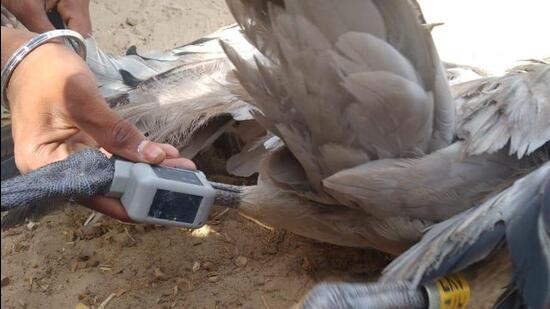
“The villagers informed the local police and BSF about the crane. They thought it was for spying,” a BSF officer said, adding that the WII researchers in Ahmedabad will reach Barmer to take custody of the crane.
The bird, code-named ‘Lothal’, was tagged by WII scientists at Nal Sarovar, a Ramasar site near Ahmedabad, a few months ago. The satellite tagging gives an insight into the path the bird takes on its journey from its breeding ground in Kazakhstan and Russia to the wintering ground in Nal Sarovar area.
WII has satellite tagged six common cranes, of which one of them has stopped transmitting data due to some reason.
The cranes tagged by WII use the Central Asian flyway and going by the number of common cranes and demoiselle cranes flocking at various parts of the state, Gujarat emerges as an important wintering destination in the Indian subcontinent for the cranes, according to WII scientist Dr R Suresh Kumar who heads the study.
What has baffled Kumar is that the bird has not flown back to its breeding ground.
“All the other four cranes that we tagged and are still transmitting have reached Kazakhastan and Russia. It is very late for ‘Lothal’ to have stayed back. We have been tracking it on a daily basis. It was in Vaav taluka of north Gujarat recently from where it flew to Barmer about ten days ago. We thought it would now leave for its long migration journey, but it did not. We were told by some locals at Nal Sarovar that some flocks stay back. I found it tough to believe then. But now my own tagged bird is refusing to leave,” said Kumar adding that more data and research needs to be done about why this happens.
Lothal is healthy and was in a group of about 10 other common cranes that have not migrated so far this year. The cranes arrive in October in Gujarat and begin to migrate to their breeding grounds by March.
“Cranes move in flocks of large or isolated populations and every year about four lakh common and demoiselle cranes flock to Gujarat,” according to Uday Vora, a retired chief conservator of forest and presently a member of the National Wetland Committee. The bird feeds on rhizomes that are found in plenty in the region.
Kumar of WII said that a member of his research team Harendra Bariya is on his way to get Lothal from the villagers and they will then decide on the next course of action after examining the bird.
In October 2020, a common crane that was satellite tagged in March 2020 by the Wildlife Institute of India (WII) near Nalsarovar returned from her breeding site in Kazakhstan. In doing so, the bird named ‘Vadla’ after the village near the Nalsarovar Ramsar site where she was tagged, covered 4,300km over 12 days. This was the first of the six cranes that WII has tagged.