E-Paper



Over 2 million students appear for NEET-UG 2026 re-exam amid heightened security
Of the 2,279,743 candidates registered for NEET-UG 2026, as many as 2,275,011 had downloaded admit cards for the May 3 exam and 2,205,035 eventually appeared.

 Prefer HTon Google


More than 2 million medical aspirants appeared for the National Eligibility-cum-Entrance Test for Undergraduate (NEET-UG) 2026 re-examination on Sunday across 5,440 centres in India and 14 abroad under extensive security arrangements, with officials closely monitoring the process following concerns of a leak raised after the original examination was held on May 3.
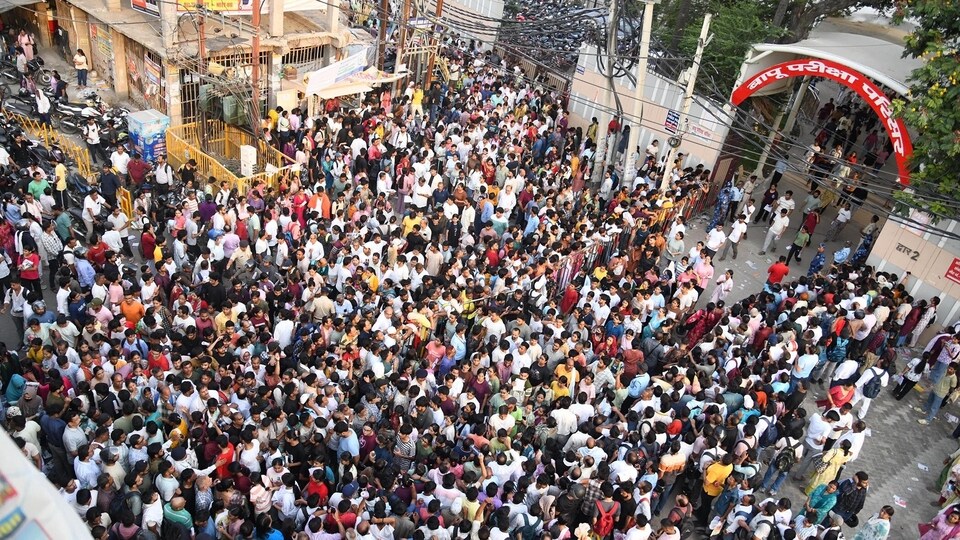
The National Testing Agency (NTA) announced the re-examination on May 15 after receiving an email on May 8 alleging a leak and noting overlaps between a circulated guess paper and the May 3 question paper. The Central Bureau of Investigation (CBI), probing the alleged leak, has arrested 13 people so far.
Of the 2,279,743 candidates registered for NEET-UG 2026, as many as 2,275,011 had downloaded admit cards for the May 3 exam and 2,205,035 eventually appeared, translating into an attendance rate of 96.92%.
NTA did not release the exact number of candidates who downloaded admit cards or appeared for the June 21 re-examination. “Nearly 2.1 million admit cards were downloaded and over 2 million candidates appeared for the examination today,” a senior NTA official said.
Commenting on the drop in the number of candidates appearing in the June 21 re-exam compared to the May 3 examination, NTA director general (DG) Abhishek Singh said, “A slightly smaller number of students appeared this time, which is natural because many students take admission in other colleges in other courses.”
Singh said several state governments and government departments extended full support to the NTA, which was able to conduct the exam with full security as well as convenience for the students. When asked if NTA received any leak-related emails or complaints this time, Singh said, “Not so far. We are 100% confident about the whole process this time.”
Commenting on the expected results date, the DG said, “Let us start the evaluation process, then we will give a date. See, we conducted the exam in 37 days. We compressed the entire exam cycle. So the results will also be announced faster than what one would expect.”
‘Physics part was tough’
The re-examination question paper, comprising 45 questions each of Physics and Chemistry and 90 questions of Biology (45 each from Botany and Zoology), was administered in 13 languages, including Hindi and English.
Candidates who appeared for the examination at various Delhi centres said they found Physics to be the toughest of the three sections and spent most of their time on that section.
Nauman Ali, 21, who gave his third attempt, said, “Biology was pretty easy, and Physics was comparatively tougher and lengthy as well compared to the last time. It took me over an hour to solve Physics questions.”
Mayuri Kumari, 19, who gave her second attempt, said the paper was moderately difficult. She added that the Physics section was tough but largely based on straightforward, formula-driven questions. “The past month has been really stressful, but I am glad that my paper went well. Physics was hard, but questions were direct, formula-based,” she said.
Commenting on the difficulty level of the paper, Neeraj Kumar Chaudhary, Physics faculty at PhysicsWallah (PW), said the Physics section was tough but manageable for students who had prepared and practised well. “The Physics section was moderately challenging, yet remained manageable for well-prepared students. The questions were thoughtfully designed to assess students’ conceptual understanding and application skills.”
Nabin Kaarki, National Academic Director-Medical at Aakash Educational Services Limited (AESL), said Physics was the toughest and most time-consuming section, as application-based numerical problems created significant time pressure.
Extensive arrangements
NTA said that “extensive arrangements” were made for all candidates, including more than 10,000 people with disabilities (PwDs) and “special arrangements” were put in place for around 81 candidates with medical conditions, among them a child who had been in a road accident and a child undergoing chemotherapy, who were determined not to miss an exam they had prepared for years.
NTA said that around 700,000 officials—police teams, observers and examination staff—were mobilised across India to conduct this examination.
Congress leader and head of Parliament panel on education Digvijaya Singh told reporters in Indore, “The NEET exam was conducted peacefully today, and I am pleased about that. Even in the previous exam, it came to light a few days later that the paper had been leaked. Let’s wait a few days and see what happens…”
‘Facilities insufficient’
However, some students missed their test after arriving late at the examination centres in Bengaluru and Delhi. Entry at the examination centres started at 11 am and last entry was allowed till 1.30 pm. The exam was conducted in pen-and-paper mode in a single shift from 2 pm to 5.15 pm (IST).
As students appeared for the NEET examination, parents across several examination centres in Delhi waited outside for hours. While the government set up cooling zones at some centres with seating facilities, coolers, and access to drinking water, parents said the arrangements were insufficient and could not accommodate everyone.
During a visit by HT to examination centres in RK Puram and Mayur Vihar, several parents were seen sitting under trees, cross-legged on the grass, on folded sheets of paper, and on staircases while waiting for their wards to finish the exam. “The government’s initiative to set up cooling zones is good, but the capacity is limited and can accommodate only around 30 to 35 parents. At most centres, over 100 students appear, so the arrangements should have been planned keeping that number in mind,” said Ayesha Monina, 48, who accompanied her 20-year-old daughter to the test centre.