
 E-Paper



Parliament session ends amid impasse on key issues
Parliament’s winter session ended on Friday, four working days ahead of schedule, after a number of opposition leaders demanded adjournment citing Christmas and the upcoming festive season.


Parliament’s winter session ended on Friday, four working days ahead of schedule, after a number of opposition leaders demanded adjournment citing Christmas and the upcoming festive season. The session saw limited government business and the introduction of only seven of the 16 non-financial bills from the government’s agenda amid repeated disruptions over the Opposition’s demand for a debate on India-China ties.
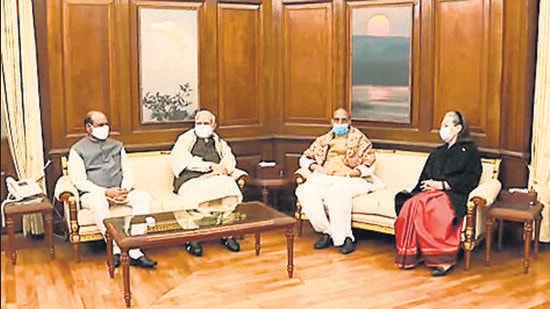
The Lok Sabha passed a rare resolution against drug menace, the Opposition frequently protested in both Houses after a clash between Indian and Chinese soldiers in Tawang on December 9 and Bharatiya Janata Party’s Kirodi Lal Meena introduced a private member’s bill on implementation of the uniform civil code in the Rajya Sabha with the ruling dispensation’s support.
Union parliamentary affairs minister Pralhad Joshi later announced, “The productivity of Lok Sabha and Rajya Sabha were approximately 97% and103%.”
The winter session lasted for 13 sittings spread over 17 days. The highlights of the session include the rare Lok Sabha resolution against drug menace, and the Upper House being able to utilise all of its time in the first session under chairman Jagdeep Dhankhar.
This is, however, the eighth session in row since March 2020 that has been cut short. Originally planned till December 29, the winter session lost four days in early adjournment. While the government maintained that Opposition pressure was responsible for the early closure, key Opposition leaders claimed the government didn’t have much business for the session.
Joshi argued “essential government business” was complete and Business Advisory Committees (BACs) of both Houses of Parliament recommended adjournment. “BACs took cognisance of demand and sentiments of Members of Parliament across party lines for Christmas/Year end celebrations,” added Joshi.
During the session, nine bills including two appropriation bills were introduced. The Lok Sabha cleared a total of seven bills and the Rajya Sabha approved nine. Of the seven non-financial bills brought to Parliament, four related to amendments in the Constitution (Scheduled Tribes) Order. The other three included the the Multi-State Co-operative Societies (Amendment) Bill, the Jan Vishwas (Amendment of Provisions) Bill and a bill to further repeal and amend outdated laws.
In the last winter session, the government had introduced 12 bills, and 10 were cleared by both Houses.
Nine pieces of legislation were approved by both Houses during this session. The winter session was one of the shortest in 17th Lok Sabha. According to the PRS Legislative Research, 36 planned sitting days have been lost due to early adjournment in this Lok Sabha.
In his press conference, Joshi focused on two key bills—the Multi-State Co-operative Societies (Amendment) Bill, 2022 and the Jan Vishwas (Amendment of Provisions) Bill, 2022— and said both were sent to joint committees of the respective House. Two key debates — on global warming in the Rajya Sabha and drug menace in the Lok Sabha – and the Opposition’s relentless protests for a debate on the Indo-China border situation capped the prime agenda for the non-government benches. 119 members participated in the drug menace debate that spanned 15 hours. In the Rajya Sabha, a “short duration discussion” on the “serious effects of global warming” engaged 17 members for about three hours.
Opposition leaders, led by the Congress, protested both inside and outside Parliament, particularly in the Rajya Sabha, and tried to push dozens of adjournment motions for a debate on the border situation, but the government didn’t budge with defence minister Rajnath Singh reading out statements in both Houses.
Dhakhar described his first session as “of learning and enriching experience” but said it also had “jolts, hiccups and aberrations.” As Rajya Sabha faced regular protests, Dhakhar said in his speech that people “cherish the hope and expectation that we will work towards realising their aspirations and fructify their dreams.” He quoted BR Ambedkar that unless lawmakers realise responsibilities and shoulder the task of looking after the welfare and good of the people, Parliament will be treated by the public with utter contempt.
“It is through this prism that we have to calibrate our performance,” he added.
Lok Sabha Speaker Om Birla said “differences of views of political parties on issues are natural” in a functional democracy but “they need to be reflected in the form of healthy debates.”
“Agreements and disagreements on issues may be reflected in debates and not through disruption,” he reiterated, and argued that smooth conduct of the House is the responsibility of all stakeholders.
“The House must be run in accordance with the collective will and consensus. the members not to resort to disruptive tactics in the House and participate in the House proceedings to highlight people’s issues and to strengthen democracy,” Birla added.
In the Rajya Sabha, Dhankhar said 82 starred questions were answered,31 private members bills were introduced and 36 reports were presented by eight department-related parliamentary standing committees. “Disruption, resulting in loss of precious time of 1.46 hours and exhibition of unacceptable conduct, plagued the proceeding in some measure. Disruption as expression mechanism is antithetical to grace, decorum and sublimity of this solemn platform,” he said.
“I urge all of you to deeply reflect and seek reality check of the people on our performance,” he added.


