
 E-Paper



PM Modi flags off Namo Bharat RRTS, Meerut Metro | Video
The project, consisting of both the Namo Bharat RRTS and the Meerut Metro, was developed at an estimated cost of ₹30,274 crore.

 Prefer HTon Google


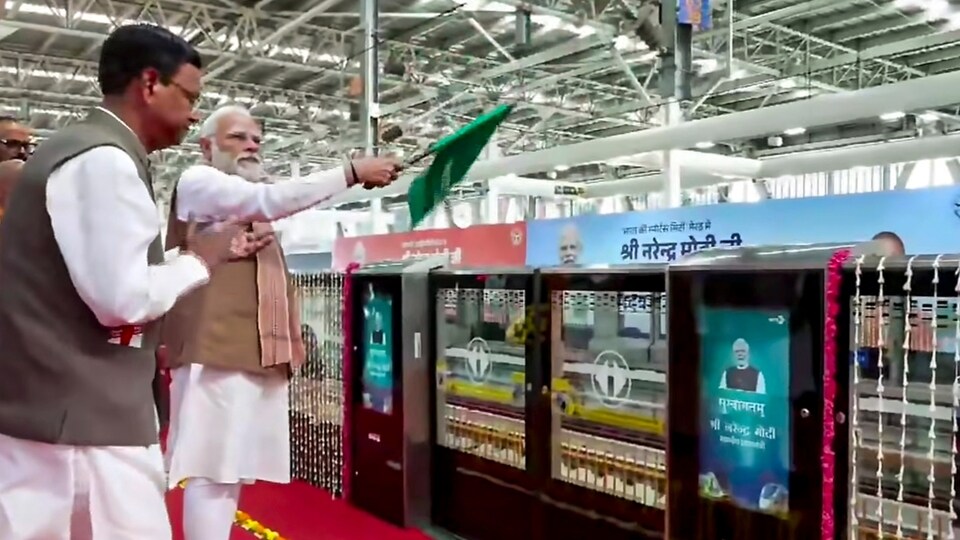
Prime Minister Narendra Modi flagged off the much-anticipated Namo Bharat Regional Rapid Transit System (RRTS) and the Meerut Metro on Sunday afternoon, February 22. Uttar Pradesh chief minister Yogi Adityanath was present with him during the inauguration.
The project aims to enable faster connectivity between Delhi and Meerut and make the national capital more accessible for people from nearby districts as well.
PM Modi flagged off the project from Shatabdi Nagar Namo Bharat Station.
PM Modi then took a ride in the newly-launched Meerut Metro till Meerut South Station and interacted with school children and officials. Later, he will also inaugurate and dedicate to the nation various development projects worth around ₹12,930 crore in Meerut.
Also read: 8 held for plotting terror attack in India, had put up ‘Free Kashmir’ posters
The Prime Minister dedicated the entire Delhi-Meerut Namo Bharat corridor to the nation and also inaugurated the remaining sections of India's first Namo Bharat Regional Rapid Transit System (RRTS). These include the 5 km section between Sarai Kale Khan and New Ashok Nagar in Delhi and the 21 km section between Meerut South and Modipuram in Uttar Pradesh.
Also read: Man pours sanitiser on live-in partner’s private parts, tries to set fire in Gurugram: Report
After flagging off the RRTS, the Prime Minister highlighted progress in the expansion of the metro network in the country. “Before 2014, metro expansion in India was very slow. During the Congress government, metros operated in only five cities. Under the BJP government, metros are now running in over 25 cities,” PM Modi said, adding that India had also built the third-largest metro network in the world.
“Over the past 10-11 years, metros have reached dozens of cities, as the BJP government aims to provide citizens with convenient, high-speed, and pollution-free transport facilities....” PM Modi said. He further stated that the metro was a safe and convenient means of travel.
“....A little while ago I travelled on the Meerut Metro…During the journey, I interacted with many school and college students and other passengers. People recalled the old days, and especially women passengers told me that a few years ago, the entire route would be deserted by evening, creating an atmosphere of fear,” the Prime Minister said, adding that the law and order situation had improved. “People also have a convenient and safe means of travel,” PM Modi said.
About the project
The project, consisting of both the Namo Bharat RRTS and the Meerut Metro, was developed at an estimated cost of ₹30,274 crore and spans around 82.15 km, including nearly 70 km of elevated track and 12 km underground.
Also read: From AI to ancient wisdom, Modi’s Mann Ki Baat reflects a changing India
Until now, rapid rail services were operating only between Ashok Vihar and Meerut South. With this inauguration, the trains will now run from Modipuram to Sarai Kale Khan and cover the approximately 82-km stretch in just 55 minutes.
The fare for the full journey has been fixed at around ₹213, calculated at ₹2.60 per kilometre.
The event also marked the beginning of metro rail services in Meerut for the first time, which is a major step in modernizing the city’s urban transport system.
(With inputs from HT correspondent)


