E-Paper



PM Modi invites EU firms to invest, boost economy
During a virtual summit, the leadership of the India and the European Union (EU) agreed to scale up defence and security ties.


India and the European Union (EU) agreed on Wednesday to start a high-level dialogue on finalising trade and investment agreements even as Prime Minister Narendra Modi invited European businesses to invest in the country to hasten a post-Covid-19 economic recovery.
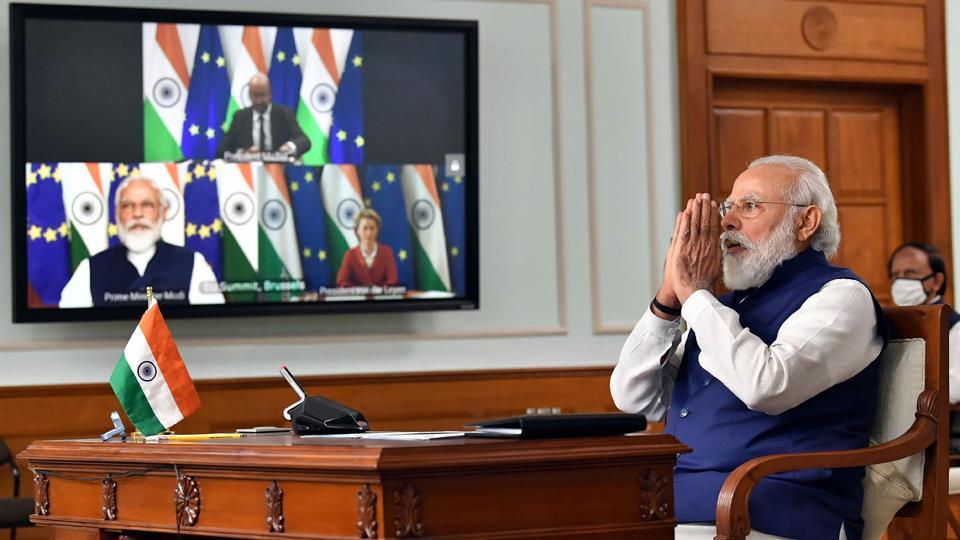
During a virtual summit, the leadership of the two sides agreed to scale up defence and security ties, including the launch of a new maritime security dialogue, consultations on crisis management and deeper cooperation between the Indian Navy and the European Union Naval Force Atalanta, the EU’s counter-piracy military operation in the western Indian Ocean.
With India’s Central Bureau of Investigation (CBI) and Europol launching negotiations to combat organised crime and terrorism, the two sides decided to intensify cooperation to tackle terror and its financing, radicalisation and abuse of the internet for such activities. Indian officials said Pakistan’s support for terrorism aimed at India and other countries in the region figured in the discussions.
While the joint statement and other documents adopted at the meeting, such as the strategic partnership roadmap till 2025, made no direct mention of New Delhi’s standoff with Beijing, many measures agreed on by India and the EU to strengthen multilateralism and protect a rules-based order appeared to be aimed at countering the rise of an assertive China.
Modi emphasised the priority India attaches to foreign direct investment (FDI) and efforts to liberalise regulations and improve the ease of doing business, secretary (west) Vikas Swarup of the external affairs ministry told a news briefing.
“He invited European businesses to utilise the opportunities in India and conveyed that Atmabirbhar Bharat {Self-Reliant India} is aimed at integrating domestic production with global supply chains,” he said.
Though the two sides launched negotiations on a bilateral trade and investment agreement (BTIA) in 2007, talks stalled in 2013 over differences on market access and movement of professionals.
Swarup said the two sides have now agreed to launch a high-level dialogue between India’s commerce minister and the EU trade commissioner to foster progress on “balanced, ambitious and mutually beneficial” trade and investment agreements, address trade irritants and discuss supply chain linkages.
Though no time-frame was set for concluding these agreements, a meeting of the dialogue mechanism will be held “as soon as possible, in the next few months”, he added.
Modi, who co-chaired the summit with European Council President Charles Michel and European Commission President Ursula von der Leyen, said the India-EU partnership can play a key role in post-Covid-19 economic reconstruction and human-centric globalisation.
The two sides, he said, are natural partners because of shared values such as democracy, respect for international institutions and multilateralism, at a time when there are “different types of pressures on the rules-based international order”.
“Like you, I am committed to deepen relations between India and the EU. For this, we must adopt a long-term strategic perspective and an action-oriented agenda should be implemented within a stipulated time-frame,” Modi said.
The European leadership noted that while the 27-member bloc is India’s largest trade and investment partner, India represented only 2% of EU’s total trade. India’s annual trade in goods and services with the EU is worth $140 billion, and European firms have invested more than $91 billion in the country.
Von der Leyen said trade and investment agreements will have to ensure market access and avoid barriers. The EU side raised with Modi the need to make tough choices such as phasing out coal while discussing cooperation on climate change. The EU side also offered to share its experience in data protection legislation as convergence of standards will facilitate data flows, she said.
Michel, who described India as an “indispensible partner” at a news conference, said India’s recent election as a non-permanent member of the UN Security Council for 2021-22 and to the G20 presidency in 2022 will allow the two sides to work together on multilateralism and keeping the global trading system open.
Officials of both sides acknowledged that the India-China border standoff figured in the discussions, and that Modi shared his views on the current situation in the border areas.
Without mentioning China, both Michel and von der Leyen assured India of EU’s support.
Michel said: “The EU and India are more than economic partners – we are political partners committed to peaceful resolution of conflicts, security and rule of law...India can count on the EU and we count on India to be a key partner.”
Von der Leyen added: “Today, our main message has been that the EU stands by India as friends and partners.”
Asked whether India was more strategic than China for the EU, Michel replied the EU-China relationship was “complex” and the bloc supports all efforts to maintain channels of dialogue to find peaceful solutions. However, he added that India was a partner because both sides share the “same vision of globalisation inspired by democratic standards and principles of freedom, liberty and inclusivity”.
The two sides decided to ramp up cooperation on Covid-19 vaccines and diagnostic and treatment tools based on their strengths in the production of pharmaceuticals and research and development. They agreed to work for the accessibility and affordability of tools and universal and affordable vaccines.
The European Parliament has debated the controversial Citizenship (Amendment) Act (CAA) in the recent past and Michel said the EU side raised the matter with Modi during the meeting. “We trust the Indian institutions, we understand that the Supreme Court will have a role to play in order to assess this legislation,” he said.
EU will continue a strong dialogue with India on human rights to exchange best practices and have the “best possible understanding about how to tackle this important issue”, he added.
The two sides also welcomed the signing of a civil nuclear cooperation agreement whereby the Department of Atomic Energy and Euratom will cooperate in civilian nuclear applications in agriculture, healthcare and industry, radioactive waste management and nuclear security. The EU also welcomed India’s proposal to build a connectivity partnership that is open, sustainable and rules-based.