
 E-Paper



PM Modi lauds villages for ‘do gaj doori’ mantra in social distancing
Panchayats, along with the women-run Self-Help Groups, have provided key support to the government outreach in vast belts of rural India.

 Prefer HTon Google


Marking out villages for special praise in the fight against coronavirus, Prime Minister Narendra Modi on Friday underlined how the ‘do gaj doori (a distance of two yards)’ mantra practised by villages is a useful social distancing example to be followed by everyone.
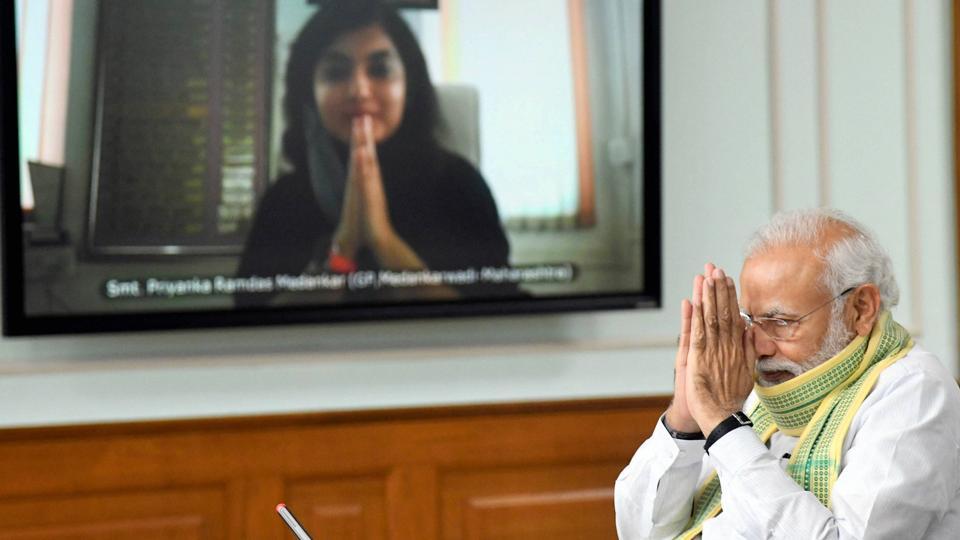
The slogan given by rural India “showed the wisdom of the people”, he said.
“With its simple mantra of Do Gaz Ki Doori, rural India has described social distancing in simple words, villages have showcased the best of their principles, traditional values to fight coronavirus,” Modi, who used a ‘gamcha’ as face mask, said.
Asking villages to be self-sufficient, the PM told gram panchayats how the coronavirus pandemic has taught valuable lessons that the country should not look for solutions outside the country.
“This pandemic has thrown at us new challenges and problems which we have never imagined, but it also taught us a very good lesson with a strong message. It has taught us that we have to be self-reliant and self-sufficient. It has taught us that we should not look for solutions outside the country. This is the biggest lesson we have learnt,” said the PM addressing gram panchayat heads on the occasion of the National Panchayati Raj Day.
Panchayats, along with the women-run Self-Help Groups, have provided key support to the government outreach in vast belts of rural India.
Many of them have undertaken door-to-door campaigns while others have stitched masks or made hand sanitisers, providing vital help in India’s action against Covid-19 pandemic.
“Every Village has to be self-sufficient enough to provide for its basic needs. Similarly every district has to be self-sufficient at its level, every state has to be self-reliant at its level and the whole country has to be self-reliant at its level”, Modi said, as he underlined that “progress of panchayats will ensure the development of the nation and democracy”.
The PM’s interaction with panchayats also comes days before his meeting with the CMs to decide the future course of action after the extended, federal lockdown ends on May 3.
A series of activities have already been allowed in rural areas including wide-ranging relaxation for agricultural workers. After May 2, there are distinct possibilities of more relaxations in the offing while the government will continue to monitor the containment zones.
The PM announced that he will make the panchayats stronger as he wants to provide self-sufficiency to villages.
“In the last five years nearly 1.25 Lakh panchayats have been connected through broadband from a mere 100 before. Similarly, the number of Common Service Centres had crossed 3 lakhs”, he said.
He also pointed out the mobile manufacturing in India, which has led to reduction in costs but improved connectivity in Indian villages.
The PM also launched e-Gram Swarajya App and Swamitva Scheme. While the e-GramSwaraj helps prepare and execute Gram Panchayat Development Plan, the Swamitva scheme helps to map rural inhabited lands using drones and latest survey methods.


