
 E-Paper



PM Modi, Putin and Xi hold hands at BRICS summit in a powerful show of unity
The camaraderie at BRICS was not without precedent, with the three leaders having shared a similar moment at the SCO summit in Bishkek.

 Prefer HTon Google


Prime Minister Narendra Modi, Russian President Vladimir Putin and Chinese President Xi Jinping were seen holding hands at the BRICS summit on Saturday, in a display of bonhomie between the leaders.
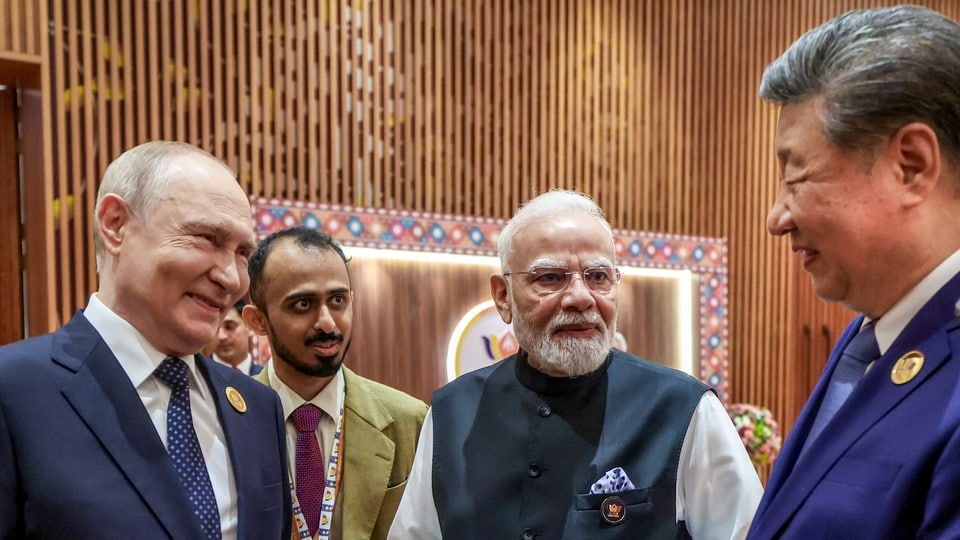
The striking moment of camaraderie was not without precedent, with the three leaders having shared a similar warm moment at the Shanghai Cooperation Organisation summit in Bishkek earlier this month. The latest photograph comes even as India hosts the BRICS summit amid heightened geopolitical tensions, providing an added significance to their public show of unity.
Follow live updates on BRICS summit here
Jinping is in India after seven years, his last visit being in 2019 for an informal summit with PM Modi, months before the 2020 India-China standoff when relations plummeted to their lowest point since the 1962 border war. However, there has been a thaw in ties since then, with an an understanding being reached in October 2024 on disengagement of troops at all “friction points” in Ladakh sector of the Line of Actual Control (LAC). Putin visited India in December, 2025 for the 23rd India–Russia Annual Summit.
The two-day BRICS summit, being held on September 12 and September 13 in New Delhi, has also seen attendance from Iranian President Masoud Pezeshkian, South African President Cyril Ramaphosa, Indonesian President Prabowo Subianto, Egyptian President Abdel Fattah El-Sisi, Malaysian Prime Minister Anwar Ibrahim, Abu Dhabi Crown Prince Mohamed bin Zayed Al Nahyan, and Ethiopian Prime Minister Abiy Ahmed Ali.
BRICS adopts New Delhi declaration; voices concerns on rise of unilateral tariffs
The BRICS group of nations unanimously adopted a joint declaration on Saturday, the first day of the annual summit in New Delhi, Prime Minister Narendra Modi said. “No member has raised any objection. The New Delhi Declaration 2026 is adopted unanimously,” PM Modi said.
The joint statement by member countries condemned the imposition of “unilateral coercive measures which are contrary to international law”, while expressing concern about growing risks of nuclear danger and conflict. It said nuclear safeguards, safety and security must always be upheld, including in armed conflicts.
Also Read | Reform of UN Security Council can no longer wait: PM Modi at BRICS summit
The declaration stressed the need to work together to maintain smooth flow of global trade, supply chains and energy, while voicing serious concerns about rise of unilateral tariff and non-tariff measures which distort trade and are inconsistent with World Trade Organisation rules.
The declaration also advocated for a multilateral approach which respects diverse national viewpoints and positions on crucial global issues. “We reiterate our commitment to strengthening multilateralism and multipolarity and to upholding international law, including the Purposes and Principles of the Charter of the United Nations (UN) in their entirety,” it said.
Deep Dive


