
 E-Paper



PM Modi inaugurates UER-II, Dwarka Expressway: What to know about the mega highway projects
The Delhi section of the Dwarka Expressway and the Urban Extension Road-II (UER-II) have been built as part of a comprehensive plan to decongest the capital.

 Prefer HTon Google


Prime Minister Narendra Modi inaugurated two major national highway projects worth nearly ₹11,000 crore in Rohini on Sunday, aimed at easing traffic congestion and improving connectivity across Delhi, the national capital region.
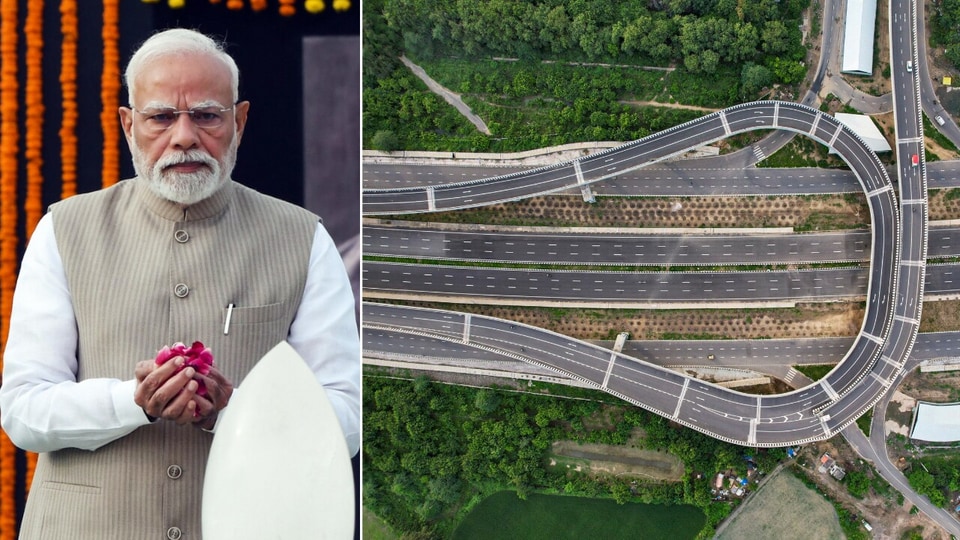
Narendra Modi was felicitated by union road transport and highways minister Nitin Gadkari during the inauguration ceremony on Sunday.
According to the Prime Minister’s office, the projects — the Delhi section of the Dwarka Expressway and the Urban Extension Road-II (UER-II) — have been developed under a comprehensive decongestion plan for Delhi. The ceremony was scheduled for around 12:30 pm in Rohini, and is expected to begin shortly.
“These initiatives reflect Prime Minister Modi's vision of creating world-class infrastructure that enhances ease of living and ensures seamless mobility,” the PMO said in a statement on Saturday.
What are the key projects
The Prime Minister will inaugurate the 76-km Urban Extension Road-II (UER-II), designed as Delhi’s third Ring Road, at an estimated cost of ₹6,445 crore.
He will also open the 29-km Dwarka Expressway, including its Delhi section and tunnel access to Indira Gandhi International Airport.
Together, these projects are expected to reduce travel time from Noida to IGI Airport and ease congestion on Delhi’s Ring Road, NH-48, NH-44, and the Barapullah elevated corridor.
According to the National Highways Authority of India (NHAI), Modi will flag off four of the five packages of UER-II, connecting Mahipalpur near IGI Airport to Alipur in North Delhi.
Meanwhile, phases three and four of the Dwarka Expressway, including a 5.1-km tunnel linking the road directly to IGI Airport will also be unveiled.
“These two roads will significantly reduce congestion in and around Delhi and NCR,” a senior NHAI official said.
UER-II
- Length: 75.71 km (54.21 km in Delhi, 21.50 km in Haryana).
- Cost: ₹6,445 crore.
- Packages: Five in total; four being inaugurated today.
The newly finished highway project will provide faster access from Gurugram, west and south Delhi to NH-44, Chandigarh, Punjab, and Jammu & Kashmir, bypassing Dhaula Kuan and the city’s ring roads.
Built using about 10 lakh metric tons of inert material recovered through biomining of legacy landfill waste in Delhi, this project also marks a step towards sustainability.
UER-II will link to the Delhi-Dehradun Expressway, starting near Akshardham temple, enabling faster routes from Haryana and Rajasthan towards Dehradun.
A new 65 km highway from Tronica City to the under-construction FNG Expressway has also been approved. In future, the corridor will connect five major NCR expressways: Delhi-Dehradun, Delhi-Meerut, Noida-Greater Noida, DND-Faridabad, and Yamuna Expressways.
Dwarka Expressway
- Delhi stretch: 10.1 km, including the tunnel to IGI Airport.
- Haryana stretch: 29 km between Mahipalpur and Kherki Daula on NH-48, inaugurated in March 2024.
The Dwarka Expressway, which spans a total of 29 kilometres, has been developed in two parts across Delhi and Haryana. The Delhi stretch, at 10.1 kilometres, includes a 5.1-kilometre tunnel that directly connects the corridor to the Indira Gandhi International Airport, providing faster and easier access for air travellers.
The Haryana section, covering 29 kilometres between Mahipalpur and Kherki Daula on National Highway-48, was inaugurated by Prime Minister Modi in March 2024.
Once fully operational, the expressway is expected to ease congestion on the busy Delhi-Gurugram route, significantly improving connectivity for commuters from western Delhi and surrounding NCR suburbs.


