
 E-Paper



Cornered by rivals, PM Oli is back with a ‘ludicrous’ claim on Ram’s birthplace
PM Oli’s remark on Ayodhya, the second in a month, comes against the backdrop of an acrimonious power struggle within the ruling Nepal Communist Party that is widely seen headed for a split.

 Prefer HTon Google


Prime Minister KP Sharma Oli this week attempted to ignite a fresh row over Lord Ram’s birthplace, telling a delegation that he was convinced that Lord Ram was born in south Nepal’s Ayodhyapuri and not Uttar Pradesh’s Ayodhya.
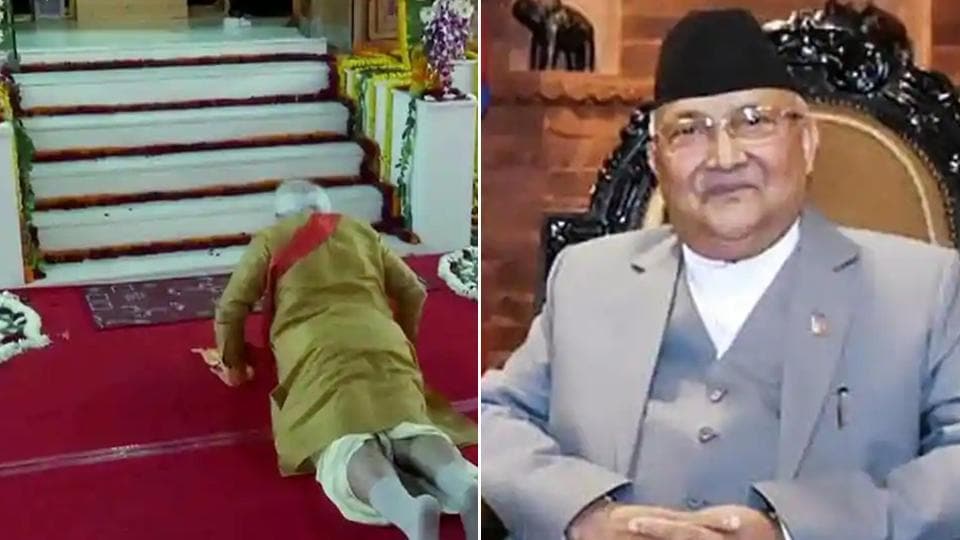
PM Oli’s remark on Ayodhya, the second in a month, comes against the backdrop of an acrimonious power struggle within the ruling Nepal Communist Party that is widely seen headed for a split. PM Oli has made it clear that he isn’t going to step down anytime soon as demanded by the rival camp led by the party’s co-chairman Pushpa Kamal Dahal and the two other former PMs, Madhav Nepal and Jhalanath Khanal.
PM Oli’s rivals have the majority within the party but have been unable to dislodge the prime minister who has been needling India - Nepal’s new map was one such effort - to endear himself to China’s communist party.
Also read: Nepal okays map tweak, India calls it ‘untenable’
PM Oli’s claim last month that Lord Ram was born in south Nepal’s Ayodhyapuri, and not UP’s Ayodhya, was delivered in this context. The remark was described as “ludicrous” by his party who spotted a pattern in the prime minister’s “undiplomatic” and “irritating” pinpricks targeting India.
New Delhi had then let it pass after the foreign ministry in Kathmandu rushed to put out a clarification, clarifying that the prime minister only meant to highlight the importance of further studies and research of the cultural geography represented by Ramayana.
PM Oli worked hard to rake it up again on Saturday.
The prime minister, who has been bunking meetings of the NCP’s top leadership for weeks, took out two hours to meet a delegation from Madi in Chitwan district to discuss his plans for Lord Ram’s birthplace. He told the delegation led by Madi mayor Thakur Prasad Dhakal that they should get down to prepping for Lord Ram’s idol and promote Ayodhyapuri as his place of birth. A suggestion to rename the municipality to Ayodhyapuri was also floated at this meeting.
PM Oli’s continuing effort to appropriate Lord Ram’s birthplace has drawn sharp reactions from religious leaders in Nepal including the priests at the Janaki temple. Acharya Durga Prasad Gautam, the Nepalese priest who participated in the bhumi poojan at Ayodhya, had run down PM Oli’s claims, describing the claim as absurd.
Also read | ‘Keep Lord Ram out of regional politics’: Ayodhya saints lash out at Nepal PM Oli
Kathmandu watchers say the shrewd communist leader’s sudden interest in religion lately appeared to be designed to signal to China and its ambassador Hou Yanqi that he was their best bet against India and should receive Beijing’s support.
Ambassador Hou, derisively described as Nepal’s new viceroy to reflect her influence over the prime minister, has been quietly working to avoid a split in the Nepal Communist Party. At one point, she is learnt to have messaged to Oli’s rivals that the Chinese Communist Party’s sole interest was to ensure that the NCP - formed in 2018 after the merger of Nepal’s two communist parties - did not split.
“PM Oli is trying hard to tell China that he is indispensable to serving Beijing’s interests in Kathmandu,” a Kathmandu watcher in New Delhi said.
PM Oli last month made it clear that the NCP could split if he was pushed out of the government when his camp re-registered his old party CPN-UML as a political party with the election commission. The ruling NCP was formed with the merger of the Communist Party of Nepal (Unified Marxist–Leninist) and Dahal’s Communist Party of Nepal- Maoist Centre in 2018
PM Oli hasn’t spoken about it. But Dahal, who suspects the move to register the new party is part of PM Oli’s Plan B; to split the NCP in case he is forced to resign, has told his followers to prepare for the “worst”.
Diplomats in Kathmandu said they had not been able to decipher why Dahal, a former guerilla leader, and Madhav Nepal had not pushed PM Oli hard enough so far though he has had the numbers on his side.
“It is a little curious,” he said, wondering if PM Oli’s upper hand over his rivals had something to do with some “political vulnerabilities”.


