
 E-Paper



PM-led ‘collective leadership’ pitch pays dividends for BJP
The Bharatiya Janata Party’s gambit of using collective leadership led by PM Narendra Modi steer its campaign demonstrably reaped dividends.

 Prefer HTon Google


In wresting control of two states, Rajasthan and Chhattisgarh, from the Congress and retaining its government in a third province, Madhya Pradesh, with a historic victory, the Bharatiya Janata Party’s (BJP) gambit of using collective leadership led by Prime Minister Narendra Modi steer its campaign demonstrably reaped dividends on Sunday.
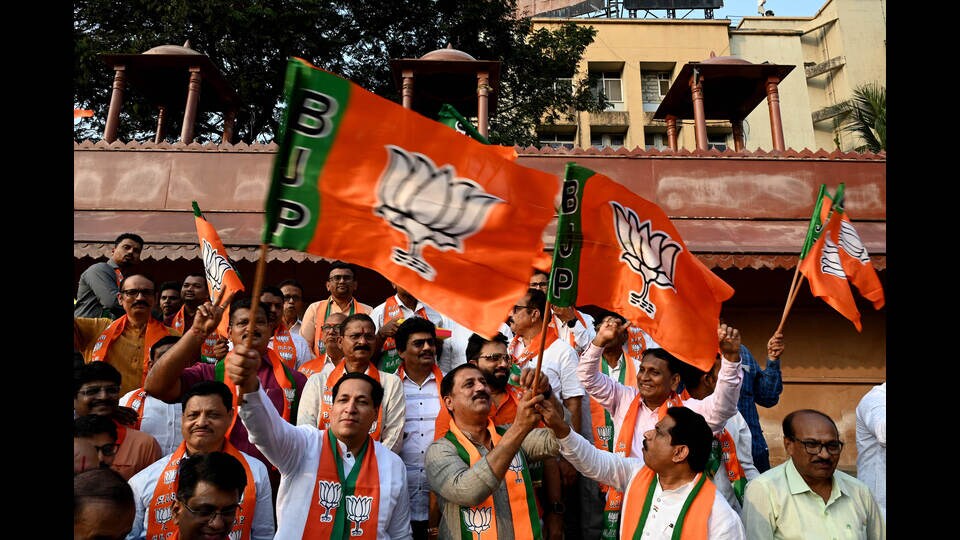
As did the party’s strategy of relentlessly attacking the Congress on allegations of irregularities and corruption, focussing on its welfare outreach, and nurturing key vote blocs such as women and tribals.
This approach was most visible in Madhya Pradesh, where anti-incumbency was one of the biggest challenges and where the old guard was not the face of the party in the polls, and also in Chhattisgarh, where the party was visibly weak going into the elections, without a strong state leadership.
In Rajasthan, the party used the same tactic, but was also backed up by a strong set-up led by former chief minister Vasundhara Raje.
In all three states, the party won clear mandates — 164of 230 seats in Madhya Pradesh, 115of 199 in Rajasthan and 54of 90 in Chhattisgarh. In 2018, the party had faced a drubbing in all three.
Instead of projecting or naming incumbents as chief ministerial candidates, the party banked on the popularity of Modi and the Union government’s social schemes – an approach that party leaders said focused on the strength of the “Modi guarantees”.
“Not just the Lok Sabha polls, but all elections are now fought on the PM’s name and credibility,” said a general secretary, asking not to be named.
The approach best crystallised in the Madhya Pradesh campaign, where the party was in power for 18 of the last 20 years. Several state leaders, who asked not to be named, said there was a perception in the party that the 2018 performance, when the BJP won 109 seats, coming second to Congress’s tally of 114, was due to the anti-incumbency sentiment against chief minister Shivraj Singh Chouhan.
Chouhan’s not leading from the front became obvious when the high command—Modi and Union home minister Amit Shah—launched the Jan Ashirwad Yatra, marking the first steps towards a change in order.
In the state, the party leadership fielded lawmakers as well as senior Union ministers, sending out a message that the top slot could see a new occupant. Chouhan, who is referred to as mama, or uncle, had been the CM for four terms. Party leaders said while his schemes, especially for the women and disadvantaged groups, were popular, there was a “fatigue factor” associated with him.
With senior leaders and Union ministers Faggan Singh Kulaste, Narendra Singh Tomar, Prahlad Patel and national party general secretary Kailash Vijayvargiya in the fray, the party sought to benefit from the individual support base of these leaders and the caste groups they represented. Voters who were not inclined to vote for the old leadership saw an opportunity for change.
Party president VD Sharma told HT that the party’s slogan “MP ke mann mein Modi, aur Modi ke mann mein Madhya Pradesh, ” clinched the elections.
“Today, the people have blessed Modi ji. We said in this elections that if you want Modi ji to become the PM in 2024, then we need to form the government with an overwhelming majority... And the people have blessed us,” he said.
Union minister Ashwini Vaishnaw, who was the co-incharge of campaign in the state, also credited the PM’s guarantees for the victory. “Each and every person in Madhya Pradesh has seen the work the BJP has done. The (performance) of the double engine government and the full confidence that every citizen has in Modi’s guarantees is clearly reflected in today’s results,” he told HT.
In Rajasthan, while there was no similar incumbency fatigue with former CM Raje, the party stuck to the same strategy. “Rajasthan has alternated between the Congress and the BJP. Consequently, the voters are not stuck with the same leadership. Even if the government has been pro-people or popular, there is an appetite for change,” a second party leader based in Delhi said, asking not to be named.
This leader added that Raje’s hold over a sizeable section of legislators, her popularity among women voters and her acceptance across caste groups, give her a strong footing and influence. “We had lawmakers such as Rajyavardhan Singh Rathore and Diya Kumari as contestants who were also touted as possible faces to replace Raje, but her political astuteness and grasp over the cadre in the state make her a force to reckon with,” said the second leader.
Chhattisgarh, where former chief minister Raman Singh had three terms until being ousted in 2018, was also a campaign that saw a collective leadership pitch.
“Both Raje and Singh are strong personalities in their own states but the BJP has a tradition of allowing generational shift and it has become more pronounced since 2014. So, collective leadership was seen as a means for allowing a newer crop of leaders,” said a third senior party functionary, asking not to be named.
A change in faces at the state level was identified as one of the measures to prevent 2023 from being a repeat of 2018.
In Chhattisgarh, senior leaders such as former minister Ram Vichar Netam, Union minister Renuka Singh, state president Arun Sao, were among the lawmakers fielded as new faces to ensure that they pull votes through their individual clouts in their constituencies and caste groups.
“In the state, there is a perception that only OBC or ST leaders can lead the government. Singh, a Thakur was the CM for three terms and very popular, but the impact of the allegations against the government under his charge made him a liability in 2018. Though he was involved in this election campaign, he was definitely not the face,” said the first leader quoted above.
Just as the Congress had done to unseat it, using corruption as the lever, the BJP drew on allegations of irregularities and scams against outgoing CM Bhupesh Baghel.
“The party’s narrative was the problems faced by the common man from the problems faced by the farmers to the corruption exposed by the Mahadev app. What turned the tide in our favour was when the party spoke about purchase of paddy procurement and promised a bonus. This was done on the instruction of the central high command,” said a fourth senior leader, involved in the state’s election campaign, asking not to be named.
The focus on issues, the person added, was meant to make up for the absence of leaders who were seen as strong contenders to Baghel.
Given the popularity of schemes and guarantees announced by the Congress and the impact these had in states such as Karnataka and Himachal Pradesh, the BJP too offered sops such as the Mahtaari bandhan Yojna, which would provide ₹1,000 a month to married women.
The party also did not underplay specific state-centric issues in its campaign, such as employment, problems among farmers or unrest among social groups, over issues such as reservation and caste census.


