
 E-Paper



India natural ally in shaping Indo-Pacific: Oz PM
Morrison, who has established a close working relationship with Prime Minister Narendra Modi, was effusive in his praise of India’s role in Covid-19 vaccine distribution and the Vaccine Maitri initiative that has so far supplied 65.5 million doses to 91 countries


Australia perceives India as a natural partner in shaping the future of the Indo-Pacific and the elevation of bilateral ties to a comprehensive strategic partnership has boosted cooperation in areas ranging from trade and critical minerals to defence, Australian Prime Minister Scott Morrison said on Thursday.
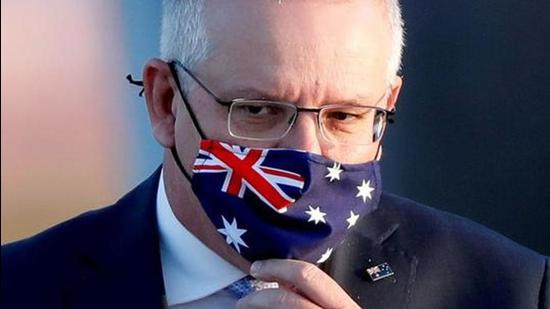
The first Quad Leaders’ Summit last month reflected the momentum being built by Australia, India, Japan and the US to forge a positive and inclusive agenda for the Indo-Pacific, Morrison said in his keynote address at Raisina Dialogue, the flagship conference of the external affairs ministry.
Morrison, who has established a close working relationship with Prime Minister Narendra Modi, was effusive in his praise of India’s role in the Covid-19 vaccine distribution and the Vaccine Maitri initiative that has so far supplied 65.5 million doses to 91 countries.
“Australia sees India as such a natural partner in shaping the future of our region,” he said, adding this was due to a combination of geography, values, growing economic security and people-to-people ties.
“In India, I know we have a friend who will help build our region, where all nations can prosper,” he said.
Welcoming India’s “increasingly active role” in the Indian Ocean and the wider Indo-Pacific and its leadership in manufacturing and distribution of vaccines, Morrison noted that New Delhi is building economic capability, promoting maritime security and advocating regional cooperation.
“We welcome your leadership, Prime Minister Modi, and welcome India’s leadership and engagement, whether it’s on the outstanding vaccines that are necessary and the Maitri campaign that you’ve engaged in,” he said.
The elevation of bilateral ties to a comprehensive strategic partnership last June was a “declaration of our shared values and interests, our capabilities and the deep trust we have for each other”, and this has led to new ways of cooperation in commerce, critical minerals, science, technology, defence, maritime security and critical technology issues, Morrison said.
It also led to Australia joining the navies of India, Japan and the US in the Malabar exercise last November, and this reflects the “deep trust, shared ambition and the united commitment to keeping our region safe and secure”, he added.
At the same time, Morrison said he had told the Quad Leaders’ Summit that other nations can rely on Australia at a time when the region faces challenges that no country can take on alone. The summit was a mark of the momentum being built among like-minded countries in the region to forge a positive and inclusive agenda for the Indo-Pacific, he added.
Without naming China, Morrison cited many issues linked to Beijing’s aggressive and assertive actions as the foremost challenges confronting the Indo-Pacific. Though full of promise, the Indo-Pacific is the “epicentre of strategic competition” and there are tensions over territorial claims and unprecedented military modernisation, he said.
Democratic nations were being threatened and coerced by foreign interference, and cyber-attacks are becoming more sophisticated, including from state-sponsored actors, while “economic coercion is being employed as a tool of statecraft” and liberal norms are under assault, he added.
“Our region confronts some formidable challenges, and the pandemic has sparked a renewed appreciation among like-minded nations for each other and what all of us can contribute to our partnerships and to our region,” Morrison said.
Sameer Patil, fellow for international security studies at Gateway House, said India’s relations with US allies such as Japan and Australia have flourished on the back of the vibrant India-US security ties. “Australia’s inclusion in the last Malabar naval exercise underlined the expanding defence partnership with India. Both the countries have similar concerns about China’s growing aggressiveness – in India’s case, it’s the border standoff, and Australia is grappling with China’s growing influence both domestically and in the South Pacific. On the back of this, India-Australia ties are set to thrive,” he said.


