E-Paper



‘Rich nations should achieve net zero emissions before 2030’: India at COP27
New Delhi has turned up the heat on developed countries at UN Climate Conference (COP27), underlining that the failure to deliver financial resources to developing countries was “an enormous failure” and that goalposts were being changed constantly to require developing countries to do more


SHARM EL SHEIKH: India intervened at the ministerial high-level roundtable on pre-2030 ambition at UN Climate Conference (COP27) on Monday to ask rich countries to do more, saying some developed countries must reach net zero emissions even before 2030 and that net zero goals for 2050 are not enough.
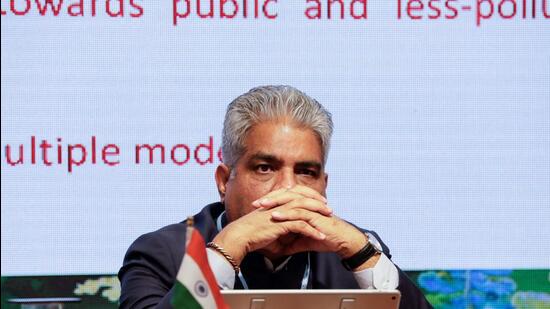
Union environment minister Bhupender Yadav who represented India at COP27 at Sharm El Sheikh in Egypt, said “pre- 2030 ambition must be measured in terms of whether countries are staying within their fair share of the carbon budget, taking note of both the historical period and in the future.”
New Delhi’s call comes at a time when there are a lot of red lines around how the goal of keeping global warming under 1.5°C will be articulated in the cover decision text of COP27 that will emerge by end of this week.
US special climate envoy John Kerry said on Sunday that a few countries have resisted mentioning a global goal of limiting warming to 1.5°C in the official text of the COP27, Euronews reported.
A senior delegate from India also said on Saturday that during meetings on mitigation work programmes (MWP) – measures that relate to lowering emissions -- rich countries outlined the top 20 emitters and insisted that the measures be addressed to these.
This is key because many of the top emitters in absolute terms are developing countries such as India, China and Brazil, but in per capita terms, and when historical emissions are considered, their role in the warming of the planet is demonstrably lower than industrialised western nations.
Observers also said the US and other Annex 1 countries were trying to selectively push a language on 1.5°C goal that goes against principles of equity and “common but differentiated responsibilities” that were agreed upon under the Paris Agreement, and indirectly pushes all countries to embrace net zero emission goals by 2050.
Scientists and independent experts have already said that the 1.5°C goal seems practically impossible to achieve under current circumstances. The updated pledges submitted since COP26 in Glasgow take less than 1% off (only 0.5 gigatonnes of CO2 equivalent) projected 2030 greenhouse gas emissions whereas a 45% cut in emissions is needed for limiting global warming to 1.5°C, the United Nations Environment Programme said on October 27.
“Our understanding is that the Annex-I Parties have not met their pre-2020 commitments together and several individually as well. But the real question, according to the best science, is the cumulative emissions until 2030. So pre- 2030 ambition must be measured in terms of whether countries are staying within their fair share of the carbon budget, taking note of both the historical period and in the future. By this scientific criterion, some developed countries must reach net zero even before 2030 and 2050 is not enough at all. So, this is where we must begin talking about opportunities for ambition,” Bhupender Yadav said in his intervention.
“The opportunities for ambition vary across parties. This we must recognize. If not, our efforts to increase ambition from those who have little to give, will only result in inaction. Developed countries must take the lead – after all the bulk of both finance and technology transfer is available with them. The Convention and the Paris Agreement both recognize this, but we have not had adequate action,” Yadav added.
India also made it clear that carbon offsets of the kind US announced on November 9 called the Energy Transition Accelerator (ETA) may not be able to address the climate finance needs of developing countries.
“Leaving it to markets alone will not help. Markets do not function well in normal times, but either do not function or function very inequitably in moments of crisis. We see this with the energy crisis in developed countries. For developing countries, public action includes public sources of climate finance and technology. These are essential,” he said.
India also indirectly referred to the global methane pledge launched by the US and the Methane Alert and Response System (MARS) which uses satellite information to detect and act on major emissions sources. “To target small farmers for mitigation in the name of ambition would be a serious mistake. As in India, if in developing countries, if we target domestic and public lighting, and increasing use of clean fuel to replace biomass, we can achieve some significant gains in low-carbon development,” he added.
“The failure to deliver financial resources to developing countries is an enormous failure. Calling for ambition from developing countries is not meaningful if the time required from low-carbon development is not recognized. Unfortunately, with every decade, with every new agreement, with every new scientific report, more and more action is demanded from developing countries. If goalposts are changed constantly, it will not yield results but only words and promises,” Yadav said.
On attempts to selectively push language from the Glasgow pact on the 1.5°C goal, Yadav said developed countries are now trying to shift goalposts.
“This is yet another instance where there is a constant shifting of the goalposts. The Paris Agreement has just begun implementation, and that too after the lost years of Covid. The first Global Stocktake is underway and will conclude next year. So why is there any need to start talking of the adequacy of the provisions of the Paris Agreement? Of course, provision of the means of implementation under para 5 of Article 4 will help raise ambition. But there is also the question of whether technology is available and ready and whether it can be deployed at a reasonable cost. If this cannot be done, but ambition is forced, then the growth will be restricted in developing countries,” he said.
HT reported on October 28 that the G7 consisting of Canada, France, Germany, Italy, Japan, the United Kingdom and the United States have approached India to join a Just Energy Transition Partnership (JETP) which will help finance the rapid deployment of clean energy projects in India and possibly reduce dependence on coal. India has not signed on or rejected the partnership offer as yet, officials aware of the matter said.
Inter-ministerial consultations are presently being anchored by the Ministry of External Affairs on the matter. The concept of JETP began with South Africa last year at COP26. France, Germany, the UK, the US, and the EU (the International Partners Group, or IPG) committed to providing $8.5 billion over three to five years to support South Africa’s national climate plan. Following the South Africa partnership, the G7 in its G7 Leaders’ communique of June 28 this year said the G7 is working with India, Indonesia, Vietnam on more such partnerships.
South Africa launched its Just Energy Transition Investment Plan for 2023 to 2027 last week. The political declaration on JETP in South Africa sets out a commitment to mobilise an initial amount of approximately US$8.5 billion over the next three to five years, But South Africa’s investment break up showed that most of the amount will be sourced through concessional and commercial loans instead of grants.
India on Monday asserted that such partnerships should not push for an early start to decarbonisation.
“Just transition in developing countries is simply about enabling low-carbon development. It cannot be about an early start to decarbonization in any sector, though decarbonizing various sectors as and when feasible will arise sometime in the future. This will be detrimental to both the overriding priority of achieving the SDG goals by 2030 and subsequent development. Fossil fuels will continue to be part of the rational use of natural resources to protect energy security. Support for just transition means increased support for the deployment of renewables, increased support for the development of renewable technologies and means to cope with the costs of such development and the deployment of such technologies,” Yadav explained in his statement.
“It is developing countries who will face far more severe consequences if we breach the target of limiting the global temperature rise to 1.5°C. Rich industrialised countries are cherry-picking language from the climate talks at COP27 to shift the blame on poorer nations, while using all possible tricks to delink emissions reduction targets with equity and their obligation to provide scaled-up finance,” said Harjeet Singh, head of global political strategy, Climate Action Network International.