
Sign in

Rich-poor divide in India widening as economy grows: Report

A new report examining 25 years of India’s economic liberalisation says exclusion of a large section of Dalits and Muslims have not gained adequately from the growth unlike more influential empowered sections of the society

Updated on: May 12, 2017, 07:07:40 IST
Hindustan Times | By
Share
Share via
  • facebook
  • twitter
  • linkedin
  • whatsapp
Copy link
  • copy link

As India’s economy grew rapidly, the inequality between the richest and the poorest rose, the number of landless farmers increased and employment generation was lowest in 2015, says a new report examining 25 years of India’s economic liberalisation.
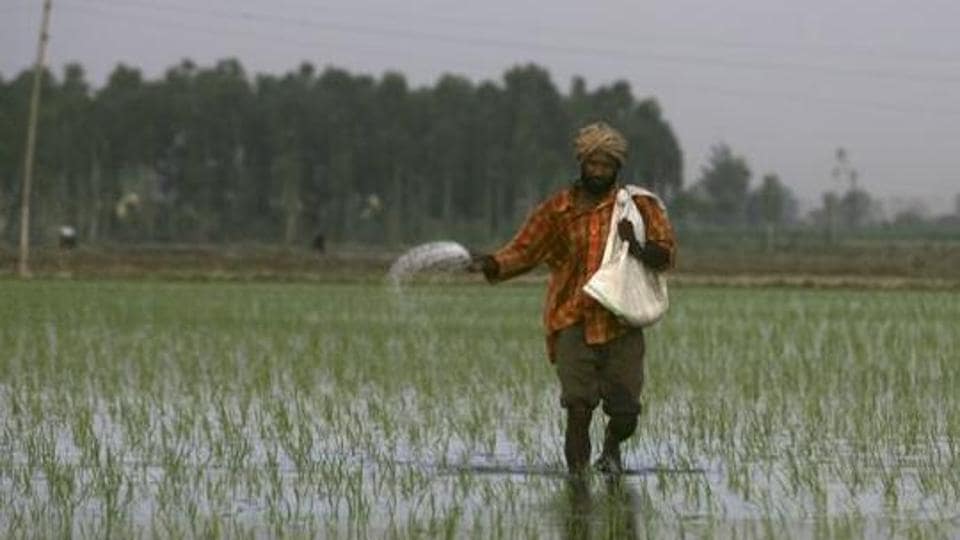
A farmer sprinkles fertilizers on a rice crop on the outskirts of Amritsar. Employment generation has been its lowest in 2015 in the past 25 years, and so did the number of landless farmers increase. (AP File Photo)

Pointing that distribution of growth gains have not been equitable, the India Exclusion Report 2016 says the post-1990 growth was up to three times of the levels in the first four decades since Independence but the rate of poverty reduction slowed down from 0.94% per annum during 1981-1990 to only 0.65% between 1990 and 2005.

The high decibel growth led to 12-fold increase in wealth for the richest 10% people since 2000, while for the poorest 10% the income jumped by just three times and the reason was dismal new job creation. Quoting the labour bureau’s data, the report to be released on Friday said that only 1.35 lakh new jobs were created by the Narendra Modi-led National Democratic Alliance government in 2015, lower than the previous UPA government.

India’s experience contrasts with that of Brazil, Indonesia and, on some indicators, Argentina, which recorded significant progress in reducing inequality during the same period. “China, India, the Russian Federation and South Africa which have all become less equal over time,” the report said.

“There is no doubt that lives of people have changed for better because of liberalisation but the promise of poverty eradication still remains to be fulfilled,” said Harsh Mander, who heads Delhi-based rights advocacy group the Centre for Equity Studies that prepared the report.

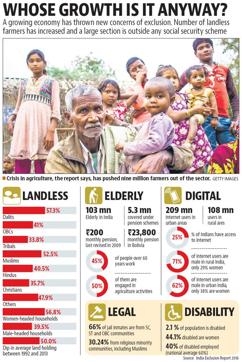
“The gains have thrown new concerns of exclusion which needs to be addressed and discussed. In India, pensions cover only 40% of the elderly, landlessness among Dalits and Muslims is highest and these two (legally illiterate) communities are in high proportion in jails.”
Article image

The report also highlights that though India’s score on Global Hunger Index has improved since 2008 its ranking has fallen as other countries such as Rwanda, Cambodia, and Myanmar have done better than the world’s fastest growing economy.

The report said that growth has lead to higher migration with 35-40 million labourers, almost half of the casual labourers outside agriculture, being seasonal migrants. A probable reason given by a researcher Anirban Bhattacharya was that proportion of cultivators has fallen whereas farm labourers have almost doubled since 1951.

He also pointed out that the most deprived in the society – Dalits and Muslims – have least access to land with just 2.08% of around 200 million Dalits having land more than 2 hectares. Around 58% of whatever meagre land Dalits have is not linked to irrigation, a key for life sustaining productivity from their farms.

Crisis in agriculture, the report says, has pushed nine million farmers out of agriculture between 2001 and 2011 leading to increase in urban migration from 16.5% in 1971 to 21.1% in 2011, as average land holding has halved since 1992. Worst is the statistics that in the past 20 years (1994-2014), more than 3 lakh farmers committed suicide in India.

The report raises pertinent questions regarding half of India’s 103 million elderly outside any social security scheme, 40% of disabled women in rural India without jobs and exclusion of the poor on account of digital illiteracy as government pushes Digital India.

  • Chetan Chauhan
    ABOUT THE AUTHOR
    Chetan Chauhan

    Chetan Chauhan is the National Affairs Editor looking into all aspects of news and features from across India. A Chevening scholar with over three decades of experience in reporting and news management, Chetan has extensively covered all important aspects of the social sector, political economy, environment and climate change nationally and internationally. He did a journalism course at the Reuters Institute of Journalism in Oxford and Digital Media training at Nanyang Technological University in Singapore. He started as a reporter with The Statesman in 1996 and joined the Hindustan Times in 2000 in the metro bureau covering environment, crime and Delhi politics. He covered hot local news, from the Jessica Lal murder case to the rebellion of Delhi Congress MLAs against then Chief Minister Sheila Dikshit, to the replacement of toxic vehicle fuel with cleaner compressed natural gas (CNG) in the national capital. Some of his stories on air pollution became part of the Supreme Court’s landmark MC Mehta versus Government of India case in the National Capital Region (NCR), forcing the government to take corrective measures. As part of the national political bureau since 2004, he covered important central sectors such as environment, education, social justice, labour, rural development, water resources, renewable energy, agriculture, broadcasting and the Planning Commission for more than a decade producing several exclusive and investigative breaking stories. His specialisation is the environment, having covered at least a dozen United Nations global conferences on climate change, biodiversity and wildlife including climate summits in Paris, Copenhagen and Bali. He also covered India’s two five-year plans ---11th and 12th and reported on drafting and execution of right based laws such as Right to Education, Right to Information and rural job guarantee law, MG-NREGA, now being introduced in new format as VG-RAM-G Act. He has in-depth knowledge of social sector issues. He was one of the first to report on tigers vanishing from Sariska and Panna wildlife reserves in 2004 and 2008, respectively, leading to the setting up of the National Tiger Conservation Authority (NTCA) and the introduction of stringent penal provisions for poaching. He has written extensively on the rising human-animal conflict in India and the degradation of India’s biodiversity hotspots because of mining and other activities. Since 2004, Chetan has covered Parliament comprehensively and participated in training on the nuanced coverage of Parliament proceedings. He has travelled extensively across India to cover national and provincial elections since 1998, especially in the Hindi heartland states, considered India’s road to power. He writes a regular column for Hindustan Times, Ecostani, on important national politics, economy, Himalayan ecology and environmental issues. His other responsibilities include providing inputs for edits and edit page articles for the publication, apart from managing news flow from across India.Read More

Get the latest India News, breaking headlines and real-time updates from across the country. Stay informed about politics, government policies, crime, weather and major national developments.