
 E-Paper



SC refuses to stall meeting to pick new poll chief, stay law
The Supreme Court has refused to stall the first meeting under the 2023 law to select a new election commissioner, stating that a law cannot be suspended through an interim order. The meeting, expected to be chaired by Prime Minister Narendra Modi, will take place this week. The court has agreed to examine the matter in April when a similar petition is scheduled to come up. The 2023 law has been criticized for excluding the Chief Justice of India from the selection committee and allegedly failing to preserve free and fair elections.


The Supreme Court on Tuesday refused to stall the first meeting under the Chief Election Commissioner and Other Election Commissioners (Appointment, Conditions of Service and Term of Office) Act, 2023 to select a new election commissioner (EC), saying the operation of a law cannot be suspended through an interim order.
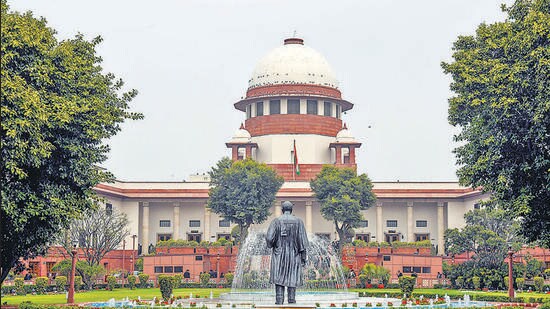
Prime Minister Narendra Modi is expected to chair the first meeting under the 2023 law this week. Leader of Opposition in the Lok Sabha, Adhir Ranjan Chowdhury, and a Union minister will also be a part of the three-member selection committee that will find the successor to EC Anup Chandra Pandey, who is set to retire on February 14.
“We can’t stay legislative amendments just like that...It can’t be done like this. By an interim order, we can’t give you the final relief in your petition,” a bench led by justice Sanjiv Khanna told advocate Prashant Bhushan.
Bhushan, appearing for NGO Association for Democratic Reforms (ADR), was seeking an interim order from the bench, arguing that EC Pandey will retire on Wednesday, and his successor is going to be picked under the new law any time this week.
“They will pick up someone this week. Lok Sabha elections are approaching and that is why we are pressing for an interim order,” Bhushan submitted before the bench, which also comprised justice Dipankar Datta.
But the bench retorted: “May be one or two people will come in but we cannot grant you interim relief in a matter like this... We also know our parameters. When an interim order can be passed involving a legislation and when it cannot.” Bhushan contended that his plea would be rendered infructuous if the court were not to intervene in the upcoming selection process.
The court replied: “Mr Bhushan, constitutional validity matters are never rendered infructuous... we will hear it with the other petition that is pending before us (Jaya Thakur’s).” To this, Bhushan said that the petitioner was before the top court because they wanted some orders before the next general elections.
“We understand that but at the same time we will have to examine this in terms of our power of judicial review,” replied the bench.
It issued notice on notice to the Union government and agreed to examine the matter in April when a similar petition filed by Congress leader and petitioner Jaya Thakur is scheduled to come up.
The bench had on January 12 issued a notice on Thakur’s petition, which like the ADR’s plea questioned the exclusion of the Chief Justice of India (CJI) in the selection committee and urged the court to declare the 2023 law as unconstitutional for allegedly failing to preserve free and fair elections – a part of the basic structure of the Constitution. On that day too, the bench refused to stay the operation of the new law even as it agreed to examine its validity later.
President Droupadi Murmu, on December 28, gave her assent to a bill that seeks to put in place a new mechanism for the appointment of CEC and ECs. The new law has provisions to set up a search committee chaired by the Union law minister and two other persons not below the rank of secretary, to prepare a panel of five persons for consideration of the selection committee for appointment as CEC or ECs. It provides for a selection committee, chaired by the Prime Minister, leader of Opposition and a Union minister, to make recommendations to the President for appointment of CEC and other ECs.
During the passage of the bill in the Rajya Sabha on December 12, the Opposition staged a walkout before the voice vote was held, alleging that its provisions were “undemocratic”. The government maintained that the bill was in line with the top court’s directions.
The new law, however, marked a departure from a judgment of a Constitution bench in March last year, which directed for inclusion of the CJI in the selection panel until Parliament came up with a new law. The judgment in Anoop Baranwal vs Union of India said that the selection of CEC and ECs should be done by a panel headed by the Prime Minister and comprising two other members – leader of Opposition in Lok Sabha and the CJI to ensure transparency in the selection mechanism.
The apex court had then extensively referred to a similar mechanism for selection of the director of the Central Bureau of Investigation (CBI) and Lokpal while underlining the “devastating effect of continuing to leave appointments in the sole hands of the Executive”.
To be sure, the March 2, 2023, judgment by the five-judge bench was delivered without a law to regulate the appointment of the CEC and ECs, as mandated by the Constitution. Instead, until then, the appointments were carried out through the 1991 Transaction of Business Act, which the court had noted, lacked objective standards regarding the selection and qualification of the CEC and ECs.
The ADR’s petition in the Supreme Court complained that the 2023 law allows the executive to dominate the matters of appointment of EC members, threatening democracy. It also questioned the Act over brushing aside the March 2023 judgment to include the CJI as a member of the high-powered selection committee and replacing him with a Union minister to be nominated by the PM.
By nullifying the Supreme Court judgment, the ADR contended, the government has clearly breached the principle of having an independent mechanism for such appointments, putting free and fair elections in peril.
Thakur’s petition has highlighted that it is inherent in a democratic set-up that the agency, which is entrusted the task of holding elections to the legislatures, should be fully insulated so that it can function as an independent agency free from external pressures from the party in power or executive of the day.
Another petitioner Gopal Singh, whose plea was also listed with Thakur’s petition on January 12, has urged the court to implement an “independent and transparent system of selection” by constituting a neutral and independent selection committee for appointment of the CEC and ECs.


