
 E-Paper



SL polls did not cause a ripple in TN govt: Experts
Tamil Nadu chief minister M K Stalin has written to India’s external affairs minister S Jaishankar to speak to the Lankan government over the fisherman’s issue


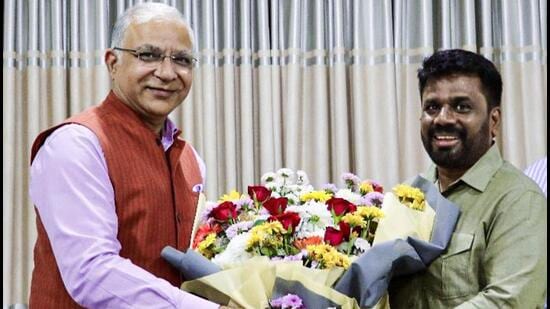
After Anura Kumara Dissanayake (AKD), heading the Marxist-leaning Janatha Vimukthi Peramuna, was sworn in on Monday as the president of Sri Lanka across the Palk Strait, Tamil Nadu chief minister M K Stalin wrote to India’s external affairs minister S Jaishankar to speak to the Lankan government over the fisherman’s issue.
Stalin did not mention the new government and stuck to seeking the release of Tamil Nadu fishermen by Sri Lankan forces, trying to make a point that election results in the island country may not have much bearing on state politics.
Times have changed from when the politics of Tamil Nadu and its neighbouring island Sri Lanka, with a minority Tamil population, were intertwined during the civil war, which ended in 2009.
“Ironically, this time Tamil Nadu’s non-political actors and parties did not show much interest in Sri Lanka’s election because they did not have expectations through this election for the Tamil reconciliation in the island,” said political analyst Ramu Manivanan.
“Sri Lankan Tamils also did not respond in a huge way to Dissanayake’s candidature, so Tamil Nadu did not show much anxiousness or surprise at the outcome of the elections.”
The attitude over the fishermen’s issue between Lanka and Tamil Nadu too is unlikely to change under Dissanayake, say watchers of the island nation.
“Concern over what goes on in Sri Lanka has reduced. The only interest is about the common Tamil candidate,” said general secretary of Tamil National Liberation Movement, Thiyagu (who goes by single name). Pakiyaselvam Ariyanethran was named as the common candidate by a batch of Tamil parties in Lanka based in the north and east regions, where most of the Tamil population is concentrated. Sri Lanka’s Leader of Opposition Sajith Premadasa, who lost to Dissanayake, got the highest share of Tamil votes in the election, according to the results.
“Dissanayake is not just pro-Sinhala and has no regard for Tamil votes,” says Thiyagu, adding that there may not be any change regarding the issues of release of fishermen and fishing area at all as Dissanayake’s priority would be to deal with the economic crisis.
In agreement, Manivannan said that the new government would focus on economic recovery, which is also the concern of the island’s Sinhalese majority, and the fishermen’s maritime border issue is a matter dealt with by Lanka’s military and defence.
“But, the state government would want to keep the pressure on Tamil Nadu’s fishermen,” said Manivannan. “Unless the Indian government directly intervenes in the matter, there might not be a change in attitude. It is not to say that Dissanayake will not focus on ethnic reconciliation but the foremost priority is economic recovery of Sri Lanka. To place Sri Lanka vis-a-vis India and China (as critics point out that Dissanayake is pro-China), because of the Left radical background this government has and India has been engaging Dissanayake for more than a year. That speaks a lot about India’s foresight in Sri Lankan politics.”
Stalin in his letter to Jaishankar said that 37 fishermen from Tamil Nadu and their three motorised country boats and an unregistered boat were apprehended by the Sri Lankan Navy on September 21 when the island nation voted. “As I have been pointing out, such instances of arrests of Tamil Nadu fishermen while fishing in their traditional fishing waters have been on the rise,” Stalin said.
“Besides this, the Sri Lankan courts are levying penalties that are beyond the means of these fishermen. Strong measures must be taken to prevent the Sri Lankan authorities from apprehending fishermen and their fishing boats,” the letter added.
The Stalin-led DMK’s ally, CPI (M), has urged Lanka’s new government to ensure that the continued attack on fishermen is stopped.
For the 57,000 Sri Lankan refugees living in Tamil Nadu too, a vote for change in the island nation doesn’t make much impact as most of them wish to stay back and seek Indian citizenship. It’s one thing that Dissanayake’s politics espousing Sinhala chauvinism doesn’t find favour among them but the refugees also say that they have better job opportunities in Tamil Nadu even if it’s menial labour. “The refugees here, particularly the generation that was born in refugee camps, care more about the state and Indian politics,” a refugee, who lives in a refugee camp in Sivaganga district, said on condition of anonymity.
The refugee was a member of the militant Tamil Eelam Liberation Organization (TELO) and was among the many who came to Tamil Nadu for protection after the Indian Peace Keeping Force withdrew its troops from Sri Lanka between late 1980s and 1990. TELO was a separatist militant organisation like the Liberation Tigers of Tamil Eelam (LTTE) that fought for an independent Tamil statehood in Sri Lanka but much of their cadre was wiped out by the latter.
Some families who had gone back to the island nation had struggled through the economic crisis before Mahinda Rajapaksa was booted out in 2022 following civil uprising. “We care more about what happens in Tamil Nadu and Indian politics more. That’s what makes a difference to our lives now,” the refugee said.


