
 E-Paper



SLBC tunnel crosses dangerous ‘shear zone’ in major breakthrough
The Srisailam Left Bank Canal (SLBC) tunnel project in Telangana’s Nagarkurnool district has achieved a crucial breakthrough, with engineers successfully negotiating one of the most dangerous geological formations in the Nallamala forests along the revised alignment, officials familiar with the matter said

 Prefer HTon Google


The Srisailam Left Bank Canal (SLBC) tunnel project in Telangana’s Nagarkurnool district has achieved a crucial breakthrough, with engineers successfully negotiating one of the most dangerous geological formations in the Nallamala forests along the revised alignment, officials familiar with the matter said.
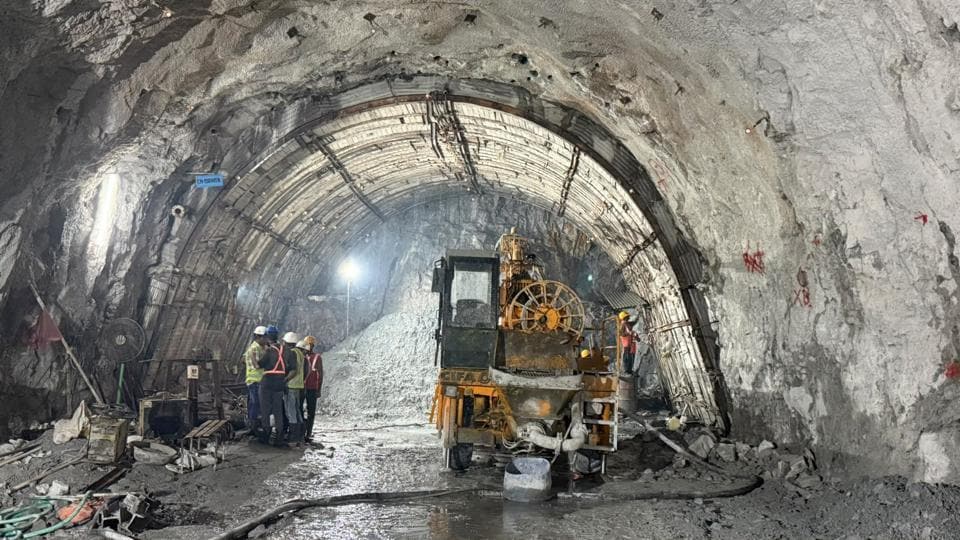
The breakthrough comes more than a year after the deadly tunnel collapse on February 22, 2025, which claimed the lives of eight workers and forced authorities to abandon the original alignment in the affected stretch.
The latest achievement is significant as the shear zone encountered on the new alignment posed a major challenge to excavation because of unstable rock conditions and high geological risks.
A shear zone is a weak geological formation created by intense pressure and stress, causing rocks to shift, fracture and become loose and unstable. The shear zone along the revised SLBC alignment extended for about 10-15 metres. “It took nearly a month to cross the vulnerable stretch safely,” an official of the state irrigation department said.
The ₹4,600 crore tunnel project aims to transfer Krishna River water from the Srisailam reservoir to provide irrigation to four lakh acres in the erstwhile combined Nalgonda district and drinking water to 516 villages en route.
Of the total 44-km main tunnel, a 20.5-km stretch was completed from the Devarakonda end and another 14 km from the inlet end at Domalapenta. Two tunnel boring machines were deployed from either side to expedite the work.
With only 9.6 km left to be drilled from the inlet side deep in the Nallamala forest range, the tunnel collapsed on February 22, 2025, within four days of work commencing, trapping eight employees, including two project engineers.
Subsequent investigations revealed that the accident occurred due to a similar geological formation. Extensive seepage had been detected and grouting undertaken to control it. However, the intervention resulted in a huge reservoir-like accumulation beneath the surface. When the Tunnel Boring Machine (TBM) advanced into the area, the ground collapsed, killing eight workers.
Following the accident, experts concluded that continuing excavation with the TBM through the affected geological conditions was not feasible. The Telangana government ordered a de novo review and shifted the alignment to a point about 100 metres before the accident site. A bypass tunnel was subsequently taken up along the revised alignment.
According to the official quoted above, the excavation strategy has also undergone a major change. The TBMs, which proved unsuitable for the complex geology of the Nallamala hills, were abandoned, and authorities adopted a drilling-and-blasting methodology supported by close geological monitoring and immediate ground support.
In February this year, the state irrigation department roped in the National Geophysical Research Institute (NGRI) to undertake a helicopter-borne Versatile Time-Domain Electromagnetic (VTEM) survey, a high-resolution geophysical study, to identify faultlines in the Nallamala forest range. A transmitter mapped subsurface geological formations up to a depth of 1,000 metres, providing vital data about shear zones and underground water flows.
Based on the survey data, engineers proceeded with the realigned route carefully to avoid shear zones. “As part of the safety measures, steel pipes were inserted into the rock strata well ahead of excavation and grouting was undertaken to strengthen the roof and side walls. Work was resumed only after the ground was assessed to be sufficiently stable,” the official said.
Instead of excavating the entire shear zone in one stretch, workers proceeded cautiously in small sections. Each portion was immediately secured using rock bolts, shotcrete and steel girders to prevent loose rock and soil from collapsing. “This step-by-step approach enabled workers to safely negotiate the most hazardous portion of the revised alignment,” he said.
Colonel Parikshit Mehra, who had worked with the Border Roads Organisation and has expertise in constructing tunnels in the Himalayan ranges, was engaged as the tunnelling secretary by the state irrigation department. He is now playing a crucial role in the SLBC tunnel rescue effort.
“We have now crossed the most dangerous shear zone successfully and every step of the bypass tunnelling work was being undertaken with utmost caution,” Mehra said.
According to him, the bypass tunnel has been excavated for about 141 metres from the inlet side. The revised alignment is expected to rejoin the outlet-side alignment after another 240 metres of excavation.
Despite successfully crossing the shear zone, engineers are maintaining a high degree of caution as further vulnerable geological formations have been identified along the remaining stretch.
The official quoted above said the NGRI has identified four additional danger zones along the remaining portion of the tunnel, due to Nallavagu, a stream flowing over the tunnel alignment. “However, we are confident of overcoming these hurdles by closely monitoring the excavation using sensors at every stage,” the official added.
The government is now targeting completion of the project by May 2028. Once completed, the 43.930-km SLBC tunnel is expected to become the longest tunnel constructed in India from just two portals, marking a major milestone for Telangana’s irrigation infrastructure.


