
 E-Paper



Ukraine relief, Indo-Pacific boost form core of 2+2 talks
With the Russian invasion of Ukraine emerging as a key point of discord in recent weeks, the joint statement found a way to bridge the differences between the two sides.

 Prefer HTon Google


Bridging their differences on the crisis in Ukraine, India and the United States, at the 2+2 ministerial dialogue, recommitted to the bilateral strategic partnership, articulated their shared interest in securing a free and open Indo-Pacific, hailed Quad “as a force for global good” and reviewed mutual efforts to respond to the worsening humanitarian crisis triggered by the Russian invasion.
The two countries have also taken the next steps in their defence and space cooperation – they signed a memorandum of understanding on space situation awareness, they will conduct a dialogue on space and artificial intelligence this year, India has become an associate member of the combined maritime forces task force in Bahrain, and the US has acknowledged India’s focus on developing its domestic capabilities and promised to explore co-production and co-development.
Defence minister Rajnath Singh and external affairs minister S Jaishankar met their American counterparts, secretary of defense Lloyd J Austin and secretary of state Antony J Blinken for separate bilateral conversations, participated in the virtual conversation between President Joe Biden and Prime Minister Narendra Modi, led delegation level 2+2 talks, and addressed the press on Monday in Washington. Blinken also hosted a dinner for the visitors and Austin. A joint statement was issued at the end of the ministerial dialogue, the first under the Biden administration.
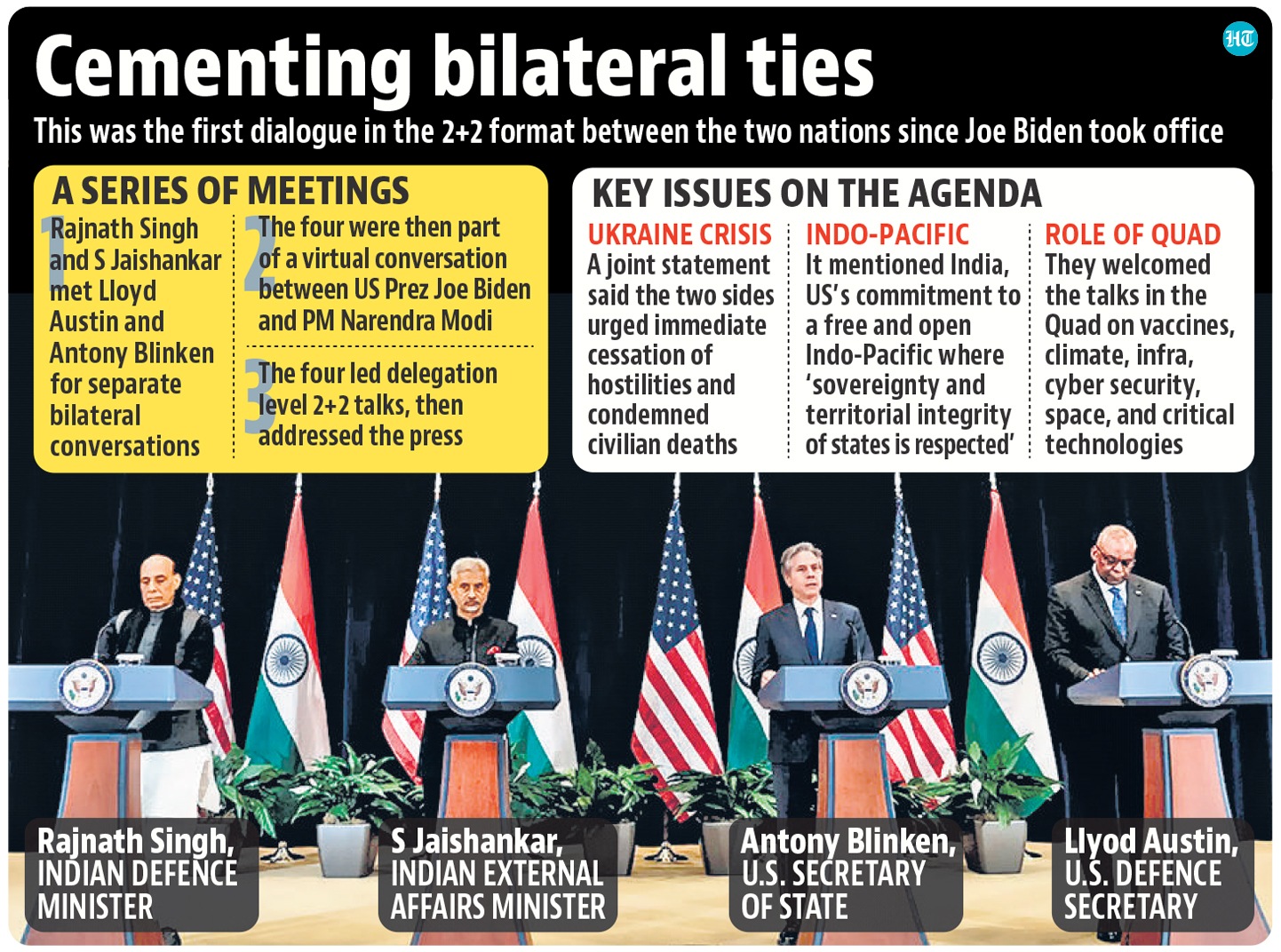
With the Russian invasion of Ukraine emerging as a key point of discord in recent weeks, the joint statement found a way to bridge the differences between the two sides. It said that the ministers reviewed mutual efforts to respond to the humanitarian crisis in the country and assessed its broader implications. “They urged an immediate cessation of hostilities. The ministerial unequivocally condemned civilian deaths. They underscored that the contemporary global order has been built on the UN Charter, respect for international law, and the sovereignty and territorial integrity of all states.” India has articulated these principles in its approach to the crisis in the past, but it is the first time they find space in a joint India-US statement.
Blinken said that the US will continue to increase its support to Ukraine, and called on other nations to do the same and condemn Moscow’s increasingly brutal actions. “In our judgement, it is important that all countries, especially those with leverage, press Putin to end the war. And it’s also important that democracies stand together and speak with one voice.” But the secretary of state also noted that India made “very strong statements” in New York at the UN, condemned civilian killings, called for an independent investigation and provided significant humanitarian assistance to Ukraine and placed India’s engagement with Russia in a historical perspective, acknowledging the US’s own reluctance in the past to be a close defence partner.
“India’s relationship with Russia has developed over decades at a time when the US was able to be a partner to India. Times have changed. Today, we are able and willing to be a partner of choice with India across virtually every realm – commerce, technology, education, and security. And that was very much the nature of the conversation we had today,” the secretary of state said.
Commenting on the larger political and strategic message of the dialogue, political scientist Devesh Kapur at the Johns Hopkins University said that while fact that there are differences on Ukraine cannot be brushed under the carpet, both countries had shown they had their eyes on the long term.
“Major powers will have their own interests, and these interests won’t always coincide, even among friends. But if you are unable to look beyond the short term, then it shows that the relationship did not have much ballast to begin with.” The fact that there weren’t any “histrionics”, Kapur said, indicated a level of maturity and strength in ties. “Both governments have actually handled this far more maturely and focused on commonalities than many observers who have focused only on differences.”
A key focus of the joint statement as well as the ministerial remarks was the shared convergence in the Indo-Pacific. The statement spoke of India and the US’s commitment to a “free and open Indo-Pacific in which the sovereignty and territorial integrity of all states are respected, and countries are free from military, economic and political coercion”, and reaffirmed their dedication to regional stability and prosperity “with an inclusive regional architecture, abiding by the rule of law, freedom of navigation, peaceful resolution of disputes and ASEAN centrality”. India and the US also highlighted the importance of adherence to international law to meet challenges to the “rules-based order, including in the South China Sea”.
Austin was the only cabinet member to repeatedly highlight China’s aggression and attempts to “refashion the region and the international system to serve its authoritarian interests”. But each of the principles highlighted in the statement on the Indo-Pacific is seen as a signal to China, which has been accused of violating the rules-based order, coercing neighbours, attacking sovereignty and territorial integrity of other countries, and making unlawful claims in the seas.
India and the US also hailed Quad, with Jaishankar saying, “We appreciate the attention and energy devoted by the US to the Quad. Its elevation and intensification in the last year benefits the entire Indo-Pacific. Indeed, the Quad has emerged as a powerful force of global good.” The ministers welcomed the discussions in the Quad working groups on vaccines, climate, infrastructure, cyber security, space, and emerging and critical technologies. Vaccine production and distribution has emerged as the flagship initiative of Quad over the past year, with Blinken saying, “We are working through the Quad vaccine partnership, with our colleagues in Australia and Japan, to make these vaccines available throughout the Indo-Pacific. As of today, Quad partners have collectively provided more than 500 million vaccine doses; we are rapidly expanding production to make more at the Biological E facility in India.” The next Quad leaders-level summit is scheduled for this summer in Tokyo.
A core strategic component of the discussions was cooperation in defence, across domains. The ministers reaffirmed their commitment to building “an advanced and comprehensive defence partnership in which the US and Indian militaries coordinate closely together across all domains”.
On space, the agreement on space situational awareness is expected to help India get information which will help it with both space debris management and space asset security. Explaining its strategic significance, Ajay Lele, a senior fellow at Delhi’s Manohar Parikkar Institute for Defence Studies and Analysis, said, “SSA is important to trace activities in space. Till date, only the US has a major network to do so. We all came to know about China and Russian ASAT (anti-satellite weapons) because the US told the rest of the world about it. To monitor counter-space activities, it is important and the collaboration indicates that India and the US can jointly keep a watch on China’s space warfare programme.” The ministers also welcomed plans to hold an inaugural space dialogue in 2022, as well as an inaugural Artificial Intelligence dialogue “to harness opportunities for joint innovation and cooperation in new domains”.
The ministers welcomed the progress made towards the “full implementation” of the Basic Exchange and Cooperation Agreement – a foundation defence agreement India and the US signed in 2020 – “to support the exchange of geospatial information”. They acknowledged the central role played by their respective navies in advancing shared interests in the Indian Ocean Region and the wider Indo-Pacific and discussed deeper maritime cooperation, “including in underwater domain awareness.” To support the Indian military’s expanding operational outreach, the ministers also welcomed bilateral logistics operations “such as replenishments at sea, air-to-air and ground refueling” and committed to increasing such cooperation, including through the Logistics Exchange Memorandum of Agreement (LEMOA), another foundational agreement signed between the two countries in 2016.
India and the US also agreed to support increasing the “scope and complexity” of regular bilateral and multilateral military exercises, as well deepen cooperation between special forces. They welcomed projects under the Defence Technology and Trade Initiative, including a project agreement to co-develop air launched unmanned aerial vehicles. With defence minister Singh strongly advocating India’s indigenisation efforts, the ministers committed to work closely across their respective governments on “co-production, co-development, cooperative testing of advanced systems, investment promotion, and the development of maintenance repair and overhaul facilities in India”. They also agreed to explore the possibility of the US using Indian shipyards for repair and maintenance of US maritime sealift command to support mid voyage repair of US naval ships. Austin said that the US recognises India as a “defence industrial leader in the Indo-Pacific and a net provider of security in the region”.
Explaining the significance of the concrete announcements, Sameer Lalwani of the Stimson Center said that while the new activities in space, cyber, and artificial intelligence domains were exciting, the most notable parts of the 2+2 readout on the strategic side included the commitment to building routine military cooperation, including the regular exercise of logistics cooperation like underway replenishment, and India’s agreement to join the Combined Maritime Forces Task Force as an Associate Partner.
“We need to see more details, but this potentially suggests that the US and India are going to not only participate in joint exercises but share in joint operations and missions. That would be a big step forward for defence cooperation in the Indo-Pacific.”


