E-Paper



Uttarakhand CM announces study of other hill towns’ carrying capacity
Experts have attributed the high load of new buildings and the drainage of thousands of litres of household waste-water into the ground daily in the absence of a sewerage network as one possible reason for the town sinking slowly.

 Prefer HTon Google


Uttarakhand chief minister Pushkar Singh Dhami on Wednesday announced that the state would conduct a so-called carrying-capacity study of different hill towns following subsidence in Joshimath town, which has exponentially grown in recent decades.
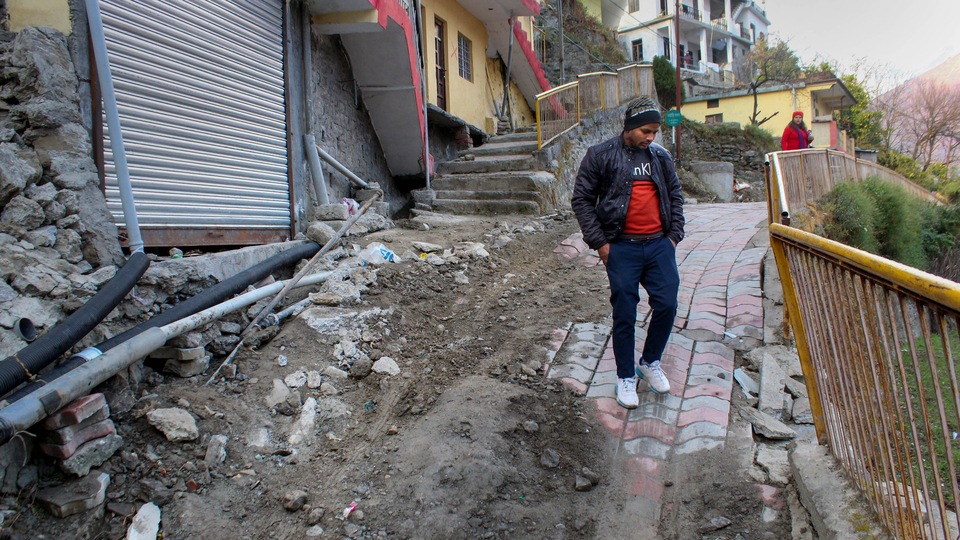
Experts have attributed the high load of new buildings and the drainage of thousands of litres of household waste-water into the ground daily in the absence of a sewerage network as one possible reason for the town sinking slowly. Based on satellite imagery, the Indian Remote Sensing Agency has said that Joshimath town sank by 2.5 inches every year between 2020 and March 2022.
To be sure, experts have also highlighted other factors, including large infrastructure projects such as NTPC’s Tapovan hydro power one, and the Char Dham road project.
The Uttarakhand hills are overburdened, and Dhami admitted that this could result in subsidence in the future. “There is a growing concern about the carrying capacity of hill towns. We will conduct studies on the carrying capacity of Joshimath and other hill towns of the state. If there are more constructions than the carrying capacity of the towns, then construction will be immediately stopped in such towns.”
YP Sundriyal, professor of Geology at HNB Garhwal University, Srinagar said towns such as Karanprayag (where houses have developed cracks), Gopeshwar, Guptkashi, Mussoorie, Srinagar, Tehri, Almora, Pithoragarh and Munsiyari have developed beyond their carrying capacity.
“The root cause is that in the last two decades of state’s formation, the concretisation of the hill towns has increased, with people from villages moving to hill towns which have better education and healthcare facilities and employment opportunities. This has led to increase in population of these hill towns, burdening their terrain, especially with water seeping into ground creating sub-terraneous cavities in the absence of the proper sewerage networks,” he explained.
Sundriyal added that unregulated concretisation of Himalayan towns can precipitate Joshimath-like tragedies. “When the state wants to go ahead with a project, government geologists toe the government line. Here in Srinagar, we are opposing the construction of road on the fragile slopes . But the government’s geologist declared the site fit for construction.”
Experts said one indicator of the hills getting burdened is the 2,000 major landslides reported in the state since 2015 . Extreme weather events -- these are becoming more frequent on account of the climate crisis -- make things worse. The state has recorded over 7750 extreme rainfall events and cloud bursts since 2015, according to the latest report of Uttarakhand State Disaster Management Authority.
MPS Bisht, Director, Uttarakhand Space Application Centre said all the hill towns need a site specific plan, which takes account of all the issues, including slope angle, terrain type, load bearing capacity of soil, seismic patterns in the area, and overall carrying capacity of the terrain. “Most of the structures that are coming up on the fragile slopes of hill towns are not following the National Building Code. Many hill towns have multi-storeyed buildings. One can see what happened to the two hotels in Joshimath, which have inclined towards each other and need to be demolished now.”
Kalachand Sen, director at the Wadia Institute of Himalayan Geology said there is need to develop a long-term strategy with regard to what projects and constructions should be allowed in sensitive Himalayan valleys. “Himalaya are seismically active and rising every year, so there will always be some sort of slope stability issues. When this is coupled with anthropogenic issues, the situation can get aggravated. So, we have to take a call on what needs to be allowed in fragile areas and what should be totally prohibited.”
This is not the first time the Uttarakhand government is talking about conducting carrying capacity studies. Hemant Dhyani, former member of Supreme Court appointed High Powered committee (HPC) on Char Dham Project, said the Uttarakhand Action Plan for Climate Change which came in force in 2014, has talked about conducting carrying capacity studies , but not followed up.
That plan mentioned the adverse impact of growth of religious places as centres of tourism, increasing anthropogenic burden on the hill towns and poor disaster management planning as concerns. “It took the Joshimath crisis for the government to finally wake up to the concerns about the fragile ecology of the Himalaya,” he said.
The high-powered committee had suggested a daily limit of pilgrims to Char Dham shrines -- 5000 a day in Kedarnath , 6000 in Badrinath , 3500 in Yamunotri, and around 4000 in Gangotri . But the government allowed more 15,000 people to Kedarnath and more than 17,000 to Badrinath last year, Dhyani said.
There is also a growing fear in the state that two of its most popular large towns, Nainital and Mussoorie, could see significant subsidence.
Nainital has been giving signals of this since 2018 , experts said.
In 2018, a 25-metre stretch of the famous Mall Road caved into the lake waters. In August 2021, the other side of the lake, Thandi Sadak, witnessed a major landslide, with big boulders falling into the lake waters.
Close to 48000 people live in over 7000 structures on the town’s slopes. The population has swelled, from 7,589 in 1881 . And the number of constructions/buildings in Nainital, most of them on the slopes, has increased from 520 in 1901-02.
Vishal Singh, an expert on Himalayan water bodies and deputy executive director at Doon-based Centre for Ecology Development and Research (CEDAR) said that due to various factors including climate change and demographic changes, the water flow from water sources in Mussoorie has come down marginally. “In the case of Nainital, which has a history of geological disturbances, the situation has been further aggravated by increasing population, concretisation and other related issues. There is a need to put a check on this concretisation which is burdening the fragile slopes.”