
 E-Paper



Weather trends show Capital no longer gets benign fog
Natural fog is white in colour but in the northwest India region, the colour of the fog changes depending on the dominant pollutant in that region.


For years now, the Capital and its surrounding cities have not had natural episodes of fog — cloud-like formations at the ground level that consist mostly innocuous of water droplets suspended in the air. Instead, it has been a toxic cocktail of nitrates, magnesium and fluoride compounds, a new government study has found.

The ministry of earth sciences conducted an analysis to study the chemical composition of fog in northwest India, including Delhi, between 2016 and 2021, and its findings tie in with what many living in the Capital know from experience: fog has stopped being white and thick, and is now grey, with often a mildly acrid smell.
In other words, the city stopped having experiences fogs and it is almost always a smog.
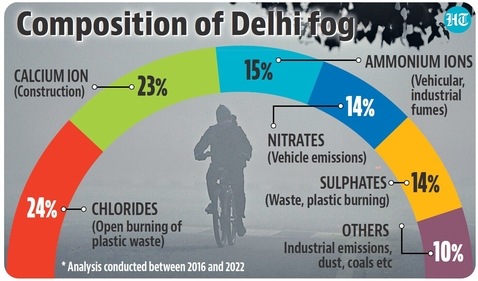
According to the study, the episodes of fog studied in the five-year period had large share of chlorides, sulphates and nitrates, and ions of calcium and ammonium — all of these are primarily by-products of vehicular emissions, waste burning and construction activities.
“Natural fog is white in colour but in the northwest India region, the colour of the fog changes depending on the dominant pollutant in that region. For instance, in Delhi, the colour of the fog is generally grey because of the high vehicular emission in this region. If you go to areas with high number of industries or areas where burning activities are rampant, the colour of the fog will be black,” said a senior official of the ministry of earth sciences, requesting anonymity.
For citizens, the study is yet another reminder of why being outdoors in the winter is dangerous. Inhaling air polluted with chlorides leads to immediate irritation in the nose, throat and eyes, and, over a long time, can cause respiratory distress. Sulphates can cause reduced lung function and aggravate an illness like asthma and nitrates can cause weakness, increased heart rate, and dizziness.
A senior scientist in the ministry, who was involved in the analysis, said waste burning, landfill fires, plastic burning and coal combustion are the major sources of such emissions, and the problem predates the study by years.
“This particular analysis is a result of samples collected over the last five years, but our studies around this topic are older than this. What we have come to understand is that Delhi and its neighbouring towns including Gurugram, Noida, Faridabad, Sonipat etc witness smog, which makes it difficult for people to stay outside in such conditions for prolonged periods. This is essentially concentrated pollutants that stick around close to our noses and mouths,” the scientist said.
According to India Meteorological Department’s (IMD) glossary, fog is when water droplets or ice crystals form very close to the surface, as a consequence of cold weather and high humidity. Smog, on the other hand, is when pollutants mix with the water droplets in the atmosphere to create an opaque layer that leads to lowered visibility.
In recent years, the Met department has largely been using “smog” as the terminology to define the phenomenon of reduced visibility in Delhi-NCR during December and January months.
The analysis found chlorides comprised the highest share of fog (24%), followed by calcium ions (23%), ammonium ions (15%) and nitrates (14%). Other pollutants that were found in the Capital’s fog were sulphates (14%), magnesium ions (4%), sodium ions (3%), potassium (2%) and fluorides (1%).
A 2021 study conducted by researchers from the Indian Institute of Tropical Meteorology (IITM) in Madras highlighted that open burning of waste, especially plastic, as the primary cause for fog and haze formation over north India.
The problem is not entirely surprising — people, especially those who are left or need to be out in the open, burn wood to stay warm.
But it was not just simple bonfires that were to blame. The study showed how complex chemical reactions involving hydrochloric acid, which is emitted from the burning of plastic waste and from the exhausts of certain types of industries, was responsible for high PM2.5 (ultrafine particulate matter with diameter less than 2.5 micrometres), which during winter months led to the formation of haze and fog over Delhi and nearby areas.
Dr Arvind Kumar, chairperson of the institute of chest surgery at Medanta and founder and managing trustee of Lung Care Foundation, said: “I see the impact of air pollution on the lungs of my patients every day while operating and some of the cases are just scary. Prolonged exposure to high levels of air pollution will have varying impacts on different people’s health but the impact would certainly be there. We are paying the price of staying in this part of the country with our health and life span.”
Madhavan Rajeevan, former secretary ministry of earth sciences, explained that “smog” was not a problem that was specific to Delhi but was a problem seen in the entire Indo-Gangetic Plains (IGP). However, the chemical-make of the fog changes as the dominant pollutant in the area changes.
“The primary requirements of fog or smog in case of Delhi, is low or no winds, low temperatures and humidity. When the wind speed improves and sun comes out, the fog tends to disperse,” Rajeevan explained.
Mahesh Palawat, vice-president (meteorology and climate change) at Skymet Weather Services, a private weather forecaster, said that the larger role of climate change is not established in the changed composition of fog over northwest India.
However, studies have shown that in the 1990s, Delhi’s fog was white in colour, thicker and would take longer to disperse, as is in the case of natural fog.
“In the 90s we used to see white fog over Delhi, which used to be thicker and would also take days to disperse. Now, we see relatively thin fog, which easily dissipates as soon as the sun comes out or when winds improve even slightly. This is proof that pollutants have been driving the fog in Delhi for the last few years,” said Palawat.


Stay updated with all top Cities including, Bengaluru, Delhi, Mumbai and more across India. Stay informed on the latest happenings in World News along with Delhi Election 2025 and Delhi Election Result 2025 Live, New Delhi Election Result Live, Kalkaji Election Result Live at Hindustan Times.


