E-Paper



With President Murmu’s Odisha visit, BJP targets tribal votes ahead of polls
Though the BJP has made a bold move by making Droupadi Murmu the first tribal President of the country, not many are sure whether it would impact the voting

 Prefer HTon Google


Bhubaneshwar: President Droupadi Murmu concluded her four-day visit to Odisha on Saturday with her visit to Madhupur in Sambalpur district where she paid tributes to Santha Kabi Bhima Bhoi at his birthplace. This was her fourth visit to the state after holding the top Constitutional post in July 2022. Her visit has given hope to the Bharatiya Janata Party (BJP) for a consolidation of tribal votes in the forthcoming Lok Sabha and assembly elections.
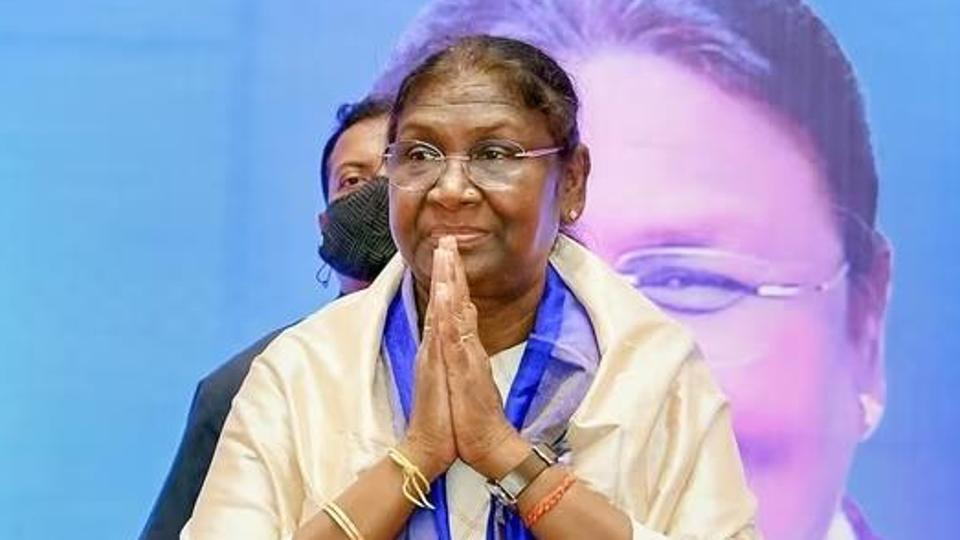
During her visit to her home state, she inaugurated the Ekalavya Model Residential School for tribal students in the Badasahi area of the tribal-dominated Mayurbhanj district, and also laid the foundation stone of various developmental projects. She also met the Juanga tribals in Keonjhar district.
Ever since Murmu was elected as India’s first tribal President, Prime Minister Narendra Modi and the BJP leadership have not stopped talking about the party’s interest for the community in the forefront with an eye on the crucial tribal votes.
As per the 2011 census, the tribal community comprises 22 per cent of the state’s population, but the question is, which side will they favour in the forthcoming polls?
Odisha has the third largest concentration of tribal population after Madhya Pradesh and Maharashtra.
Also Read: Murmu says peace, harmony essential for human existence
According to the Election Commission of India (ECI) statistics, 33 of the 147 assembly seats and five of the 21 Lok Sabha seats are reserved for tribals. Apart from these constituencies, tribal comprise more than 15 per cent of the voters in 35 other assembly and seven Lok Sabha constituencies making them crucial in at least half of the Lok Sabha and assembly constituencies.
Of the 33 tribal seats, the BJP in the 2019 assembly polls bagged 11 while the Odisha chief minister BJD won 20 seats, and in the 2019 general elections, of the five Lok Sabha tribal seats, the BJP and BJD won two seats each, indicating BJD’s hold over the tribals.
BJP’s performance in tribal-dominated districts such as Mayurbhanj and Keonjhar was dismal in the 2022 panchayat polls, with the party winning just three zilla parishad seats from 93 seats in those districts.
Though the BJP has made a bold move by making Droupadi Murmu the first tribal President of the country, not many are sure whether it would impact the voting.
Sandeep Sahu, the author of “Madam President: The Biography of Droupadi Murmu”, said he does not see Murmu’s ascension to the high office impacting tribal voting in favour of the BJP.
“It may have limited impact in her home district Mayurbhanj and partly in neighbouring Keonjhar, but I don’t see it having any impact in other districts. The BJD through its social welfare schemes has been deeply entrenched among tribals for the past several years and it may be difficult for BJP to counter that,” said Sahu.
Pritam Padhi, the tribal MLA from Koraput’s Pottangi constituency, echoed Sahu, saying his party’s micro-management of tribals is too strong to wish away.
“The BJP is indeed using the President to wean away the tribals to its fold, but it would never work. Starting from Mo Jangal Jami Yojana in which recognition of community rights of tribals over forest lands has been done by the government since last year to dropping of 48,000 petty cases against tribals, the Naveen Patnaik-led government has myriads of schemes for the tribals. When they are getting so much help from the government why would they vote for the BJP,” Padhi said.
BJP MLA from Jashipur in Mayurbhanj Ganesh Ram Singh Khuntia said his party would repeat its 2019 performance where it won the Mayurbhanj Lok Sabha seat.
“Though we did badly in the 2022 panchayat polls, the situation would be different in 2024 general polls as issues are different. After Murmu became the President, the train connectivity from Mayurbhanj to several places has improved vastly with the introduction of new trains. At least two new Ekalavya Model Residential Schools have come up in the district apart from a new postal division and a skill training hub. Tribals are impressed seeing the pace of development in the region in the last two years and we are confident of doing well,” said Khuntia.
Also Read: New species of marine slug found in Odisha named after President Droupadi Murmu
Khuntia said tribals in Odisha, particularly those from the vulnerable tribal groups would gain from the Centre’s ‘Particularly Vulnerable Tribal Groups Development Mission’ which was launched in January this year with an annual budgetary allocation of Rs.15,000 crore.
The programme, which rolled out amidst the ongoing election aims to saturate PVTG families and habitations with basic facilities such as safe housing, clean drinking water and sanitation, improved access to education, health and nutrition, road and telecom connectivity, and sustainable livelihood opportunities.
“Odisha with 8.6 lakh [860,000] PVTG households has the highest such population in the country and they would benefit immensely. We would go to the tribals with the development message of the government,” Khuntia said.
Tribal leader Gopinath Majhi who heads Campaign for Survival Dignity, a tribal organisation in Odisha, said the community was unlikely to ditch Patnaik despite the outreach by the BJP.
“The tribals are not dissatisfied with the government. The government has been by and large very responsive to our demands,” he said.
Explaining how the Patnaik-led government has supported the tribals in the demands, Majhi said that when the government amended the Orissa Scheduled Areas Transfer of Immovable Property (by Scheduled Tribes) Regulations, 1956 last year allowing the sale of tribal land to non-tribals, it also withdrew after swift opposition from the community.
Similarly, the announcement of the purchase of 60-odd minor forest produce such as tamarind, mahua seeds and sal seeds from around one lakh [100,000] tribals at a minimum support price (MSP) would be a great help to tribal, said Majhi.
Majhi said as six million tribals are dependent on forests for their survival for three to five months a year, the MSP for minor forest produce would act as economic support for tribal women. In Odisha, eight out of ten forest gatherers are women.