
 E-Paper



Young and younger: Falling age of students’ union leaders in India
An analysis of the age certificates provided by the candidates showed that the average age of the winner has fallen in the last five years, indicating that younger leaders were being elected to students’ bodies.


Leaders of students’ unions in India’s premier universities are not as old as commonly perceived.
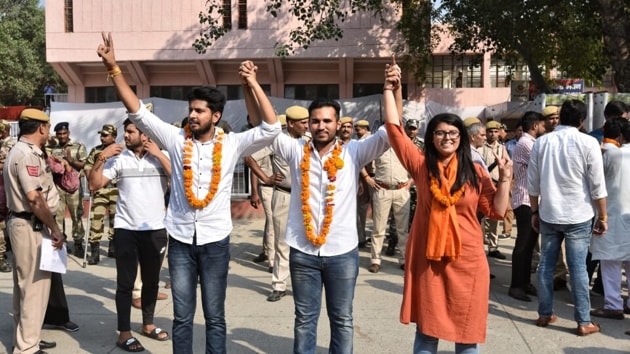
An analysis of the age certificates provided by the candidates showed that the average age of the winner has fallen in the last five years, indicating that younger leaders were being elected to students’ bodies.
The average age of office-bearers of students’ union of seven major universities across the country is 22.5 years, according to age certificates of the winners in the students’ body elections. However, the fall in the average age of the office-bearers is just about 0.5 years and not very dramatic.
It was the Lyngdoh Committee, constituted to introduce reforms in students’ union polls, that in 2006 recommended an age limit for contesting student union elections in all universities and colleges.
The age limit for undergraduate students was prescribed between 17 to 22 years with relaxation offered for professional colleges, where courses range between four to five years.
For post-graduate students, the maximum age was recommended between 24-15 years and for research students, it was 28 years. Only full-time students were allowed to contest students’ union elections by the committee.
HT reporters collected data on age of the officer bearers in students’ unions in Panjab University (PU), Allahabad University (AU), Jadavpur University (JU), Jawaharlal Nehru University (JNU), Delhi University (DU), Rajasthan University (RU) and Patna University (PU) to see whether age plays any role in students’ body polls.
It was found that it may not be so when a student decides on their vote but the data shows that the average age of students’ union leaders in these universities, except JNU, had fallen from 23 years in 2014 to 22.5 years in 2018-19.
One of the most dramatic case studies is from Allahabad University, which has a history of students’ union leaders with an age of more than 50 years.
Former vice-president of Allahabad University Students Union (AUSU) Abhay Awasthi recalled that in 1970 Jagdish Chandra Dixit became the president at an age of 52 and Laxmi Shankar Ojha got elected to the union when he was 52 in 1979. It was also the year his daughter graduated from the university.
In 2018, the average age of office-bearers of the AUSU was 25 and the reason for this was the Lyngdoh Committee fixing 28 years as the upper age limit to contest, which became applicable from 2012.
“The age may have fallen but earlier AASU leaders were more politically aware than those now,” Awasthi, now a Congress leader, said.
While students in the age group of 20 are now joining students’ politics, postgraduate students in 24 to 28 year age group have mostly won elections at Allahabad University in the last five years, said 2015 AASU president Richa Singh. Singh was the first woman president of the 96-year-old students union.
The students’ union elections for this year are yet to be held at Allahabad University.
In West Bengal’s JU, one of India’s most politically active higher education centre, the average age of the union leaders in undergraduate is 20 and postgraduate 22. The university has three student unions - Arts Faculty Students’ Union (AFSU), Faculty of Engineering and Technology Students Union (FETSU) and Science Faculty Students Union (SFSU).
“JU students’ unions have traditionally seen students of under-graduate second and third years and post-graduate first year filling up most of the posts of office-bearers,” Srijan Bhattacharya, SFI’s West Bengal state unit secretary, said.
“In recent years, we have seen younger students taking up student politics aggressively,” said Bhattacharya, who graduated in 2017 after completing UG and PG studies.
Data shows the average age of leaders elected to Panjab University Campus Student Council (PUCSC) in the last five years is 22 years. It was 23.5 years in 2014, which had fallen to 20.5 years in 2018.
Between 2014 and 2019, Nishant Kaushal, president of PUCSC in 2016, was the oldest winner whereas Vipul Atray, who was elected as joint secretary in 2018, was the youngest. Kaushal was 24 and Atray 19 when they were elected.
“I joined Panjab University in 2006 and in 2016 most of the party leaders were not fulfilling the Lyngdoh committee’s age criteria and I was asked by the party to contest,” Kaushal said.
He added that many younger students have keenly participated in the students’ union and have also been elected.
In Delhi University, where students’ union leaders include former finance minister Arun Jaitley and former urban development minister Ajay Maken, Akshit Dahiya, a first-year law student, created a record by becoming the youngest person at 20 to get elected since 1970.
His predecessors, Shakti Singh (2018), Rocky Tusheed (2017) and Amit Tanwar (2016), were 23 when they took office. In 2015, the-then DUSU president Satendra Awana was 21 when he got elected. The average age of students’ union office bearers in the past five years has been 21-22 years.
Delhi University’ Dean of Students’ Welfare Rajeev Gupta said the shift towards younger students’ union leaders could be attributed to the Lyngdoh Committee’s suggestions.
“For instance, the attendance criteria (of 75%) and academic record of the previous year does not apply to new admissions. If you think critically, the Lyngdoh criteria are less applicable for first-year or freshers,” Gupta said.
In JNU, which primarily caters to post-graduate students and PhD scholars, the average age of students’ union members in the last five years has been 24 years.
Over the last five years, the age of JNU students’ union (JNUSU) president has declined with this year’s winner, Aishe Ghosh, getting elected at an age of 24. But before her, Geeta Kumari (2017) and Rama Naga (2015) were elected when they were 23.
This year, Rajasthan University students elected the youngest students’ union president in the last five years. Twenty-three-year-old Pooja Verma was elected as the president of the Rajasthan University Students’ Union (RUSU).
In the last four years, all the presidents were in the age group of 24 to 25 years. According to university data, the average age of other office-bearers has also come down in the last five years or so.
“Age is not really a factor in politics but it is always better for those who start early. Many now choose politics as a career quite early,” said Vinod Jakhar, who was RUSU president in 2018.
Patna University, whose former presidents include former Bihar chief minister Lalu Prasad, Bihar deputy chief minister Sushil Kumar Modi and Union law minister Ravi Shankar Prasad, now has a students’ union with an average age of 20 years, down from 22 in 2014.
Patna University held students’ union election in 2012, after a gap of 28 years.
Former chairperson of the University Grants Commissioner (UGC) Professor Ved Prakash also pointed out that the recommendations of the Lyngdoh Committee have worked.
“Not only the age has come down, but there are also lesser reports of malpractices in students’ unions now. All thanks to Lyngdoh committee,” said Ved Prakash.
(With inputs from Farqan Siddiqui in Allahabad, Fatiha Iftikar in New Delhi, Snigdhendu Bhattacharya in Kolkata, Dar Ovais in Chandigarh, and Megha in Patna)


