A mid-year victory lap: The Sporting Life by Rudraneil Sengupta
Indian stars are shining in cricket and in track-and-field. But the legends to beat this year will be the women’s hockey team. The story of how they went from underdogs to fighting fit is a riveting one.
It’s been a hectic few weeks in Indian sports — England trumping India in that long-delayed fifth Test of a series that should have been played a year ago, Neeraj Chopra dropping his own national record like pins in a bowling alley, long-jumper Murali Shreeshanker notching up two of the five best jumps in the world so far this year, and…
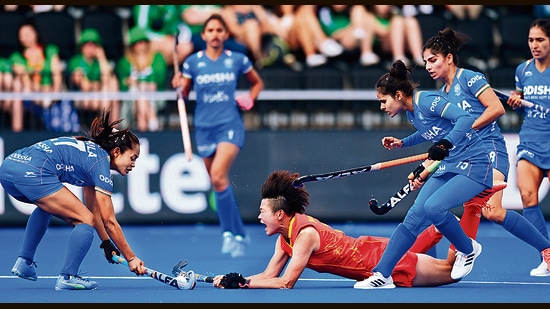
India play China at the FIH Hockey Women’s World Cup in the Netherlands last week. If they seem buoyed and confident, it’s because they don’t just suspect they might win. They have data that shows them they can. (Hockey India)
How many of you are following the Indian women’s hockey team at the World Cup? They seem to slip in and out of our consciousness, but if it wasn’t for Chopra’s historic javelin gold, the Rani Rampal-led team’s wild ride to the bronze medal playoff match at Tokyo would have been the most thrilling story for India at the 2020 Olympics.
Now here they are, in their first major tournament since those crazy days in Tokyo. They have already held England and China, but gone down in a nail-biting match to New Zealand. It reminded me of how the team, pretty much hopeless and hapless after losing all their matches in Rio 2016, made their turnaround at Tokyo 2020.
“Tokyo was crazy, gives me goosebumps just to think about it even now,” said Wayne Lombard, who had worked as the Indian team’s scientific advisor from 2017 till the end of 2021 and is now working with the South African women’s team.
The team had some severe disadvantages going into Tokyo. They had not been a part of the FIH Pro League (they made their entry last year, after Tokyo). None of the players had played in any of the top national leagues (like the Dutch league) around the world. Simply put, they had not competed against quality opposition in a long time.
“If nothing else, we knew we had to be physically at par with the best, if not better,” Lombard said.
How the team did that is the subject of an absorbing conversation that you can hear in full on HT Smartcast.
To condense a long story, the first step was to build a bank of data on each player, using GPS vests in training to map things like high-speed running, change-of-direction, acceleration, deceleration, total distance, yo-yo tests, sprint efforts, etc. At the same time, work was on to build a neuromuscular profile of each player. To test for strength: bench presses, pull-ups and squats calibrated to check for each player’s 3RM, or the amount of weight a player can push or squat three times before failing. To test for power and the athleticism: Countermovement jumps (CMJ) and pogo hops. A CMJ is done like this: the player is asked to stand in a spot, bend their knees just a little to prime the muscles of the legs and glutes, and jump straight up as high as possible, land by flexing again to absorb the energy, and jump back up without pause for three repetitions. A pogo hop is just 10 short jumps without a pause and without flexing the knees. These two simple things, done on something called a force plate gives sports scientists an amazingly rich set of data: how well the athlete’s central nervous system is working, how explosive the athlete is, how much force and how much power the athlete can generate — almost everything that makes an athlete good on the field (except lung power).
The coaching staff compared this data with the available data on top-flight hockey standards, comparing them position to position (each position makes different demands on the player). Now they knew the path each player needed to take to match top-flight physical standards.
That was three years of work, paying off in Tokyo.
“Man, the joy!” Lombard said.
The team is clearly building on that platform. If they seem buoyed and confident at the World Cup, it’s because they don’t just suspect they might win. They know they can.

 E-Paper