
 E-Paper



Archaeologists discover Mayan scoreboard in Mexico's Yucatan

 Prefer HTon Google


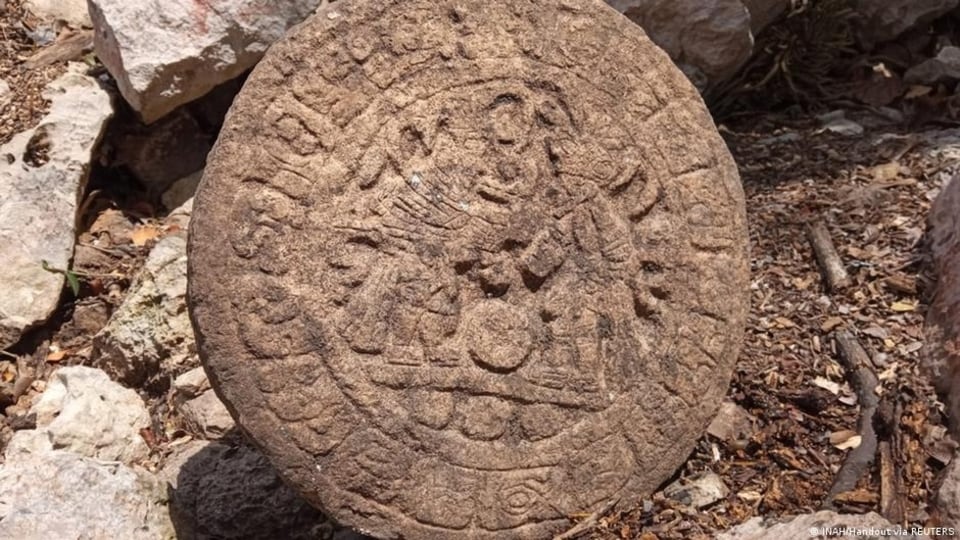
The piece displays Mayan hieroglyphic writing surrounding two players standing next to a ball. The Pok Ta Pok ball game was a traditional Mesoamerican practice.
An apparent stone scoreboard has been discovered at the Chichen Itza archaeological site in southeastern Mexico, archaeologists have said. The piece measures just over 32 cm (12.6 inches) in diameter and weighs 40 kilos (around 90 pounds). It dates from between 800 and 900 AD.
It displays Mayan hieroglyphic writing surrounding two players standing next to a ball, according to Mexico's National Institute of Anthropology and History (INAH).
"In this Mayan site, it is rare to find hieroglyphic writing, let alone a complete text," archaeologist Francisco Perez, who is coordinating investigations in the Chichanchob complex, said.
"The limestone circle, which has Mayan hieroglyphics on its edge and in the middle of it of Mayan dignitaries playing Pok Ta Pok, the pre-Columbian ball game, can change the history of the site by providing a new element that we were not aware of," Marco Antonio Santos Ramirez, director of the Chichen Itza archaeological site, said. (Also Read | Gond painting from Madhya Pradesh receives GI tag)
The Pok Ta Pok ball game was a traditional practice of Mesoamerican peoples.
Santos Ramirez said that the discovery was made thanks to investment in archaeological sites under President Andres Manuel Lopez Obrador's government.
INAH researchers are preparing to take high-resolution pictures of the stone for detailed study. They are also to prepare for its conservation.
What is Chichen Itza?
The Chichen Itza complex has been declared a World Heritage Site by UNESCO. It is one of the main archaeological centers of the Mayan civilization in the Yucatan Peninsula.
About 2 million people visit the site every year.
The Maya civilization was one of the most advanced to arise in Mesoamerica. The earliest Maya settlements were built in about 1,000 B.C..
Santos Ramirez told the EFE news agency that the text on the newly discovered stone could be the last hieroglyphics that reflect the Mayan culture of late antiquity, or around 650-900 A.D.
"Mayan classical literature stops at around 900 AD, during the glory days of Chichen Itza," Ramirez said. He said that the finding could provide new information on pre-Columbian Mayan society.
In May 2021, Lopez Obrador apologized to Mexico's indigenous Maya communities for "abuses" committed by "national and foreign authorities." Indigenous Maya people number almost 1.5 million people in southeastern Mexico and over 7 million in neighbouring Guatemala, where they make up just over 40% of the population.


