
 E-Paper



Duel purpose: Debunking the myth of the gladiator

 Prefer HTon Google


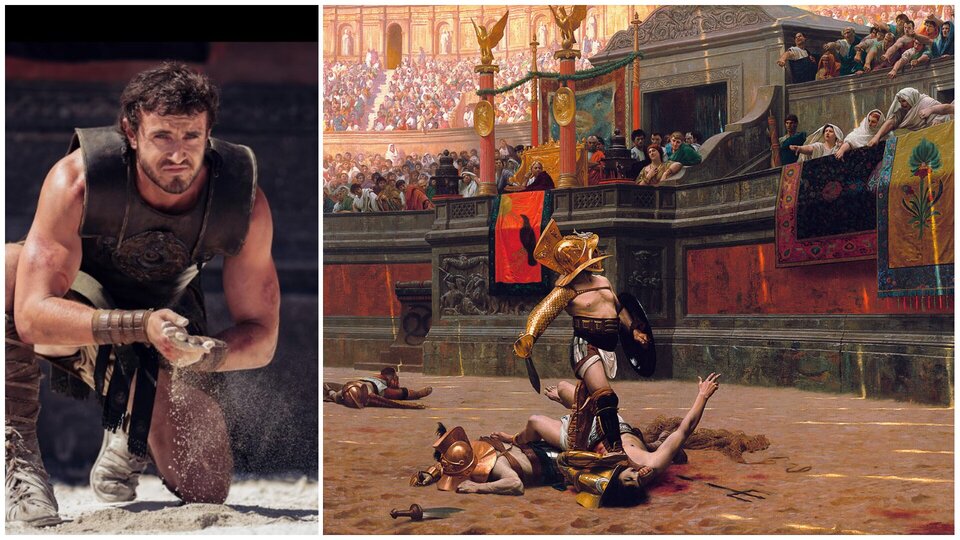
What was it like to be a gladiator in ancient Rome, within and beyond the arena? A new book dissects the gore, glory and myths about the fighters
Before gladiators stepped into the roaring arena, they entered a different kind of spectacle.
On the evening before the Games, Romans were allowed into the barracks to see the men who might die the next day. At the cena libera, a ritualistic public feast laid on for the gladiators, spectators could watch them put away enormous quantities of food and drink.
The on-lookers were often stick-thin, a result of their subsistence-level diet. The fighters, author and historian Harry Sidebottom writes in Those Who Are About To Die (2025) —his study of gladiatorial life in ancient Rome—were conspicuously heavy in contrast, “with great rolls of flesh.” Their bodies were scarred, their faces callused, “some almost deformed with one arm longer than the other,” a result of prolonged, heavy training.
Gladiators were at the heart of Roman culture.
They trace their roots to the third century BCE when aristocratic families began honouring their dead with ritual combats between enslaved people. Over the following centuries, it grew into mass entertainment, political theatre and a way to enact Roman ideas about virtue, courage and power.
Gladiators were celebrities—the walls of Pompeii were littered with graffiti featuring their names, exploits, and in one case, “heartthrob” status. But they were also reviled, their profession placing them at the bottom of the Roman hierarchy, alongside prostitutes, actors and others who took money to exhibit their bodies.
What they were decidedly not is the gladiators of Hollywood imagination—lean, shredded bodybuilders with bronzed skin and dehydrated abs. In fact, much of what we think we know about the Roman arena might be wrong, or at least greatly exaggerated. Take a look.
WHO REALLY WERE THE GLADIATORS?
While most gladiators were prisoners of war, enslaved people, or criminals, some were also free volunteers. Historians are still puzzled about why these men known as auctorati willingly joined a profession that carried such profound social disgrace.
Poverty, it turns out, was often a major motivator. Gladiators could be paid more than an ordinary soldier, with an additional reward for victory. Top gladiators could demand a massive premium: Emperor Tiberius reportedly tempted famous retired gladiators back into the ring with 100,000 sesterces – roughly equal to the annual pay of a hundred day labourers.
Others signed up for glory, or as a substitute for war.
In a Roman culture where glory was earned by a display of virtus—which represents moral virtues but also physical courage and manliness—combat in the arena was seen by some as a way to restore their public standing. Even the elite, whose presence in the arena was so anathema to Roman public morality that several Emperors (such as Augustus and Tiberius) passed laws banning it, were not immune to the lure of gladiatorial combat.
THE ODDS WERE GRIM, NOT THE GUARANTEE
Not all gladiatorial fights were to the death. “Contrary to the view most of us will have encountered in Hollywood films,” Sidebottom writes, “gladiatorial combat was not a slaughterhouse.”
Which is not to argue that the Games weren’t brutal. They certainly were.
A gladiator’s risk of dying in any given bout may have been one in eight, though that number comes with a large caveat. The surviving evidence is fragmentary and scattered across centuries, with mortality varying wildly according to time and place.
At one show put on by Roman emperor Nero in AD 57, it was reported that nobody died, not even convicted criminals. At another show in Minturnae in AD 249, all eleven bouts ended in death. Sidebottom derives his one-in-eight odds from a presumably more representative set of Pompeiian records, in which eight fights involving 16 gladiators led to two deaths.
THEIR LIFE WASN’T ALL COMBAT
Gladiators also fought surprisingly infrequently. Despite the cultural significance of the Games, they were held only a few days a year. An average gladiator could fight just one to three times a year.
There was an economic rationale behind keeping them alive as long as possible. A trained gladiator was a substantial investment. Roman jurist Gaius, in a handbook for aspiring lawyers written in the second century AD, describes an arrangement in which a fighter could be hired for 20 denarii but cost 1,000 if he was killed or badly injured. Most of a gladiator’s working life was spent in training and preparation, rather than fighting.
A DEADLY GAME BUT WITH RULES
The arena was designed to produce danger, drama and blood, but not necessarily corpses. The public executions, part of the Ludi Meridiani or the mid-day programme, that often preceded gladiator fights, already provided plenty of those. Meant to deter crime and reinforce state power, these spectacles often involved condemned criminals being mauled to death by wild animals.
The fights meanwhile, were structured affairs. Gladiators were divided into specialist fighting types with different weapons and armour, and were generally paired against complementary opponents. There were referees who enforced leges pugnandi, or the laws of the fight.
Surrender was possible, and defeat did not automatically mean execution.
“Combat between trained gladiators was thought to have an expected rhythm, like music. The crowd knew the drills and could shout out advice,” Sidebottom writes.
THEY WERE BUILT FOR THE SPECTACLE
The average Gladiator probably looked closer to Zach Galifianakis than Russell Crowe. Surprisingly though, neither their appearance nor their infamia (disgrace) stopped them from being popular. “On the one hand, gladiators are the lowest of the low,” Sidebottom explained on an episode of the HistoryExtra podcast. “But on the other hand, they’re very glamorous figures; even sex symbols.”
The gladiatorial body was engineered for this balance between violent spectacle and economic pragmatism. Ancient writers called gladiators hordearii or “barley-men”, after one of their dietary staples. Their carbohydrate-rich diet produced a thick layer of subcutaneous fat that, Sidebottom argues, produced plenty of blood while protecting vital organs.
Their armour and weapons varied based on the fighter category—a murmillo would wield a large shield and a short sword, and wear a big crested and visored helmet; the Thraex (named after the Thracian people of the Balkans) carried a smaller shield and a curved sword; the Retiarius fought using a trident and a net, wearing armour only on his left arm. Some of the oldest categories borrowed names and weapons from peoples that Rome had conquered—Samnites, Gauls, Thracians.
NOT QUITE THE SUICIDE MISSION
Were some of the disgraced men entering the arena looking for an honourable death? It makes a compelling story but historical evidence says otherwise.
The Romans certainly romanticised a calm, rational suicide ideally carried out with a blade, which the elite regarded as a “cult of the good suicide”. But Sidebottom’s research shows that it didn’t extend to the gladiators.
Of the five documented episodes of gladiator suicides he found, the gladiators chose to kill themselves rather than fight in the arena. And three of those cases involved “barbarians”— anyone who didn’t belong to the Greco-Roman cultural world.
In fact, Romans considered death by gladiator as deeply dishonourable. Condemnation to a gladiatorial school could postpone execution, and the crowd—or at least the Roman literati—could admire a gladiator who met his death with grace and resolve, but it did not restore the man’s social station.
These are just a few of the myths and misconceptions about gladiators that Sidebottom dismantles. But stripping away Hollywood exaggerations doesn’t make Rome gentler or more familiar.
Gladiatorial combat may have been regulated and even survivable, but it belonged to a culture in which watching people suffer and die was its greatest form of entertainment.
So much of what we think we know about Rome has more to do with our imagination than established fact. A compelling narrative can travel halfway around the world while historical evidence is still putting its boots on.
And if that is true of the Romans, who left us so much evidence, then what about other, less well documented cultures? More worryingly, how much of what we know about the world around us today has more to do with effective storytelling than actual truth? What shibboleths of modern life are actually as mythical as Hollywood’s gladiators?


