
 E-Paper



Flip Side: Kunal Pradhan kicks off his new column celebrating Kohli, but also Dravid

 Prefer HTon Google


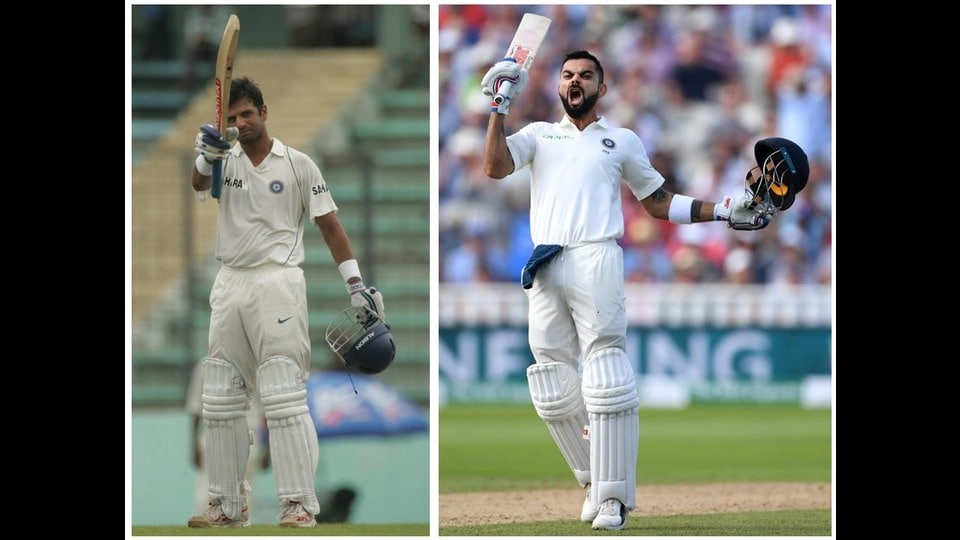
As the beloved bad boy of Indian cricket steps away, Dravid’s legacy is finally being revisited too. It’s about time we expanded this pantheon.
The scene was repeated in city after city. Young men outside barbershops, in twos and threes, posing for selfies to commemorate their newly crafted beards and newly fashioned fades, celebrated their coming-of-age by adopting the likeness of the pop culture icon of their generation.
Legacies are a tricky business, and sporting legacies even more so; these morph all the time, in a heady cocktail of lived history and ice-cold statistics. Someone elevates them by reminiscing about an important century at home, someone else adds to it with a vivid description of a fighting knock overseas, and some others pull it down by throwing statistics against the moving ball or recounting a failed series in a faraway land.
So, when Virat Kohli retired from Test cricket, a frenzy to decipher what it meant took over pundits around the world.
They knew that he was the defining batsman of his era across formats. That he didn’t just fashion victories but also rebranded the sport in his own image. That he elevated the art of batting by striking an impossible balance between slashing risks and scoring freely. That he changed cricket’s athletic paradigm by making fitness rather than finesse the foundation of a monumental career.
But they also knew that, with a Test average of 46.85, Kohli didn’t have the numbers to faithfully illustrate his impact. An HT editorial, for instance, perfectly described him as being statistically closer to VVS Laxman and G Vishwanath than Sachin Tendulkar, Sunil Gavaskar and Rahul Dravid.
Another piece, by the redoubtable sports writer Sharda Ugra, called him “fourth in line behind the biggest of our Test batting Daddies — Tendulkar, Dravid, Gavaskar”.
What struck me, as tribute after tribute rolled in, was that the attempts to aptly place Kohli in the pantheon had led to the rise of a refreshing new theme across the board, one that summed up the complex nature of sporting legacies but also delivered some long-pending justice.
Hold that thought for a moment.
Past the Wall
My favourite Rahul Dravid story is from Islamabad in 2004. We were staying at the same hotel during the third Test at Rawalpindi — I was a cricket writer then; he was already one of the Fab Four — and we ended up having dinner with a small group of common friends and acquaintances. It was the evening after the first day’s play and Dravid was 10 not out. As he got up to leave, we pressed him to stay for a few more minutes. “No, no, no,” he replied with a smile, “I’d better go get some rest. I have to bat the whole day tomorrow.” We laughed at his use of the words “the whole day” and waved goodbye.
Against a barrage from Shoaib Akhtar and Mohammad Sami the next morning, Dravid stayed true to his word. He was 134 not out at close of play on Day 2. Then, for good measure, he batted another two-and-a-half sessions on Day 3, for his highest Test score: a match-winning, series-altering, and what ought to have been legacy-defining, 270.
But India has had a strange relationship with Dravid.
Over the years, we celebrated his resolve, fortitude and technical perfection at the crease, his gallantry in the slip cordon, and his grace off the field. But we rued the fact that he didn’t have the qualities modern fandom demands. He was not dashing, flamboyant or overtly aggressive. He didn’t set pulses racing. On the contrary, his virtues were of the kind that young, restless icon-makers scoff at instead of seeking to emulate.
I’ve always held that his nickname The Wall, born of good intentions, did him a great disservice. A wall is a passive obstacle that wears down attackers without mounting a retaliation of its own. A wall can’t do what Dravid did on countless occasions (Hamilton, 1999; Leeds, 2002; Adelaide, 2003; Rawalpindi, 2004; Jamaica, 2011): charge at the opposing army, slay warriors in the path, and hoist a flag in the enemy’s citadel. Sure, there were instances when he chose to take on the role of a wall, but how could a sobriquet that barely begins to describe Dravid be used to sum him up?
His worldwide exploits and a Test average of 52.31 were somehow never enough to give him his rightful place in the Indian batting pantheon. During his career, the comparisons were always between Gavaskar and Tendulkar. Once he stepped away, the GOAT conversation hovered around Gavaskar, Tendulkar, Kohli.
Now, at long last, the discussion has broadened. At the time of the iconic Virat Kohli’s departure from red-ball cricket, another legend has been revisited and a legacy restored. Even if there will be no lines outside the barbershop for a Rahul Dravid cut.


