
 E-Paper



German dancer with over 20 years of experience in Indian classical dance explains what truly defines the art of learning

 Prefer HTon Google


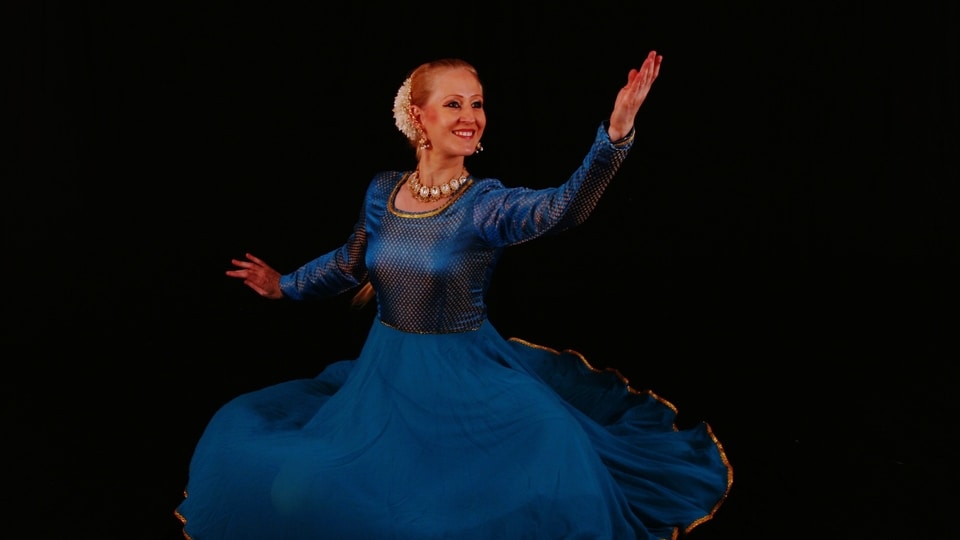
Everyone wants to learn something new. Understand the concept of immersive learning from a German Indian classical dancer with over 20 years of experience.
Art has always been an innate mode of expressing ideas and thoughts across media. In today's interconnected world, globalisation and the internet have made this exchange of thoughts and ideas almost effortless. Even without a shared language, people across geographies can easily understand trends, pop culture lingos and generational slang in a jiffy, with surprising ease. From Gen Alpha's inane 67 humour to Gen Z's fidget spinners, loom bands and bottle flips of the mid 2010s and millennials raised on Vines, any thought or idea travels fast, supersonic, at the age of the internet, via one medium or the other.
But rewind two decades back, when the internet was still in its infancy and not as widely accessible, and most knowledge existed in physical formats such as books, letters or word of mouth. At the time, shared consciousness was also not prevalent, as globalisation was yet to turn the world into a fully connected village.
It raises an intriguing question: how does someone born miles away from the cultural roots of an art really understand and embody it? And where does learning stand here?
Now, meet German dancer Anne Dietrich, who has spent more than 20 years deeply engaged in Indian classical dance forms such as Mohiniyattam and Kathak. In an exclusive interview with HT Lifestyle, she gave her insights on her beautiful artistic journey, demonstrating how, twenty years ago, she commenced her journey of immersing herself in a traditional art form and learning that it demanded rigorous training and discipline.
What defines the art of learning?
Before joining the Indian classical dance forms, Anne trained in contemporary dance. However, the turn in her journey's credit goes to word-of-mouth and her curiosity. It further reinforces that word of mouth remains one of the oldest mediums of cultural exchange, and for Anne, it proved to be true as well.
She recounted the beginning of her journey. "I got to know classical Indian dance through a friend, and I applied to Kerala Kalamandalam in South India.”
Further, her interest in the art form was also shaped by its novelty and expressive depth. She shared, “I got really interested because in Indian classical dance you use a lot of facial expression, abhinaya, gestures and mudras, and you can tell a story. This was missing a bit in my earlier art form." Anne mentioned how back then, there was no Instagram or YouTube to gain an immediate understanding of the experience. She stayed in a village in South India, underscoring the importance of lived experience in the process of learning.
Her experience depicts how curiosity becomes the catalyst for learning something new and meaningful. It is also a key reminder as to what to prioritise whenever one wants to learn something new. Belongingness, or the innate urge to fit in by hopping on the bandwagon, nowadays accelerates the learning drive, especially in today's generation (like everyone signing up for pickleball or whisking matcha) but to truly learn something, one needs to identify the deeper purpose: if it is adding anything of value to their life, which was missing before, just like Anne did in her learning process. This way, you can stay dedicated to your craft, as Anne did.
Commitment is another challenge when it comes to learning anything, especially when faced with difficulty in understanding the harder parts of the artform. Very often, one gives up on, for example, the New Year's resolution, when the process feels overwhelming. But Anne's journey is a reminder that despite the initial difficulties, perseverance is essential for learning and long-term growth.
“In my beginner years, I really struggled because everything was so different. Understanding the poses, expressions and rhythmic patterns like ‘tha thei thei’ took a lot of time, but with years of training, the style slowly became internalised and is now a part of me," she said.
What makes the process of learning anything immersive and genuine?

So what really makes the process of learning any art successful?
The German dancer attributed it largely to mentorship, which shaped and honed her journey in classical dance. She spoke profoundly about the traditional guru-shisya-parampara, the lineage of knowledge passed from the teacher (guru) to disciple (shishya). For the uninitiated, this demonstrates a long-term artistic bond, going beyond just your technical training.
This is especially true for classical artforms. “I am still deeply connected to my gurus.” Anna mentored under prestigious masters like Prof. Kalamandalam Leelamma at the Kerala Kalamandalam in Kerala (Mohiniyattam), Padmashree Bharati Shivaji, co-founder of the Centre for Mohiniyattam in Delhi, Geetanjali Lal in Delhi, with whom she has been studying Kathak since 2009, along with additional training with Pallavi Krishnan and at the Lasya Akademi in Trissur.
“I am still deeply connected to my gurus,” she mentioned. “Even in Germany, I ask my Guruji, we make a video call. This is really nice, and something we don’t really have in the same way.”
Her experience provides a key takeaway for all of us: mentorship. While one may gather surface-level information from the information available to them, true immersion and learning require guidance and consistency. And her journey proves that mastering art cannot be rushed. It has to be built over the years through training, discipline and proper mentorship. There are valuable lessons only experts in the field can provide. Seek out experts if you really wish to master any artform.
Now, given her background in Western contemporary dance, the question of fusion naturally arises. And what does it mean in the process of learning? However, for Anne, it is much more nuanced. She offered her perspective on blending art forms. Instead of viewing it as a fusion, she described the process as something more gradual: “I don't like the word fusion. I feel it is more about letting the classical style slowly melt inside the body through years of training.”
Here, the lesson for art learners is practical: whether one is learning dance or any other skill, depth comes from patience, not just from shortcuts or experimentation. Even when there is any form of prior knowledge or training in another style, as in her case, it was contemporary dance, actual mastery comes from adaptation and sustained immersion. Any existing knowledge cannot remove the discpline one requires to fully learn and embody an art form.
Word of advice
Anne's advice for the youth includes stepping away from constant digital distraction and choosing more fruitful entertainment, which is rooted in live art and cultural experiences.
“I think it is important for the younger generation to do more than just Instagram scrolling and to experience live performances, because sitting and watching dance with full attention is very beautiful for the mind and the soul," she said.
There are multiple takeaways from her journey for all us to part with. First is that learning requires curiosity, patience, commitment, and mentorship, instead of quick, surface-level exposure. Next, learning also requires adapting, observing and internalising the art instead of just performing and training.


