
 E-Paper



Madras art movement: DAG's new exhibition highlights South Indian artistic heritage

 Prefer HTon Google


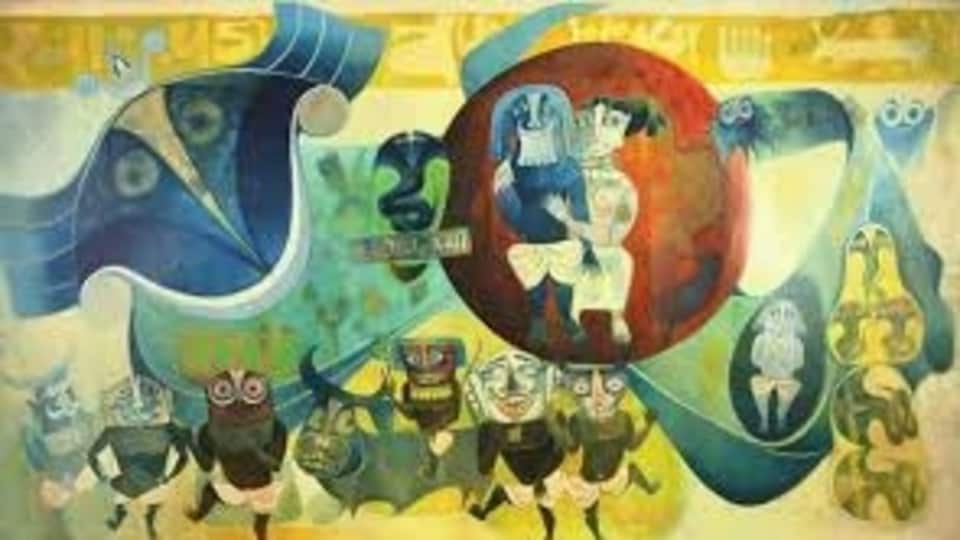
A new exhibition at DAG delves into the Madras art movement, tracing its evolution from inception to its peak in the late 20th century.
A new exhibition at DAG here examines the Madras art movement from its inception to its flowering in the second half of the 20th century, shedding light on one of the least known movements of Indian modern art whose contribution has been steeped in local folklore, mythology, architecture and history. Showcasing the works of a core group of artists responsible for the development of the art movement, “Madras Modern: Regionalism and Identity” takes a broad look at the vision that guided this seminal movement, considered to be “the last platform for Indian modernism” before it gave way to the contemporary.
The exhibition highlights the significance of the south Indian narrative in the works of artists and sculptors, including DP Roy Chowdhury, KCS Panicker, J Sultan Ali, L Munuswamy, S Dhanapal, RB Bhaskaran, P Gopinath, PV Jankiram, and S Nandagopal. The exhibition takes a broad look at all aspects that shaped the movement and the artists’ individual vocabularies, adding another rich dimension to the universe of modern Indian art.
"In the attention that was paid to the dominant art centres elsewhere in India, Madras remained a sideshow even though its contribution has been no less significant than the Bengal School or the Progressives,” Ashish Anand, CEO and managing director of DAG, said in a statement. "In drawing our attention to regional imagery as part of its modern-speak, its contribution to our collective national heritage has been overwhelming,” he added.
The Government School of Arts and Crafts (now Government College of Fine Arts) was established in 1850 and became the locus for the emergence of the Madras art movement in the 1960s under DP Roy Chowdhury, the art school’s first Indian artist principal. Roy Chowdhury laid emphasis on the development of a fine arts curriculum, put forth an empirical and perceptual approach to art making, and axed the colonial pedantry of human form study based on classical statuary.
The ideas were extended by KCS Paniker as the next administrative head by bringing in a study of modern European masters while moving towards his nativist agenda, setting in motion the process of visual arts acquiring a cultural identity as an act of political will.
Paniker’s pedagogy opened avenues for technical and creative explorations that became a hallmark of the school, contributing towards the development of the art movement in Madras. The exhibition also features works by AP Paneerselvam, Achuthan Kudallur, Alphonso Doss, C Dakshinamoorthy, C Douglas, K Adimoolam, K Jayapal Panicker, and K Sreenivasulu, among others. The exhibition will come to an end on July 6.


